
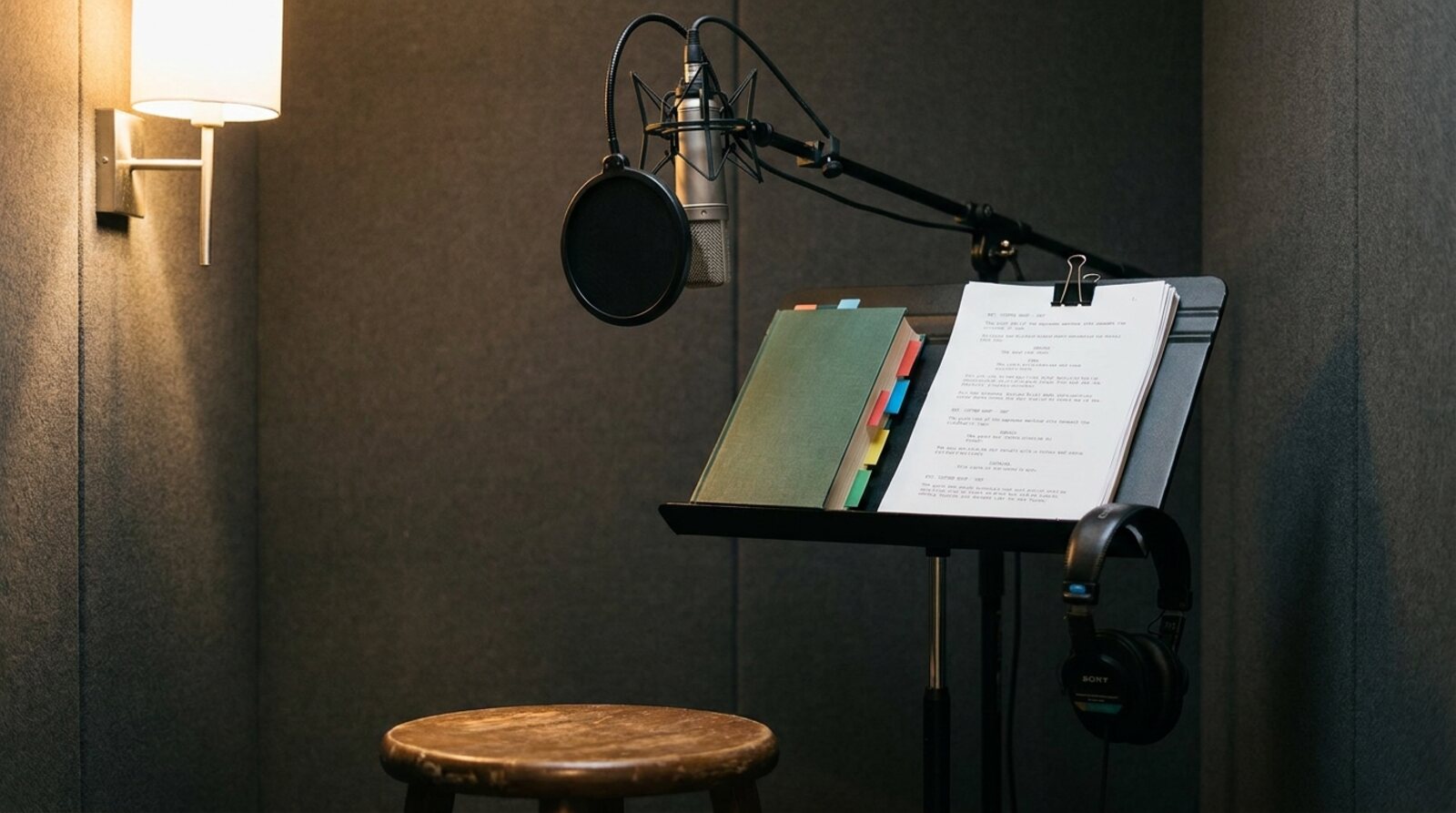
Who Gets the Book? How Audiobook Narrators Are Really Cast, From the Brief to the Author’s Yes
Before a narrator says a word into the microphone, someone has decided theirs is the voice for the book. At the big publishers, that choice starts with the text and runs through a brief, a shortlist and a sample read. It ends when the author says yes. On ACX it starts with a few pages of audition script. Here’s how audiobook casting actually works, in the words of the people who do it.
Voice actors who come to audiobooks from commercials or e-learning often expect casting to work the way it does there: a short spec, a slate, a quick read and an answer by Friday. Audiobook casting is slower and more personal. The client isn’t buying thirty seconds. They’re choosing a voice that will sit in a listener’s ears for ten or twenty hours, and the author nearly always gets a say.
Everything begins with the text
Penguin’s UK audio team is unusually open about how it chooses. Sam Halstead, editorial director for Penguin Audio, says the voice isn’t the first question. “Everything begins with the text,” he says. “The single most important thing before casting is to have an understanding of what the author wants the reader to feel when they hear their words, as in essence that is what informs how it should be performed.”
Then come the practical questions. They read like a checklist any narrator can run on a book before auditioning: “whether the text is first or third person, whether the narrator needs to be male or female, should there be more than one voice if the perspective in the text shifts, if there is a particular accent or dialect that the text requires, and do we need an older or younger tone of voice?”
Accents and names decide a lot. In the publisher’s own explainer, Halstead gives the example of a recurring character who “speaks in a Glaswegian dialect but the actor isn’t comfortable with that accent”. In that case, he says, “the recording could be really difficult to perform effectively and it could jar for listeners.” For a book set partly in Denmark, full of Danish names, “perhaps the actor best placed to narrate would be a Danish speaker.”
He’s just as clear about what comes after the voice. Penguin wants “an actor who is prepared and willing to put the work in to prepare ahead of time and really get into the nuts and bolts of the book.” Narrators, he says, need “the commitment to maintain consistency in that performance over many hours.”
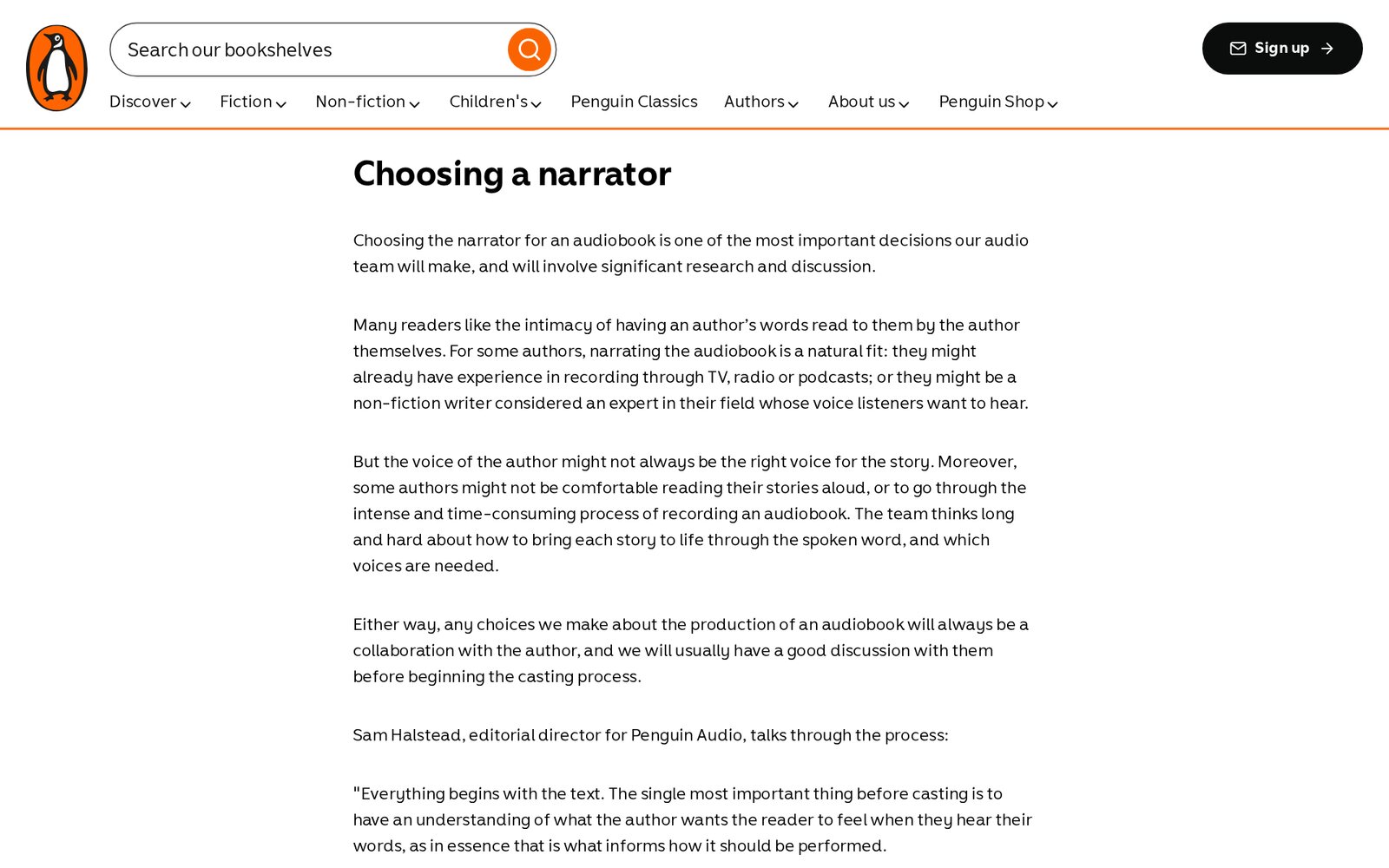
Image: Penguin Random House UK, screenshot taken 9 November 2026
The brief, the shortlist and the author’s yes
At Penguin, the audio editor reads the book first. “The first stage is casting, and our audio editor will read each book before pulling together a shortlist of potential narrators ready for discussion with the author,” Halstead says. The publisher calls every production choice “a collaboration with the author”, and it also asks whether the author should read the book themselves.
Hachette UK works in a similar way, with a written brief in the middle. Dan Jones, head of audio services for Carmelite Studios at Hachette UK, told the voice actors’ network BRAVA that each audio publisher builds the brief with the book’s editor and author. “Once we have text and a casting brief, we’ll bring some suggestions to the publisher, who will then get this signed off by editorial and the author,” he said in the interview.
 VoiceEditSuiteNewIt edits like you would, and it gets better every file.Learns from numbers, never your audio. Never used to train AI.See how it works
Most of those suggestions come through representation. “We mostly use agents, but deal direct with a small percentage of narrators,” Jones said. The studio aims for casting that “links to the background of the characters”, and before anyone is booked it gathers “tailored sample recordings of the voices we are putting forward”, with a note on why each person suits the book.
Home studios are welcome there too, after a check of the equipment, the software and how you record. “We will always want to hear some samples and some room tone recorded in the space,” Jones said.
The sample is where the author comes in. “We aim to have the author happy at this stage,” he said. If there are specific points about characters, the sample focuses on them “with a view to getting author sign-off ahead of recording.” If that can’t happen in time, the author may dial in to part of the first session to listen and give notes.
The audition is a scene from the book
On ACX, Audible’s production platform, the rights holder (usually the author) posts the book with an audition script, and narrators record from it. ACX’s advice to authors on choosing that script tells narrators exactly what the pages are meant to reveal. For fiction, it says, “pick a section that has both dialog and prose. Try to include as many different characters as possible, so you get a true sense of the narrator’s range and various voices.” For nonfiction, it suggests a passage with “obscure or foreign pronunciations”.
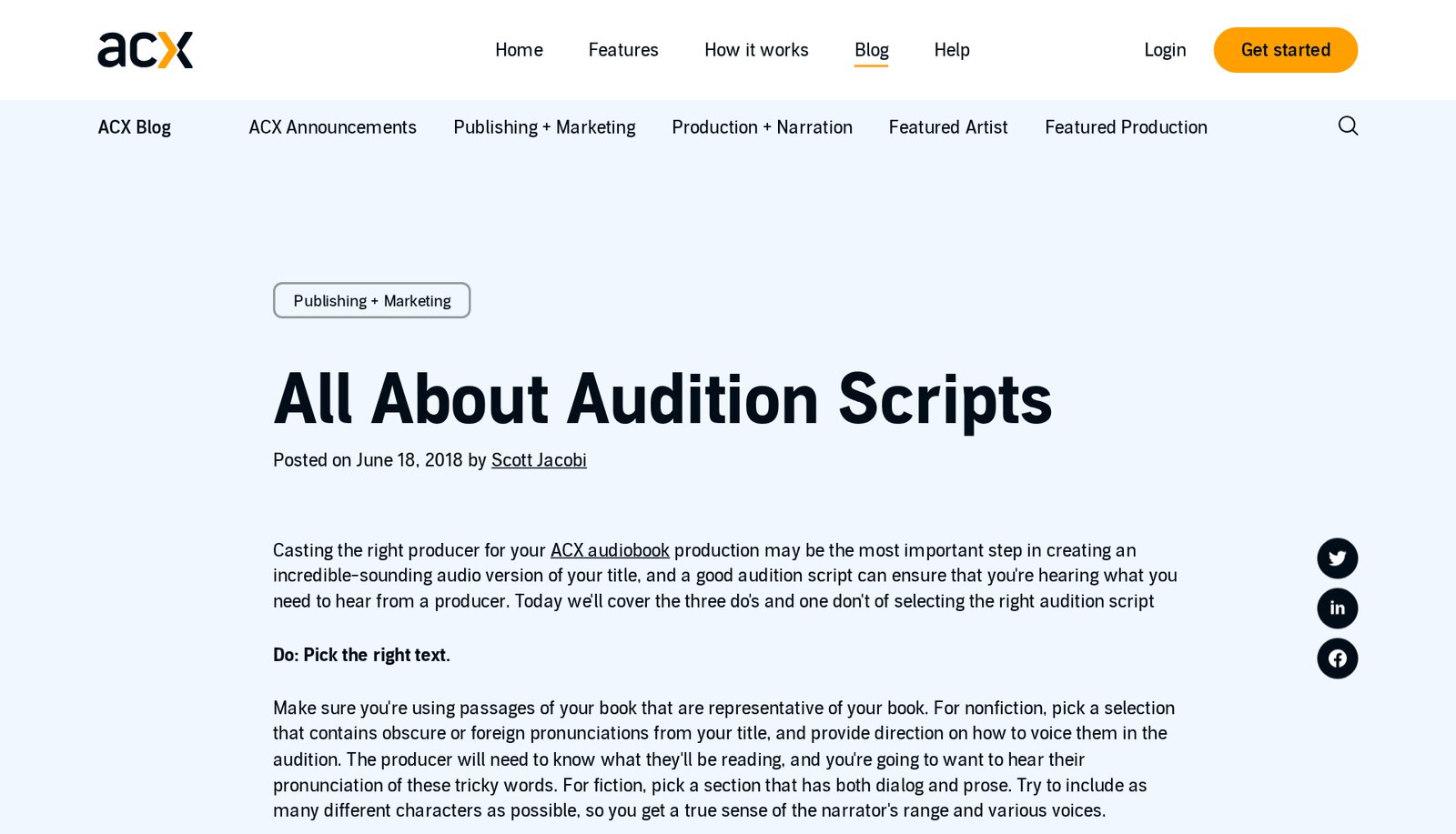
Image: ACX blog, screenshot taken 9 November 2026
It also warns authors off the obvious choice: “Don’t: Automatically use the first few pages of your title.” So read the audition pages as a clue. If the author picked a scene with four characters and a made-up language, that’s the job, for the whole book.
A separate ACX post, Four Questions to Ask Before You Audition, says much the same from the narrator’s side. “Few things turn audiobook listeners off faster than poorly voiced, cartoonish characters,” it says. It suggests messaging the rights holder before you record “and ask what time frame they expect for having their audiobook produced”. It also suggests asking “about any research needed into pronunciation for this title, as that will factor into your schedule as well.”
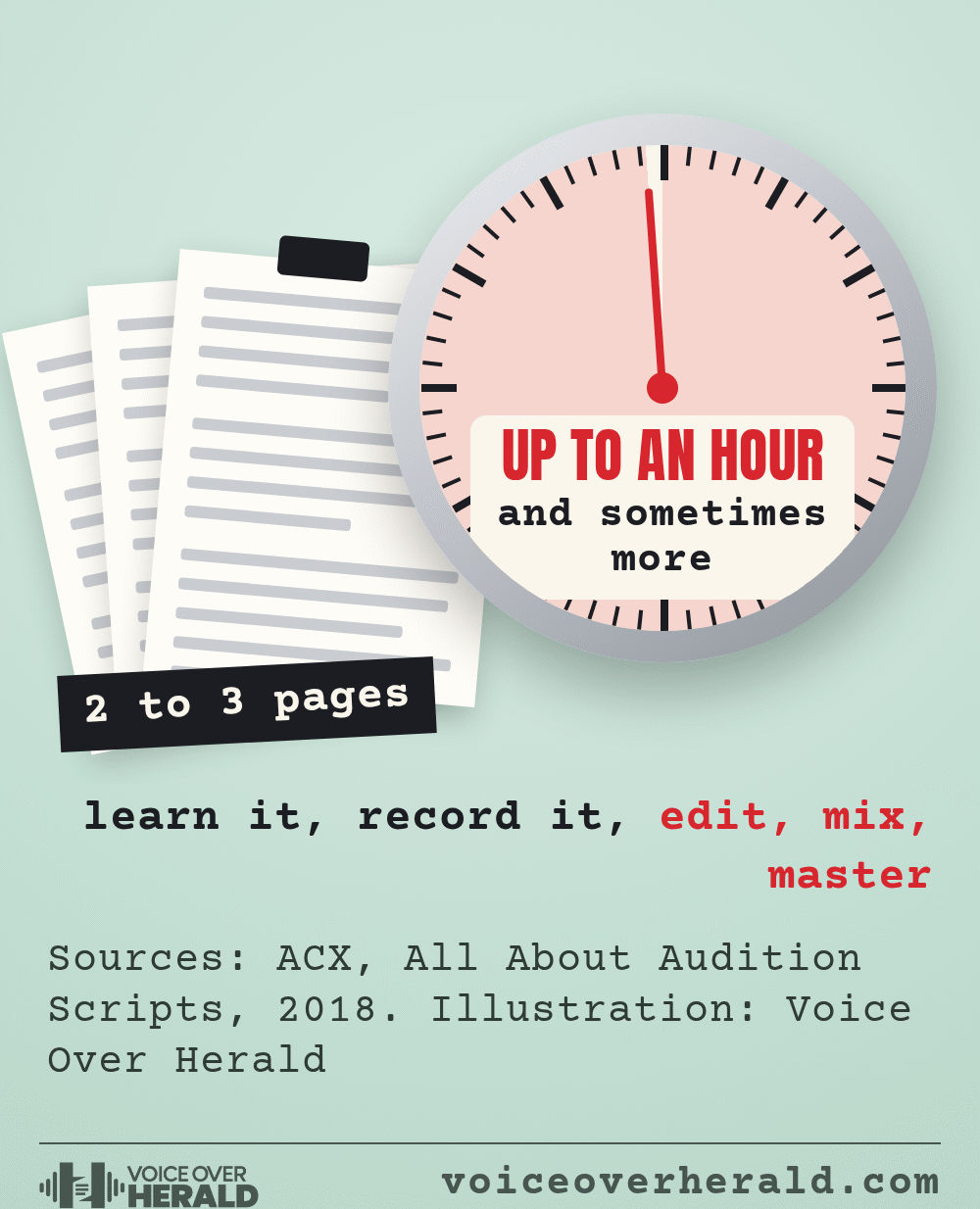
On royalty share projects, the same post says the author’s own marketing matters as much as the book. “The time your rights holder invests in their title will play a key role in how much you can expect to earn in royalties.” Our earlier piece on how ACX changed the way narrators get paid covers what has changed since that advice was written.
Open calls are widening the net
Publishers don’t always stick to the agents’ lists. When Macmillan Audio cast Angeline Boulley’s Firekeeper’s Daughter, a thriller told in the first person by a Native teenager, it ran its first ever public casting call. Libro.fm, writing after a conversation with Macmillan Audio publicist Amber Cortes, reported that “there has been an industry focus on expanding the talent pool of narrators to better reflect the growing diversity of authors and books being published.”
Boulley explained to The Nerd Daily why the book needed it: “It’s a powerful Nish kwe voice and calls for a narrator who’s also a strong Native woman.” The call went well beyond the usual channels. “We posted on social media and encouraged Native communities and organizations to share the casting call,” she said.
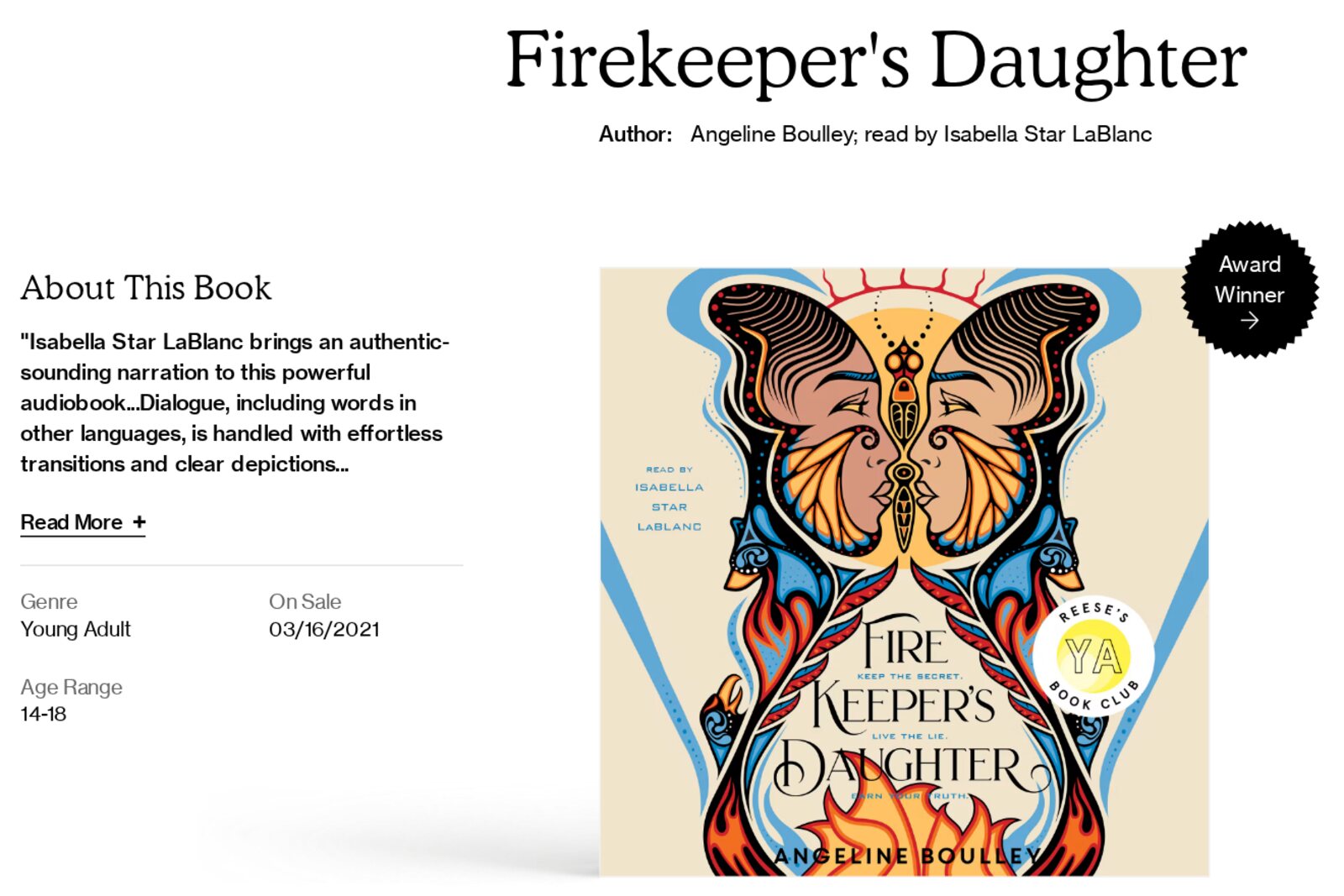
Image: Macmillan Publishers, screenshot taken 9 November 2026
The role went to Isabella Star LaBlanc, who had never recorded an audiobook. She said that reading the first excerpt was enough: “I could hear this story in the voices of the people I come from.” For Boulley, one supporting character settled it: “what took Isabella’s audition to the next level was her Granny June voice.”
Worth remembering: the lead gets you noticed, but a small character done with real care can get you cast.
Open calls happen closer to home too. In October, Fremantle Press in Western Australia went looking for local narrators for three children’s audiobooks, with two of the roles for First Nations voices, as Voice Over Herald reported.
What gets you on the shortlist
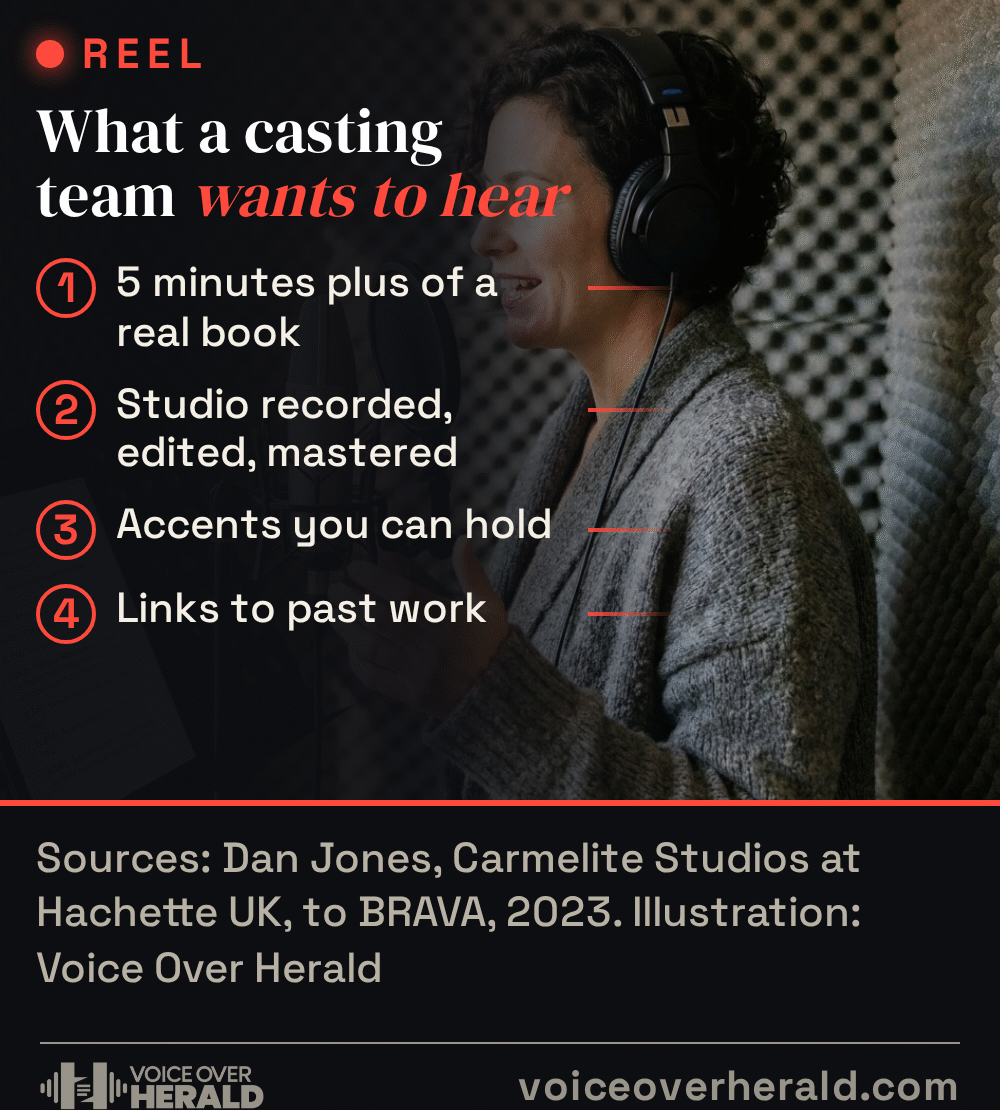
For narrators trying to get onto those lists, Jones was blunt about demos. “We prefer a proper audiobook reel if possible. We frequently see ‘Audiobook’ reels on agent’s websites that aren’t actually that.” Casting teams also listen to what you’ve already published: “We all search Audible as well to see if there’s anything on there.”
The encouraging part is that a reel doesn’t disappear once it’s sent. “We are always happy to receive showreels and we keep everyone on file who sends things in,” he said. “We might not be in touch until a suitable project comes up, but one usually does.”
His advice for anyone starting out is just as direct: “Get yourself an agent that specifically works on audiobooks and has links with the big publishers.” Then make sure that agent knows everything you can do. “We send them very detailed briefs,” Jones said, so a narrator who can switch between several accents for whole chapters, not just a line or two, should say so plainly.
Before you press record on an audition
Put it together and casting comes down to a few habits. Read the book, or as much as you can get, through the questions Penguin asks first: whose voice is it, what accent, how old, one narrator or several. Treat the audition pages as the job description. Ask about pronunciation and timing before you spend an hour on a read.
Keep a reel that sounds like a real audiobook, not a commercial with a book cover on it, and keep sending it. When the offer arrives, read it closely. Libro.fm notes that a formal offer covers “the rate, recording specifications, recording due date, etc.” Our guide to how narrators prep and handle pickups takes it from there.
Sources: Penguin Random House UK, “How a book is turned into an audiobook”; BRAVA, “Industry Voices: Voicing for Audiobooks with Dan Jones from Hachette UK” (June 2023); ACX blog, “All About Audition Scripts” (June 2018) and “Four Questions to Ask Before You Audition” (May 2013); The Nerd Daily, “Casting An Authentic Voice In Angeline Boulley’s ‘Firekeeper’s Daughter'” (March 2021); Libro.fm, “How Do Audiobooks Get Made?” (May 2025); Macmillan Publishers. Screenshots taken 9 November 2026.
Lee este artículo en español: ¿Quién se queda con el libro? Así se elige de verdad al narrador de un audiolibro, del brief al sí del autor
Know something about this story, or spotted an error? Tell the newsroom.