
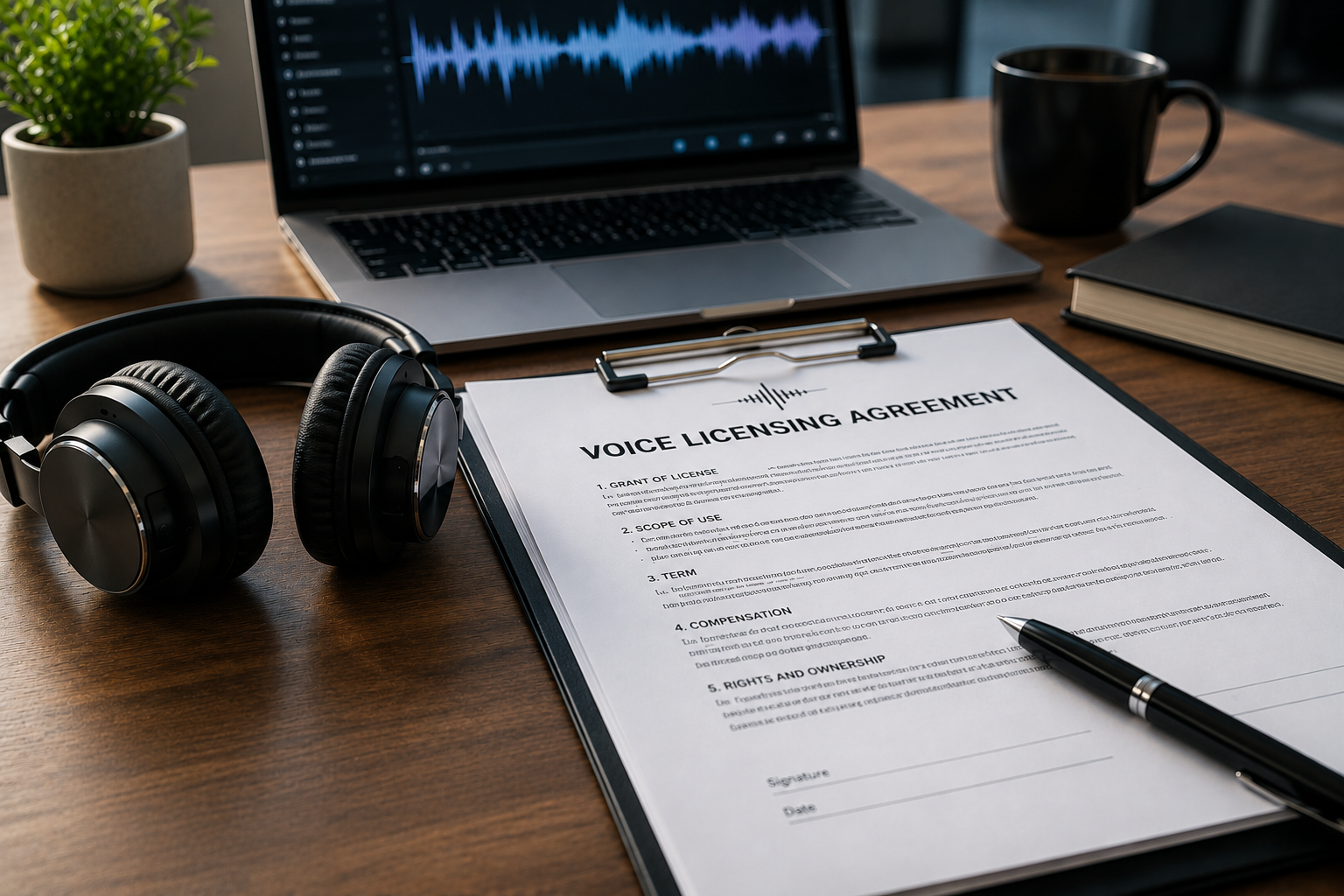
The Voice Licensing Economy: A New Revenue Stream Every Voice Actor Should Understand
The voiceover industry has always evolved alongside technology. From radio broadcasting and television advertising to digital media and remote recording, voice actors have consistently adapted to changing market demands. Today, the profession finds itself at another pivotal moment as artificial intelligence and synthetic voice technologies reshape how spoken content is created, distributed, and consumed.
Much of the public conversation surrounding AI-generated voices has focused on concerns about job displacement, copyright, and ethical considerations. While these concerns are certainly valid, they represent only one side of a much larger story. For voice professionals who understand the emerging landscape, a new category of opportunity is beginning to take shape: voice licensing.
As organizations increasingly seek authentic human voices to train, develop, and power AI-driven products, voice actors are discovering that their vocal identities may hold value beyond traditional recording sessions. The result is the emergence of a new economic model—one in which a voice can function not only as a performance tool, but also as a licensable asset.
Understanding Voice Licensing
At its core, voice licensing involves granting permission for a third party to use recorded voice material under defined contractual terms. Unlike a conventional voiceover engagement, where talent is hired to perform a specific script for a particular project, voice licensing often extends beyond a single production.
A licensed voice may be used to develop synthetic speech models, power digital assistants, support accessibility technologies, generate multilingual content, or create AI-driven customer service applications. In some cases, the arrangement involves the use of existing recordings. In others, voice actors participate in dedicated recording sessions designed specifically to create datasets for machine learning systems.
The distinction is significant because the value being exchanged is not merely a performance. It is access to a vocal identity that may be used, replicated, or referenced across multiple applications.
Why the Conversation Is Accelerating
Several factors have contributed to the rapid growth of voice licensing discussions within the professional voiceover community.
First, advances in speech synthesis technology have dramatically improved the quality and realism of AI-generated voices. Synthetic speech that once sounded robotic and unnatural can now deliver remarkably fluid and convincing performances. As a result, technology companies require increasingly sophisticated voice data to improve their products.
Second, businesses are producing more audio content than ever before. From e-learning platforms and virtual assistants to podcasts, video content, audiobooks, and customer support systems, demand for spoken communication continues to expand across industries.
Finally, organizations are searching for scalable solutions. A synthetic voice model can generate large volumes of content quickly and efficiently, making voice licensing an attractive proposition for companies seeking long-term audio production capabilities.
These developments have transformed what was once a niche discussion into a serious business consideration for voice professionals worldwide.
Beyond Traditional Voiceover Work
For many voice actors, the concept of licensing can initially feel unfamiliar because it differs substantially from the traditional project-based structure of the industry.
Historically, voice talent have been compensated for specific deliverables. A commercial campaign, corporate narration project, audiobook, or training module typically involves clearly defined usage terms and compensation structures. Once the project is completed, the relationship often concludes.
Voice licensing introduces a different framework. Instead of being paid solely for a recording session, talent may be compensated for ongoing usage, extended rights, licensing periods, or additional applications derived from their recordings.
This shift requires voice actors to think differently about the long-term value of their voices. Decisions that may appear straightforward in the short term can carry implications that extend for years.
Opportunities for Voice Professionals
Despite understandable concerns surrounding AI technologies, voice licensing may create meaningful opportunities for those who approach it strategically.
For some professionals, licensing agreements can provide an additional revenue stream that exists alongside traditional voiceover work. Rather than replacing existing business activities, licensing may complement them.
Others may benefit from partnerships with technology firms seeking diverse, high-quality voices for specialized applications. Accessibility services, educational platforms, healthcare technologies, and language-learning tools all rely heavily on spoken communication and often require authentic human vocal characteristics.
Additionally, as awareness of voice rights continues to grow, the industry is gradually developing more sophisticated frameworks for compensation, consent, and usage management. These developments may ultimately provide voice actors with greater leverage and protection than existed during the early stages of AI adoption.

The Importance of Contractual Clarity
As opportunities expand, so too does the need for careful evaluation of licensing agreements.
Perhaps the most important lesson for voice actors is that not all licensing contracts are created equal. The specific language contained within an agreement can dramatically influence how a voice may be used in the future.
Before entering into any licensing arrangement, talent should clearly understand the scope of rights being granted. Is the company receiving access to specific recordings, or are they obtaining permission to create a synthetic voice model? Is the agreement limited to a particular industry, territory, or product category? Are there restrictions on future usage?
Equally important is understanding compensation structures. A one-time payment may appear attractive initially, but it may not accurately reflect the long-term value generated by a licensed voice.
Professional guidance, whether from agents, attorneys, or industry organizations, can play a critical role in helping talent navigate these increasingly complex agreements.
Protecting Vocal Identity in the Digital Era
For voice actors, the voice is more than an instrument of performance. It is a personal and professional identity.
As synthetic voice technologies become more sophisticated, protecting that identity will become an increasingly important aspect of career management. Transparency, informed consent, and contractual safeguards are no longer optional considerations. They are essential business practices.
Professionals who educate themselves about licensing rights, ownership structures, and emerging industry standards will be better positioned to make decisions that align with their long-term goals.
The conversation is no longer simply about technology. It is about ownership, value, and professional autonomy.
Looking Toward the Future
The voiceover industry has faced periods of transformation before, and it will undoubtedly continue to evolve. While the long-term impact of synthetic voice technology remains uncertain, one thing is clear: voice licensing is becoming an increasingly significant part of the industry’s future.
For some voice actors, licensing will represent a promising business opportunity. For others, it may be a path they choose not to pursue. Neither approach is inherently right or wrong. What matters is that professionals make informed decisions based on a clear understanding of the opportunities, risks, and responsibilities involved.
As technology continues to advance, the most successful voice actors will not simply react to change. They will position themselves to understand it, navigate it, and where appropriate, benefit from it. In doing so, they will help shape the future of an industry built upon one of humanity’s most powerful tools: the human voice.