




Say Your Name, Then Get Out of the Way: How New Voice Actors Slate and Send a First Audition
The slate is the shortest thing you’ll ever record for money, and new voice actors still find ways to get it wrong. Here’s how working actors and coaches slate, label and send an audition, step by step, so the first thing a listener hears is you doing the job.
Your first real audition arrives. There’s a script, a deadline and a line in the instructions that says “please slate”. You’ve read the copy aloud twenty times. Now you’re stuck on the bit before the copy: what exactly do you say, how do you say it, and what do you call the file?
It’s the first few seconds of you a stranger hears. Voice actor Dee Bradley Baker puts the whole process plainly on his advice site for newcomers: “An audition consists of two shows. You must nail both to book the gig.” One show is the acting. The other is everything around it, and the slate is where that second show starts.
Here’s what a good one sounds like. Voice actor Mike DelGaudio plays his own slate in this video from his channel, then explains why he keeps it short.
Hear the slate: Mike DelGaudio plays the slate he sends with his auditions, and says why it stays under four seconds. Video: Booth Junkie, on YouTube
A slate is your name, said like you mean it
Caroline Turner Cole, writing for the training company Such A Voice, gives the cleanest definition: “Simply put, slating is a short introduction spoken at the beginning of an audition or a demo.” How short? “Sometimes as short as two words: your first and last name.”
That’s the floor. Tyler Hyrchuk, a working voice actor who also coaches, sets it at the same spot: “The minimum for a slate is your first and last name or your stage name.” Depending on the job, you might add the character you’re reading for, or the product, and the number of takes you’re sending.
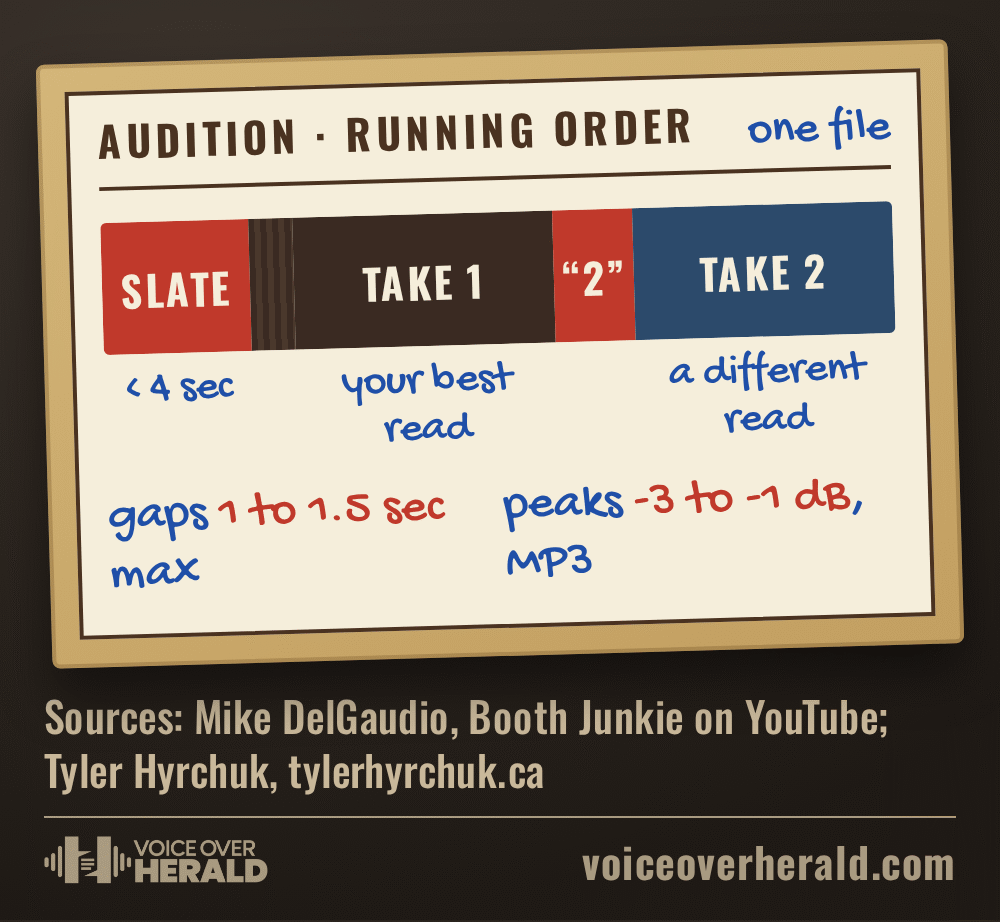
DelGaudio’s own slate, in the video above, is “Hey there, it’s Mike DelGaudio with two takes. Here’s take one.” Then, between the reads, a second clip: “And here’s take two.” He says a slate “should be less than three to four seconds at most”, because “I want them to be listening to the audition and not spending time hearing my life story.”
So no credits, no gear list, no sales pitch. Name, maybe the role, maybe the takes, then the read.
Read the brief before you say a word
Every source here agrees on the rule above all the others. Cole: “The first rule of auditioning is always to read the instructions.” The beginner training blog Let’s Go VO says the same thing with a little more urgency: “Read (and pay attention to) the breakdown from top to bottom.”
The brief, which some people call the specs or the breakdown, usually tells you the deadline, how to name the file, whether to slate and what to put in it, and how many takes to send. Whatever it says, that version wins over any habit you’ve picked up, including everything in this article.
When the brief is silent, Let’s Go VO’s default is simple: “Slate your name unless you are specifically asked not to.” And if it’s genuinely unclear, Cole’s advice is the most underused tip in the business: “When in doubt, if you’re unsure, feel free to ask.”
Short, in your own voice, in the mood of the read
Here’s where new actors trip. You’ve spent an hour finding a gravelly old wizard, and then you slate in your bright, slightly nervous phone voice. Or the opposite: you slate as the wizard and nobody knows who you are.
 VoiceEditSuiteNewAuto Clean Up now learns how you breathe.Learns from numbers, never your audio. Never used to train AI.See how it works
Cole suggests a middle path for heavy character work: “Instead you can slate in the same energy, rather than the exact same voice.” Her example is an upbeat child character, where you’d slate in an upbeat version of your own voice rather than the character’s.
DelGaudio does the same thing for commercial copy. For a serious medical spot his slate comes down to match; for a bright spot it lifts. The slate becomes a tiny bridge into the read, so the listener isn’t jolted out of one mood and into another.
Where it goes matters too. Put it at the very start of the file, unless the brief says otherwise. Karen Commins, whose Narrator’s Roadmap is a long-running reference for audiobook narrators, is blunt about the alternative: “Slating at the end of the recording doesn’t help.” Some actors record it after the takes, once they’re warm, and move it to the front in editing. That’s fine.
Slate it
Your name at the top, then the character or product if the brief wants it, then the number of takes. Keep it under about four seconds and close to the mood of the read. If the brief says “no slate”, don’t.
Usually skip it
Most audiobook auditions don’t want one. If the instructions do ask, Karen Commins says to give only your first and last name. Either way, put your name on the file.
When you skip the slate
Audiobooks are the big exception. Commins writes that “audiobook auditions don’t need slates unless the audition instructions specifically ask for one.” The rights holder wants to hear the book, in your voice, from the first second.
A brief that says “no slate” is the other one, and it means no slate. Some online platforms also ask you not to say your name in the audio at all. DelGaudio’s workaround there is to keep a slate but leave the name out: he’ll still say he has two takes, so the listener knows to stay for the second one.
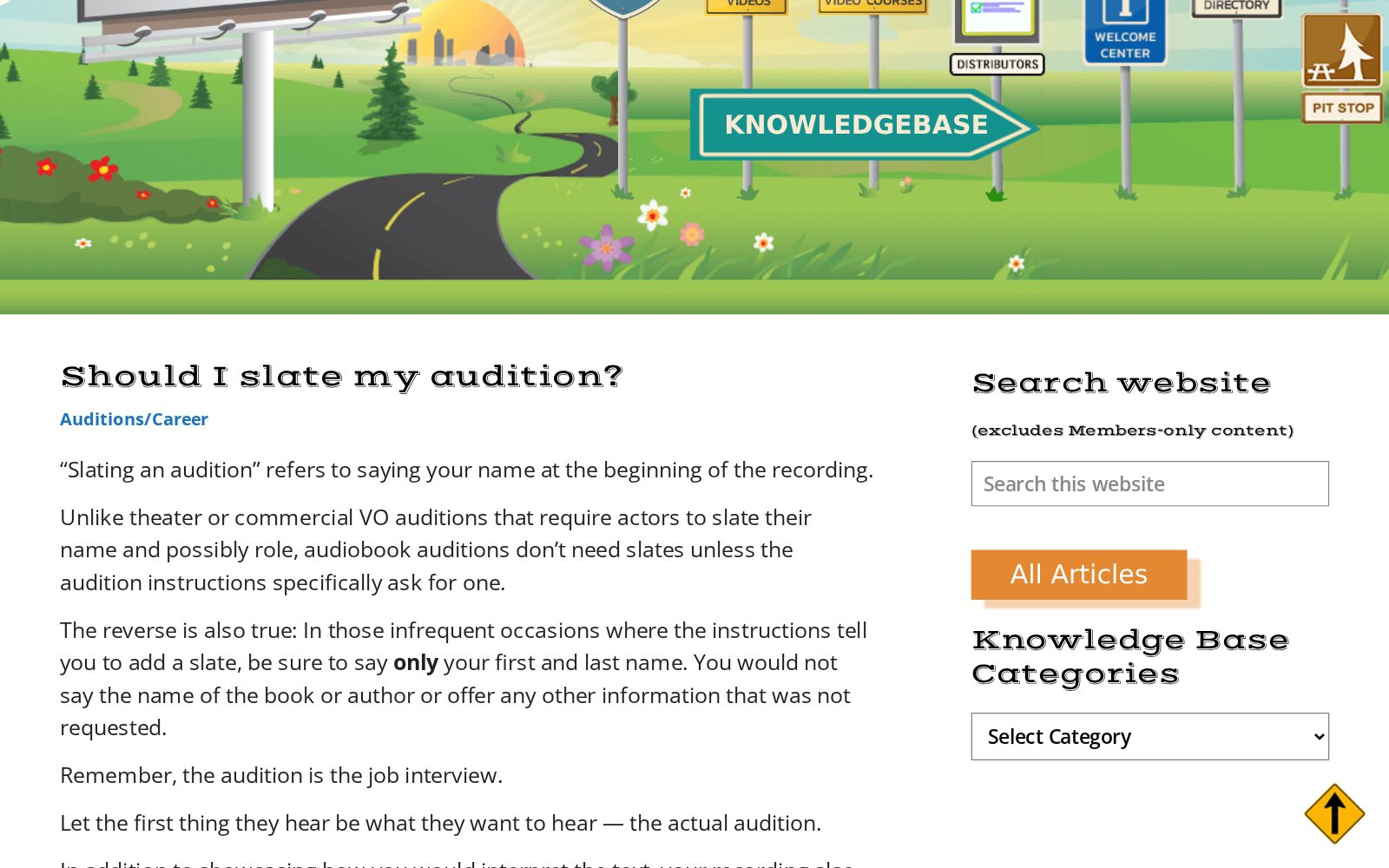
Karen Commins on slating audiobook auditions, on Narrator's Roadmap. Screenshot taken 27 November 2026. Image: Narrator's Roadmap
Skipping the slate never means skipping your name. Commins again: “Be sure you label the file with your name.” The file name is your slate when the audio can’t be.
Two takes, and make them different
Most working actors send two reads unless the brief asks for one. Hyrchuk recommends it, in capitals: “If you’re doing two takes (which I recommend) MAKE THEM DIFFERENT.” Two different reads show that you can take direction before anyone’s given you any: a warmer read and a drier one, a faster pace and a slower one, a smile and no smile.
Keep the file tight. Hyrchuk suggests no silence longer than about 1 to 1.5 seconds between takes and lines, clean out flubs and false starts, and leave in breaths only when they’re part of the performance. Watch the order, too. Some briefs with several lines want every line once, then every line again (ABC ABC); others want each line twice in a row (AABBCC). If the brief spells it out, match it exactly.
On sound, his guide says to “Send your audio as an MP3” unless told otherwise, and to “Aim to have your audio peak at -3dB to -1dB.”
Name the file like a stranger will download it
Because a stranger will. Auditions get downloaded, renamed, forwarded to a producer and dropped into a folder full of other people’s. A file called “audition final 2.mp3” vanishes in that folder.
If the brief gives a naming pattern, copy it character for character. Hyrchuk’s sample brief asks for files titled “FirstLast_CharacterName”, and he points out that the spacing and underscores are part of the instruction. “First Last_Character Name” isn’t the same thing to someone sorting files by name.
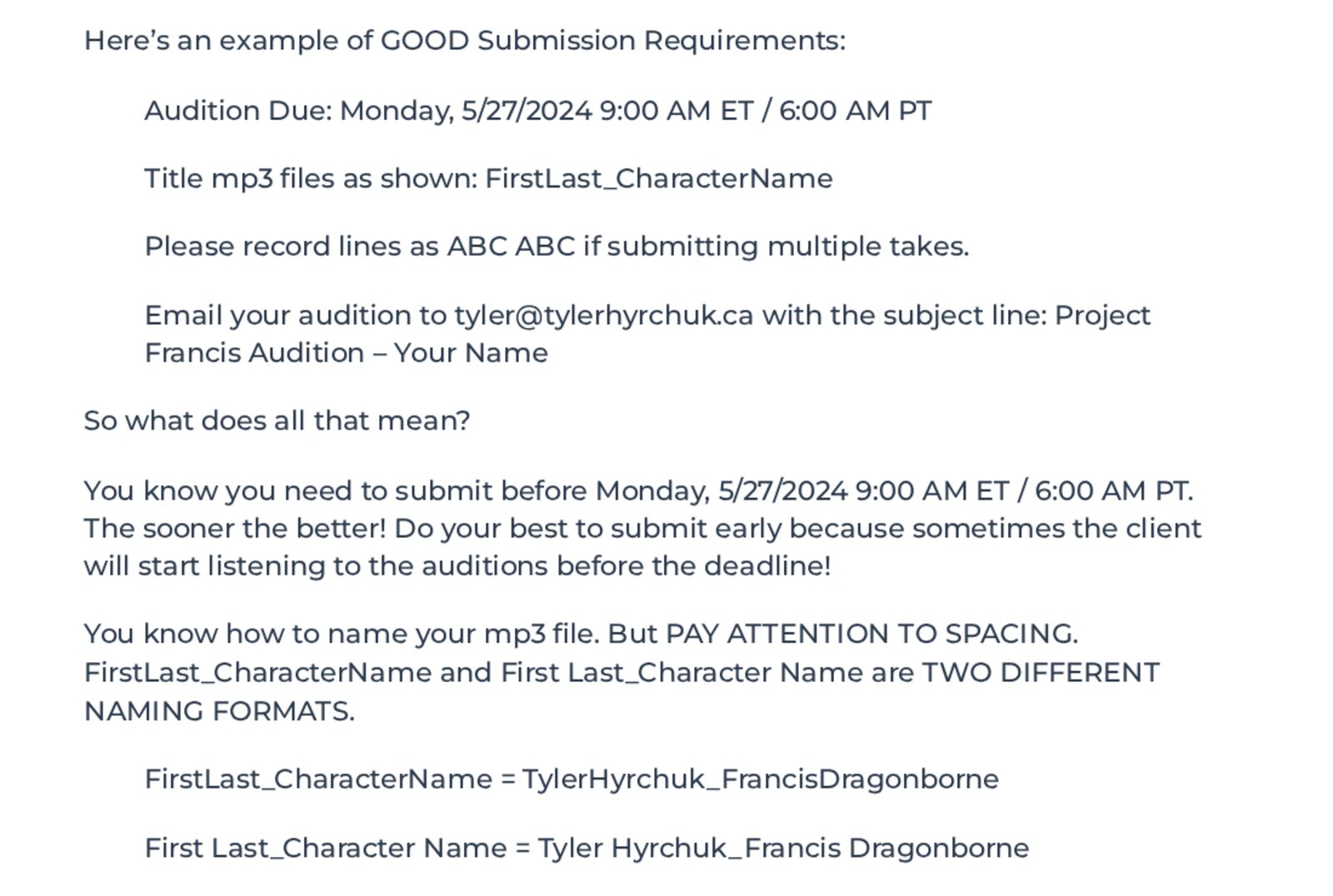
Tyler Hyrchuk's sample audition brief and his note on file name spacing, on tylerhyrchuk.ca. Screenshot taken 27 November 2026. Image: Tyler Hyrchuk
No pattern given? Start with your name, then the job, then the role or a short tag. Let’s Go VO’s example is “YourName_CompanyName_AVO.mp3”. Commins, for audiobooks, uses her name, the book title, “Aud” and the date, along the lines of “KarenCommins-BookTitle-Aud-DDMMYY”.
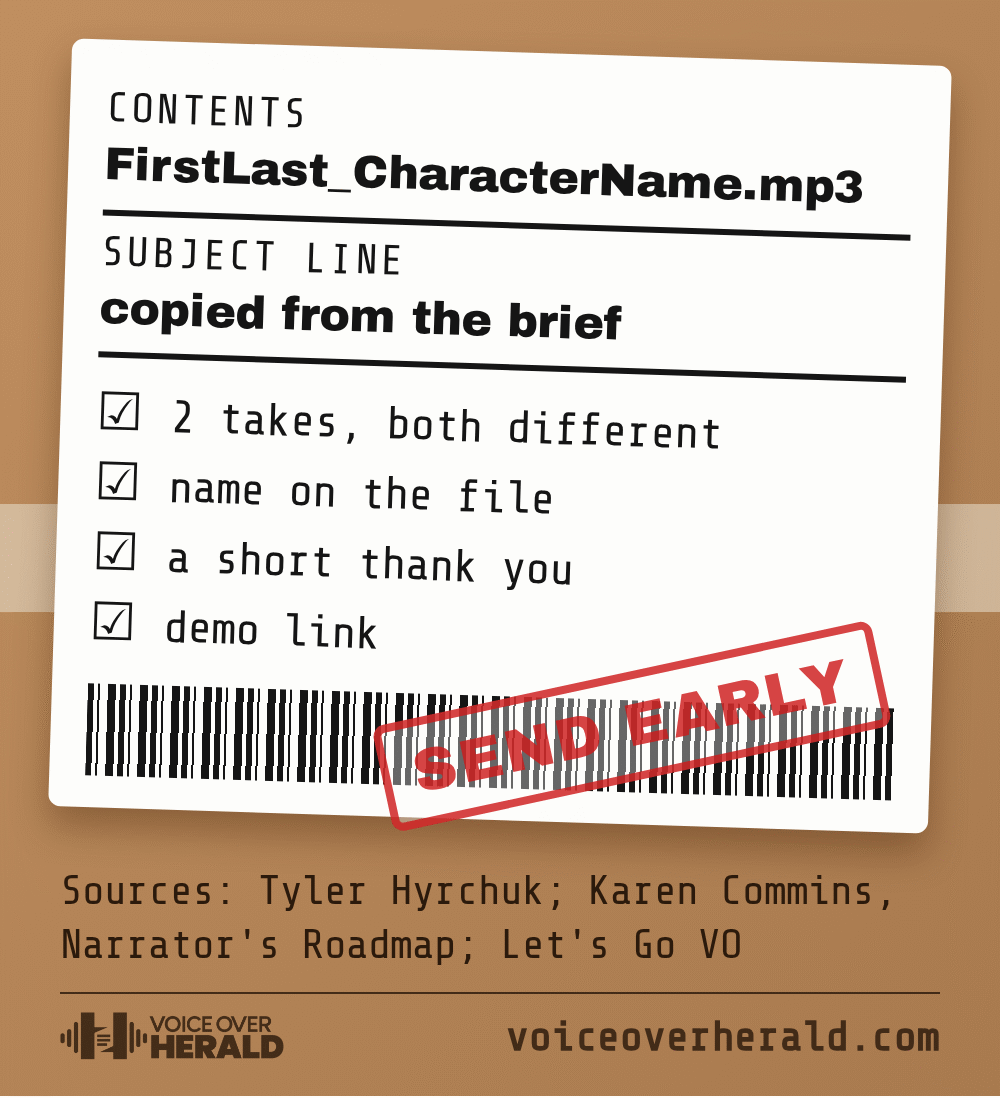
Send it early, and say thanks
The deadline is the last moment you can send, not the best one. Hyrchuk: “Do your best to submit early because sometimes the client will start listening to the auditions before the deadline!” Let’s Go VO agrees: “Submitting early on in the casting process gets your files in front of the decision makers”.
If you’re sending by email, follow the subject line the brief gives you, word for word. Then write something in the body. Hyrchuk sees an empty email as a missed chance: thank them for the opportunity, and add a link to your website and your demos. Two or three friendly lines are plenty.
Then let it go
Here’s the part nobody enjoys. Most auditions don’t book, and most of the time you’ll never hear why. Baker is clear-eyed about how quickly decisions happen: “A few seconds of listening is generally enough to render the verdict.” That’s exactly why the slate is short and the strongest read goes first.
What you can control is the next one. Baker notes that “Directing yourself solo in an audition is a skill distinct from acting.” His fix is practical: get feedback from people who know the business, and “re-do auditions that aren’t your best.” Keep your old auditions, too. DelGaudio holds on to his takes so he can go back and hear what he did.
Read the brief twice, slate in a few seconds, send two different takes under a name nobody can lose, and send early. As Baker puts it, the job at the mic is to “slate your name, speak the words and exit.”
Sources: Dee Bradley Baker, “An Audition is Two Shows.” and “Home Alone: ‘Why Don’t I Book?'” on iwanttobeavoiceactor.com; Caroline Turner Cole, “To Slate or Not to Slate?” (Such A Voice, 15 April 2021); Tyler Hyrchuk, “How Do I Audition For Voice Acting Jobs?” (17 August 2024); Let’s Go VO, “9 Audition Tips for Beginner Voice Actors” (20 September 2022); Karen Commins, “Should I slate my audition?” on Narrator’s Roadmap; Mike DelGaudio, “Quick Guide to Auditioning and Slating for Voiceover Auditions” (Booth Junkie, on YouTube).
Lee este artículo en español: Di tu nombre y hazte a un lado: cómo hace el slate y envía su primera audición un actor de voz principiante
Know something about this story, or spotted an error? Tell the newsroom.