
Audible Lets You Talk Back to Renfield. He Answers in a Replica of Johnny Flynn’s Voice
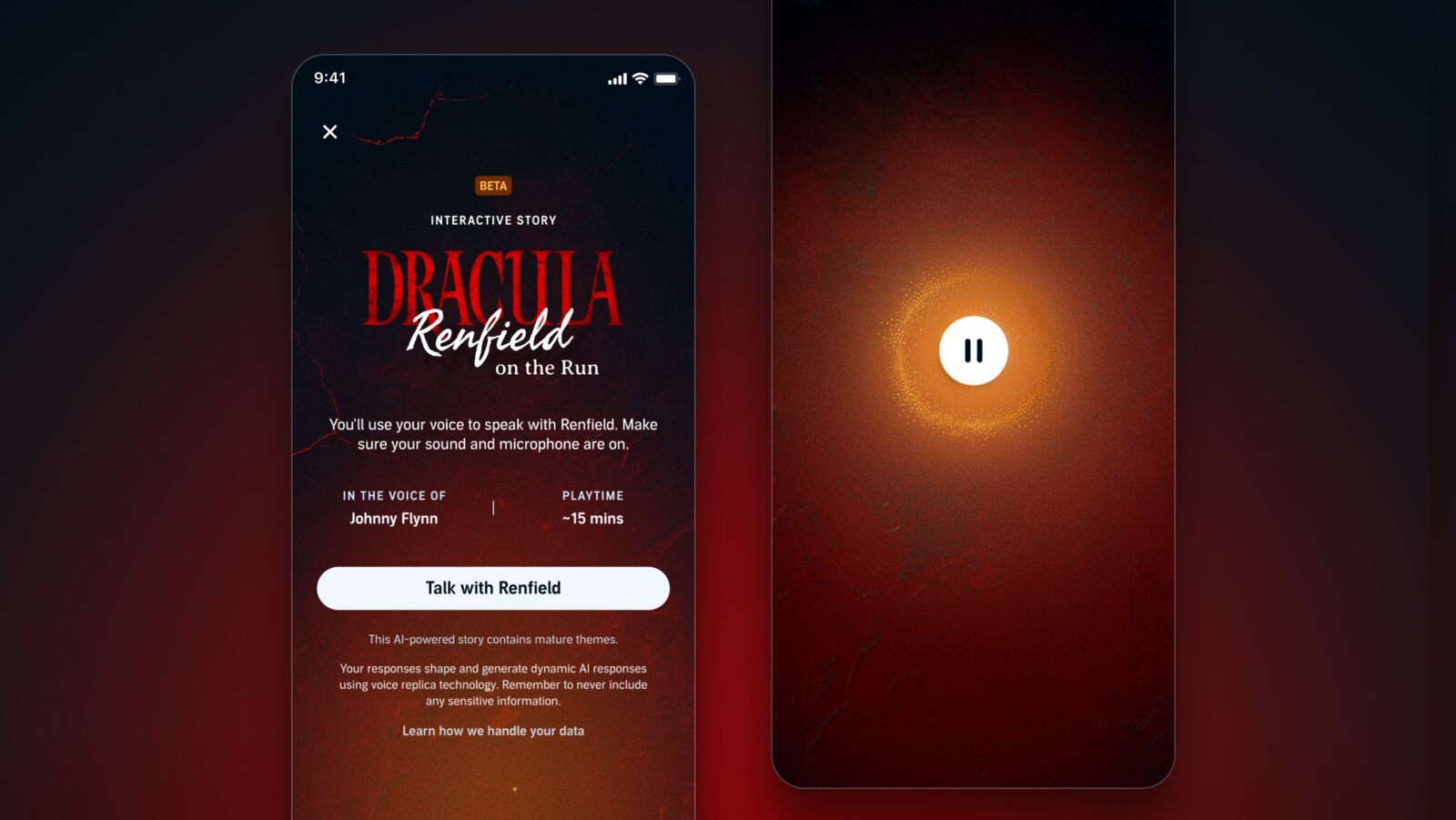
Audible’s new Interactive Story lets listeners talk to Renfield out loud and hear him answer. The screen that launches it says the answers come “in the voice of Johnny Flynn,” the actor who plays Renfield in Audible’s new Dracula, made with “voice replica technology.” It turns a narrator’s voice into something that can say lines the actor never recorded, and Audible hasn’t said what the deal behind it looks like.
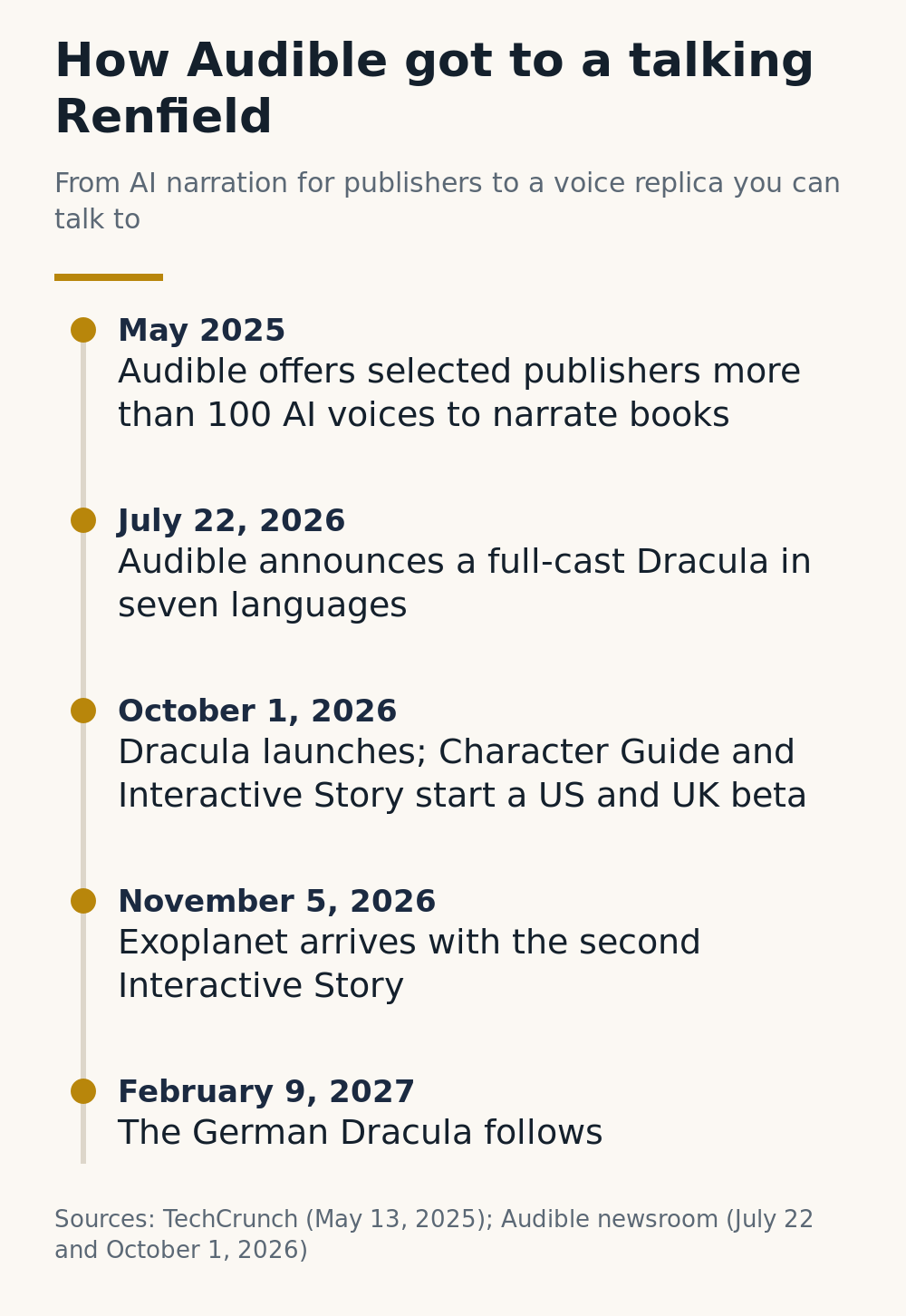
Audible released its full-cast Bram Stoker’s Dracula on October 1, with Jonathan Bailey as the Count, Ella Purnell as Mina and Maggie Gyllenhaal as Van Helsing. It’s out in English, French, Italian, Castilian Spanish and Latin American Spanish, where José María de Tavira and Esmeralda Pimentel lead as Dracula and Mina. The same day, the Amazon-owned company announced three features built, in its words, “using AI to enhance the listening experience”: Character Guide, Interactive Story and Visual Explorer. All three are in a limited beta for customers in the United States and the United Kingdom.
What the screen says
Audible’s written announcement describes Interactive Story as a “real-time conversation with a character brought to life through a unique combination of generative AI, conversational design, and rich sound production.” It doesn’t name a voice.
The product image Audible published alongside it does. The launch screen is titled “Renfield on the Run,” runs about 15 minutes, and carries two labels side by side: “In the voice of” and “Johnny Flynn.” Under the button that reads “Talk with Renfield,” the small print says: “Your responses shape and generate dynamic AI responses using voice replica technology.”
Flynn plays R.M. Renfield in the full-cast production. Geeks of Doom’s reviewer called him “immensely entertaining” and “a standout as the erudite and cunning, yet unhinged madman” in a review published on launch day.
What Audible hasn’t said is how the replica was built, what Flynn agreed to, or how he’s paid when it speaks. Nothing in the announcement suggests he didn’t agree. It just doesn’t explain the deal, and for working narrators the deal is the whole story.
How a conversation works
Renfield speaks first. He gives the listener a role, a goal and the stakes, then the listener replies in their own words and the character reacts in real time. Audible says creators set “the opening scenes, turning points, and character persona,” and its own product design keeps the story “faithful to the creator’s vision all the way through.”
The next one arrives on November 5 with the Audible Original Exoplanet, created with author Benjamin Percy, with Andy Weir as executive producer. Audible hasn’t said whose voice will answer in that one.
“In this case, AI is allowing us to create new interactive experiences that today’s listeners, especially younger audiences, are craving,” said Andy Tsao, Audible’s chief product and analytics officer. “We are opening up entry points into stories that are still part of the authors’ vision, but that make our customers’ experiences more personal and unique.”
That last word matters to anyone who records for a living. A recorded performance is the same every time. A replica that answers a listener says lines nobody wrote down and nobody recorded, in a voice that belongs to someone.

The feature that puts narrators on screen
The other big change runs the opposite way. Character Guide shows who’s speaking while you listen and offers spoiler-free character cards that, Audible says, “spotlight the performers behind each voice, complete with narrator headshots and bios.” It’s live in Dracula and in Audible’s George Orwell’s 1984, where the sample screen credits Romesh Ranganathan as Parsons. It’s coming to Exoplanet too.
A credit on screen
Names the actor speaking, in real time, with a headshot and a bio. Every line is one the actor recorded.
A voice that improvises
An AI Renfield answers whatever the listener says, using a replica of the actor’s voice. The lines are generated on the spot.
For narrators who spend whole careers as a name in small type on a product page, a face and a bio inside the player is real visibility. “We’re excited to build on these while working hand in hand with creators, because we know that more time spent with stories benefits everyone who helps bring them to life,” said Rachel Ghiazza, Audible’s chief content officer.
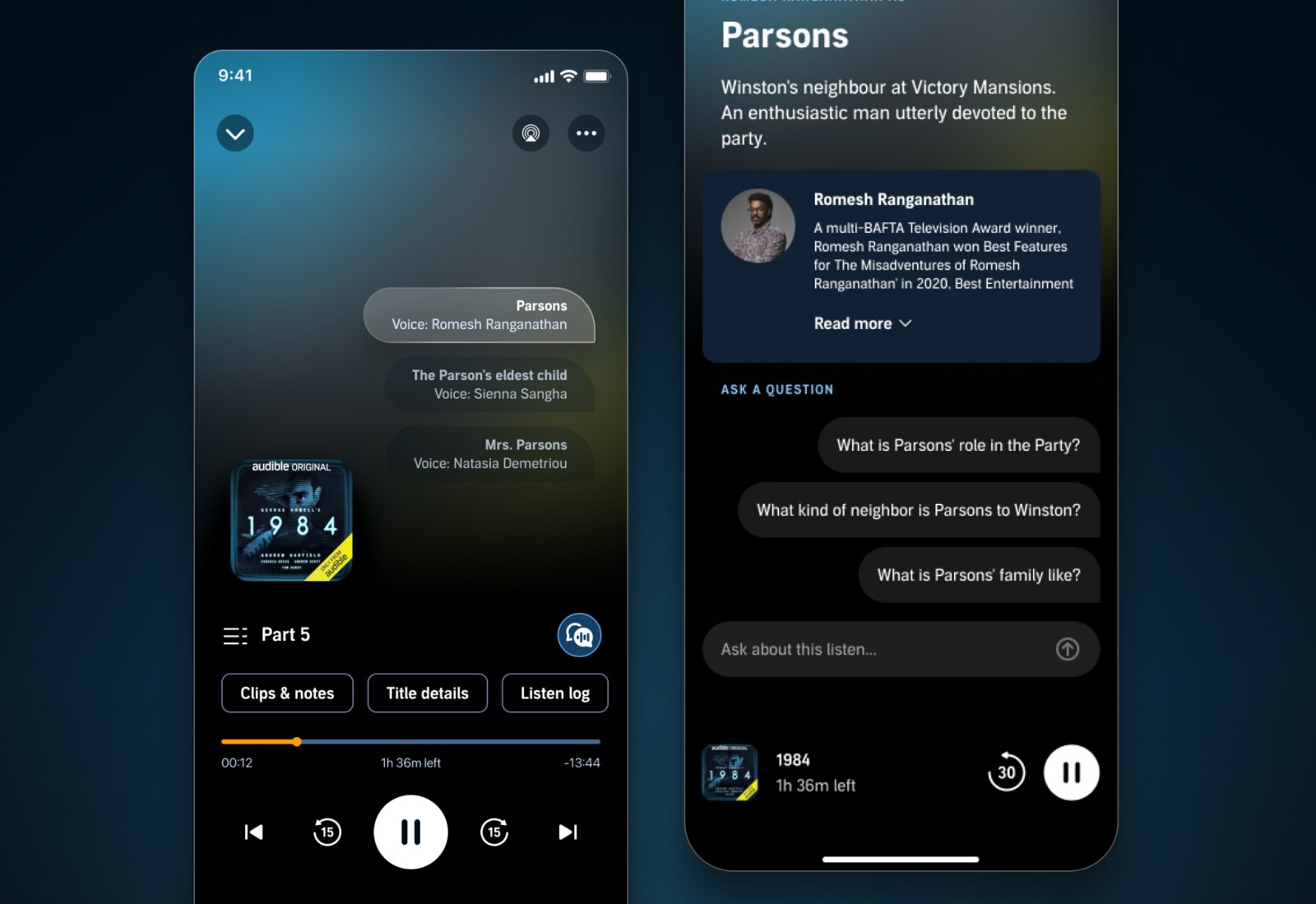
Image: Audible
Visual Explorer, the third feature, adds maps and pictures at key moments. It starts with The Cultural Tutor’s Grand Tour: The Story of Europe in Six Cities and doesn’t touch the voice at all.
What the union says about replicas
Audible’s launch landed a day after Marketplace ran a long look at AI in audiobooks, and the people it spoke to are the people this feature affects. Jeff Bennett, SAG-AFTRA’s chief legal officer, told the program the union’s position on selling a voice replica “really revolves around informed consent.” If performers know exactly how and where their voice will be used, he said, “we’re very comfortable that people can make that decision for themselves.”
 VoiceEditSuitePro audio tools built for working voice actors.Auto Clean UpACX Audiobook PrepAudition Director
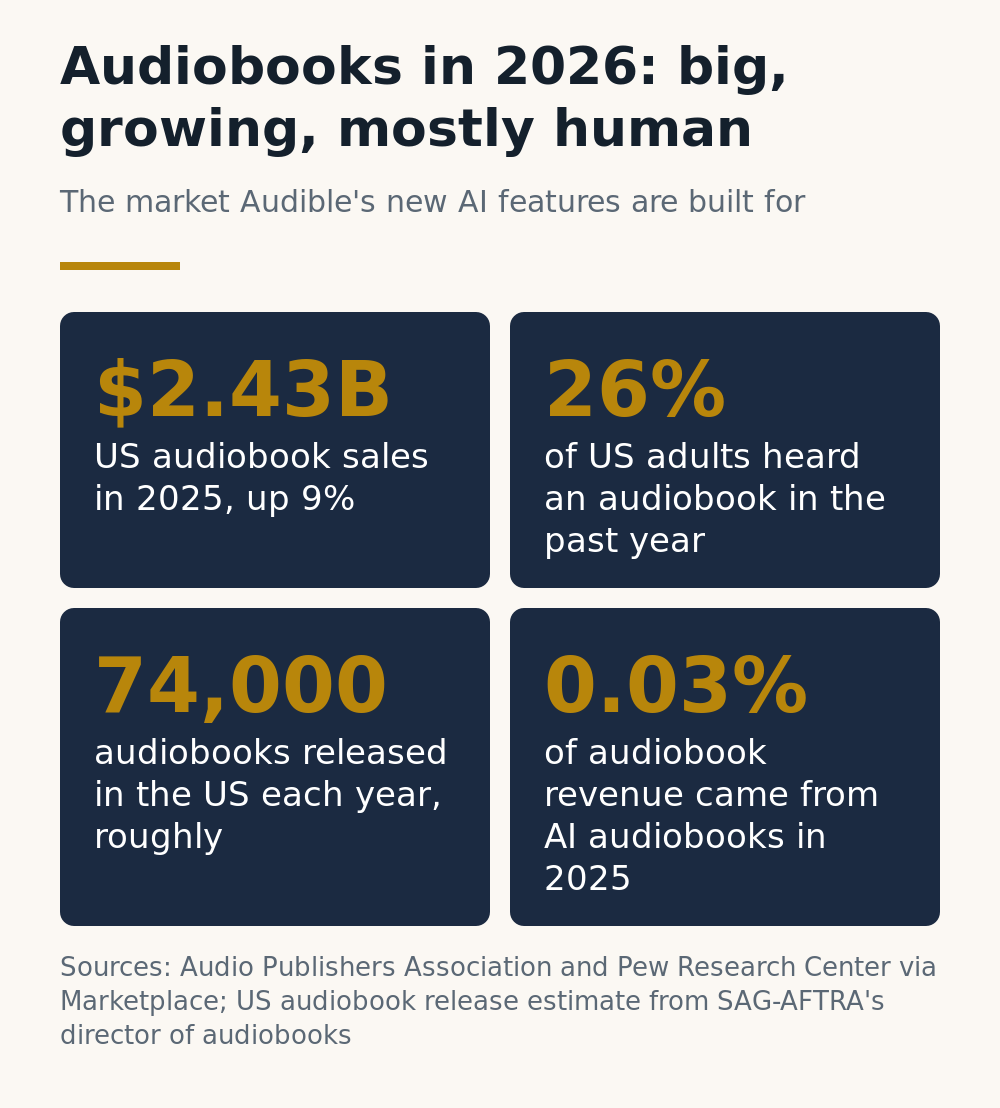
Jane Love, SAG-AFTRA’s director of audiobooks, said narrators are split. “Some people are like, ‘absolute no, I’m never doing it.’ Other people are AI-curious,” she said. She also told Marketplace that, so far, AI audiobooks aren’t eating into human work: “What we are seeing is not a decline in human production and not really an impact on human production.”
Interactive Story isn’t an AI audiobook, though. It sits beside a human one, as a bonus, and it uses the voice of a cast member from the human production. That’s a different kind of booking, and one the audiobook business hasn’t had to price before.
What narrators should take from it
Will Damron, a narrator recently inducted into Audible’s Narrator Hall of Fame, described the part of the job listeners never hear. “You have to prep the script, and that’s what takes the most time,” he told Marketplace. “If it’s a fiction book, I make a list of every character that’s in it.” He’s firmly against selling a clone of his voice.
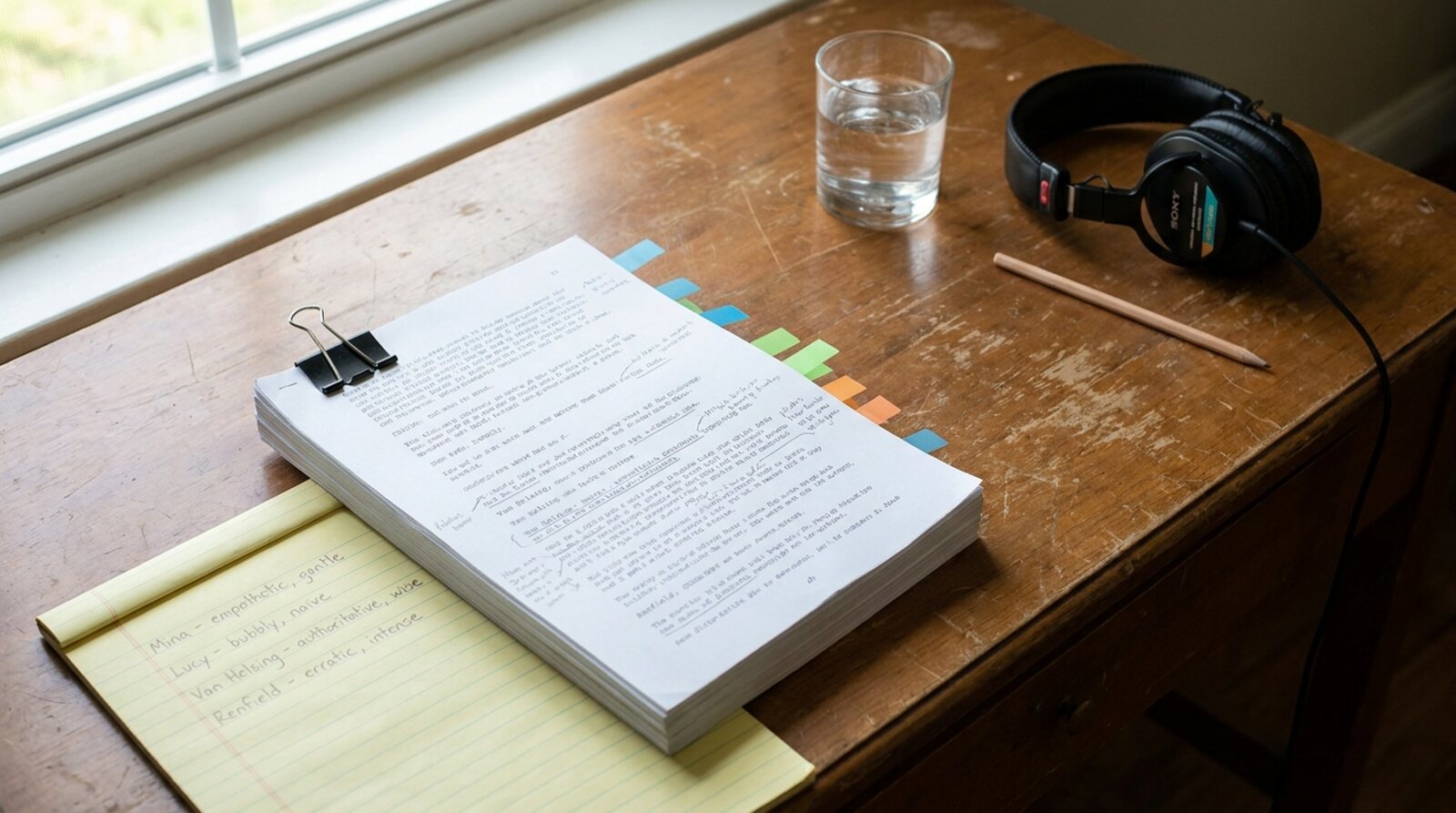
A performance built that carefully is exactly what makes a replica worth having, which is why the questions around one are worth asking before anyone signs. If a contract for a full-cast production ever includes an interactive bonus, the useful questions are plain ones. Is the replica trained only on lines recorded for this title? Can it be used in other titles or languages? How long does the permission last? Is there a fee per use, or one fee forever? Who approves what the character can be made to say?
None of that is a reason to panic about one 15-minute Renfield. It’s a beta, in two countries, attached to one production. But Audible has said it is working with creators and publishers to bring these features “to life in additional stories where it makes the most sense,” and the next one is five weeks away. Narrators who record full-cast work may find this question on their desk sooner than they think. Those who read solo titles, and who already watched Audible open its AI narration to publishers last year, will recognise the pattern.
For now, the most interesting line in the whole launch isn’t in the press release. It’s in small print on a phone screen, under a candle: “In the voice of Johnny Flynn.”
Sources: Audible newsroom, “The Next Chapter in Listening” (October 1, 2026) and its product images, and “Audible Announces All-Star Global Adaptations of Bram Stoker’s Dracula” (July 22, 2026); Marketplace, “Is AI coming for audiobooks?” by Daniel Graham (September 30, 2026); Geeks of Doom review of Bram Stoker’s Dracula (October 1, 2026); TechCrunch (May 13, 2025). Images: Audible.
Lee este artículo en español: Audible te deja hablar con Renfield. Responde con una réplica de la voz de Johnny Flynn
Know something about this story, or spotted an error? Tell the newsroom.