Australia’s Audio Awards Add a Voiceover Prize for 2027. Use an AI Clone Anywhere in the Entry and You’re Out
Australia’s newest audio awards are adding a prize just for voiceover artists in 2027, and the rule that comes with it is blunt: if an AI cloned voice turns up anywhere in your entry, it can’t be entered. Entries opened on 26 November, and the trophies are handed out in Sydney next June.
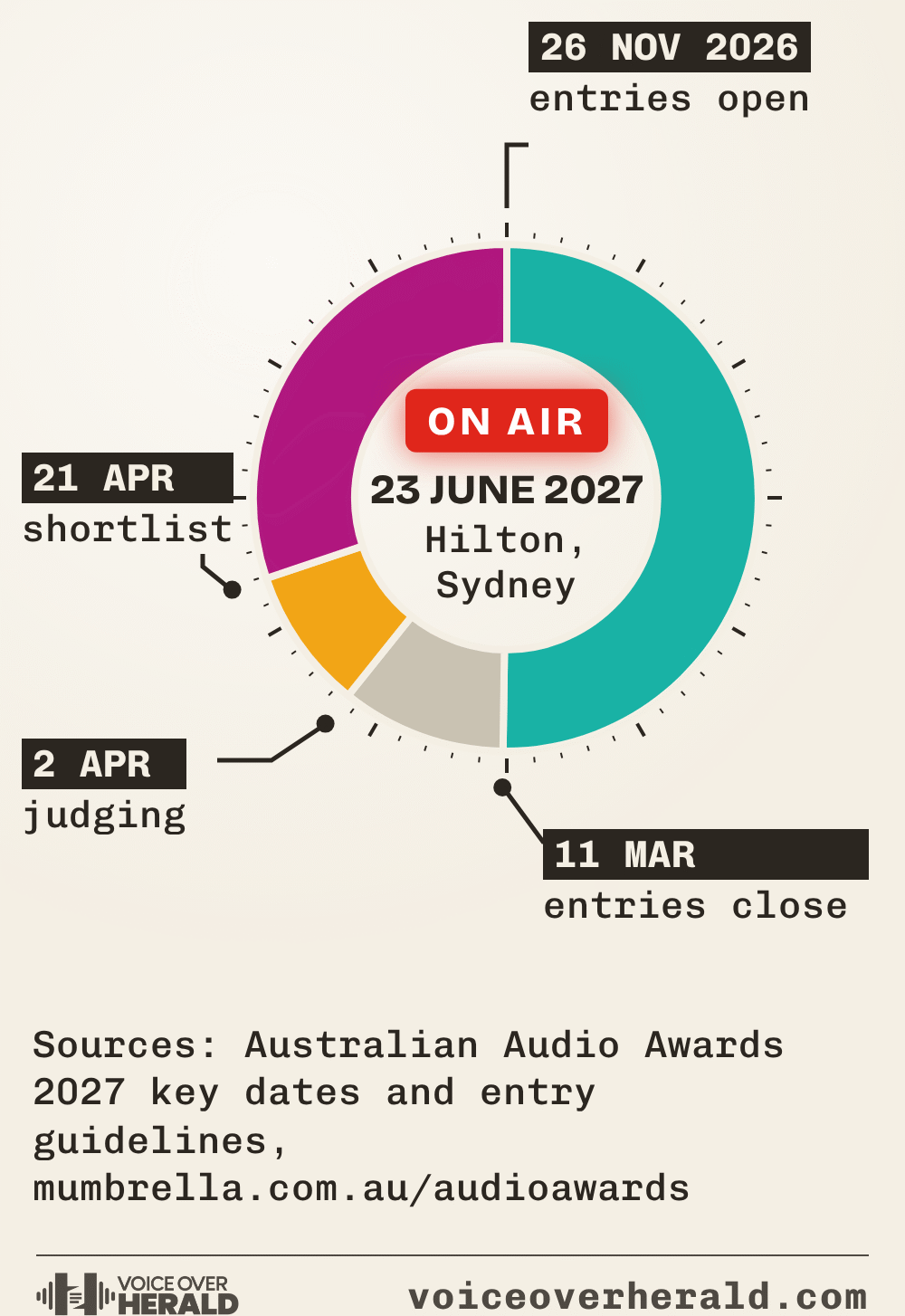
The Australian Audio Awards, run by the trade titles Mumbrella, Radioinfo and Radio Today, announced their second year on 26 November. The night moves to the Hilton in Sydney on Wednesday 23 June 2027, entries close on 11 March, and the list has grown to 28 categories across radio and podcasting.
One of the new ones is the reason working voice actors should care. It’s called Best Voiceover Artist, it has two divisions, Commercials and Long Form Narrative, and the official entry guidelines open it with a line you don’t often see from a judging panel in 2026: “Human voice actors are essential in all forms of audio content, we celebrate real voiceover artists in this category.”
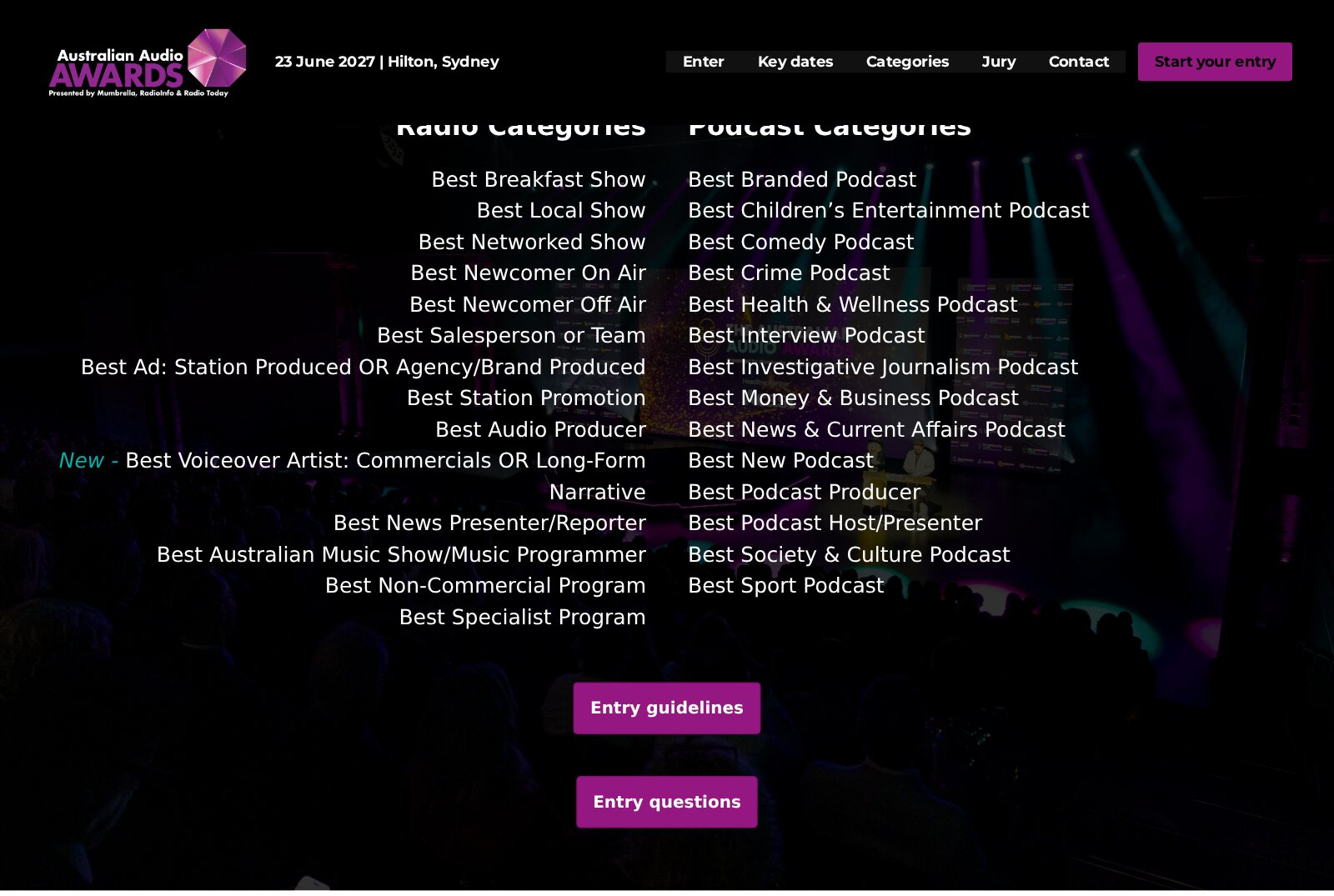
Screenshot: Australian Audio Awards website, mumbrella.com.au/audioawards, taken 28 November 2026
Mumbrella’s own announcement went further, in a footnote that reads like someone has already had the argument once. “I’m annoyed we need to mention this, but we request/insist on no AI use for the ‘best voiceover’ category,” it says, then answers the follow-up question before anyone can ask it: “‘Even if I…’ Yes. No. No AI.”
A prize that didn’t exist in May
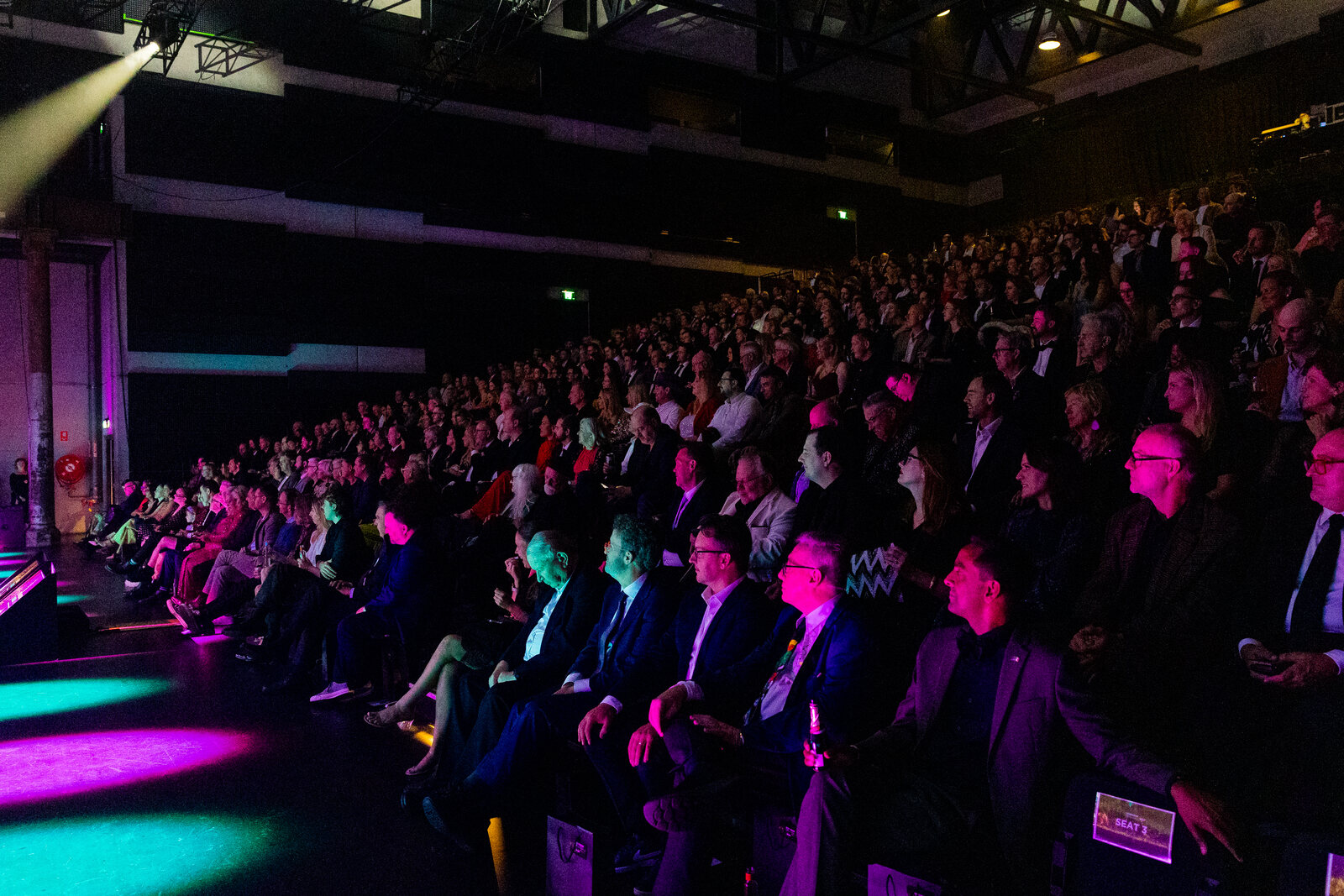
The first ceremony was held in May at Carriageworks in Sydney, hosted by the radio presenters Bianca Dye and Mitch Churi, and Mumbrella’s winners report said the ABC was the night’s biggest winner with 11 awards. Best Voiceover Artist is marked as new for 2027.
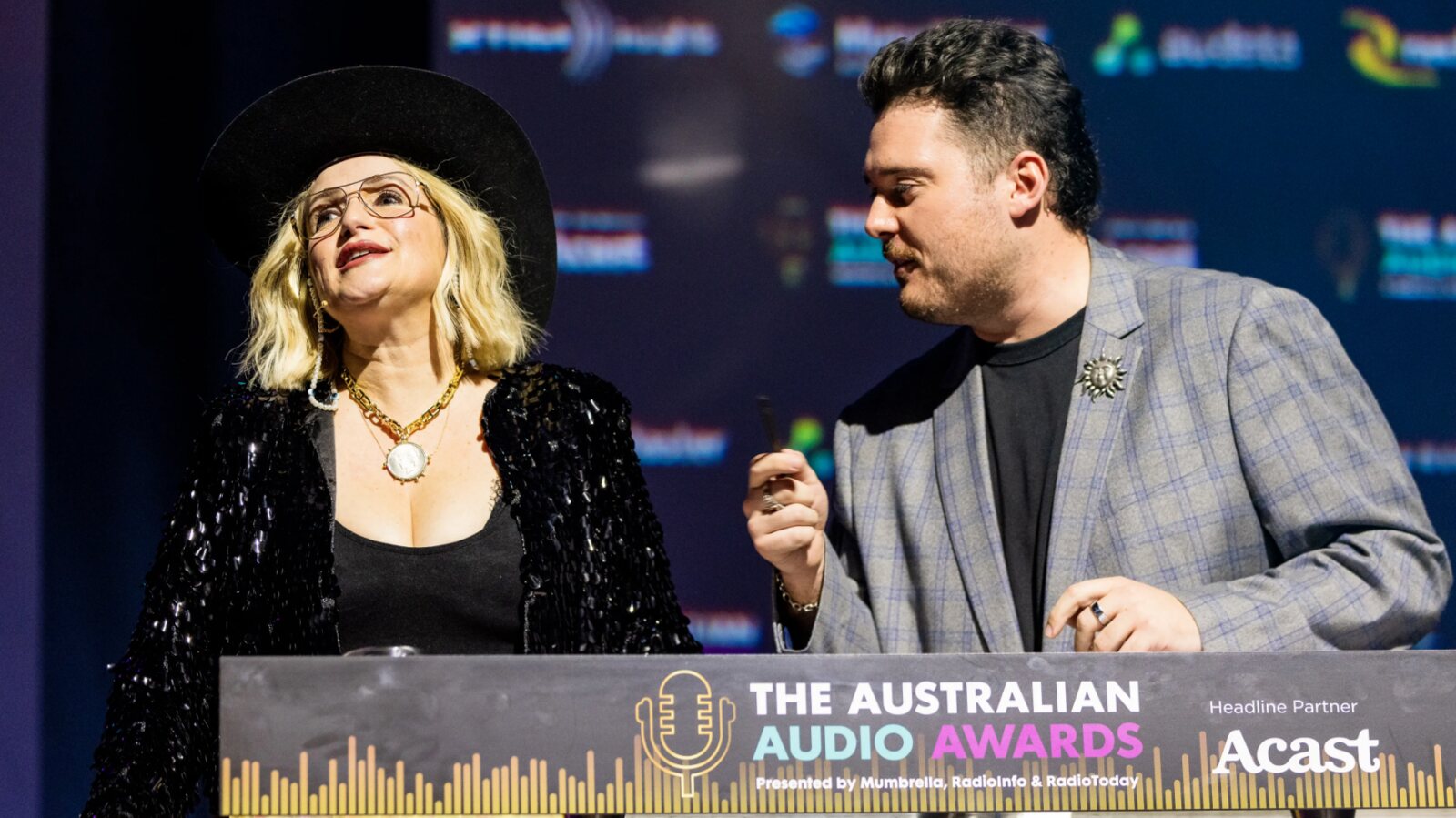
Bianca Dye and Mitch Churi hosting the first Australian Audio Awards in May. Image: Mumbrella
Steve Ahern, the publisher of Radioinfo and head of the awards jury, said the first year proved the point. “We took a risk to fill the vacuum left after the other awards folded, and it was clear from the support we got that the industry really wanted these awards,” he said in the announcement. “After many requests, we will introduce a dinner into the awards night in 2027.”
Mumbrella’s publisher Tim Burrowes is just as keen on a sequel. “The atmosphere at the first AAA ceremony was amazing, and I can’t wait to experience the same energy for a second time,” he said.
What “no AI” means in this category
The wording in the guidelines is wider than you might expect. It doesn’t only rule out a cloned lead voice. It says: “Audio that uses AI cloned voices in any part of the production cannot enter this category.” Read plainly, a commercial with a synthetic tag line at the end, or a narration with one generated character voice in it, is out, however good the human performance around it is.
 VoiceEditSuiteIt edits like you would, and it gets better every file.Every fix you make in the editor teaches Auto Clean Up more, so each file comes back sounding like you edited it yourself.See how it worksLearns from numbers, never your audio. Never used to train AI.
That line lands in a month when Australian radio is busy finding new jobs for synthetic voices. On 18 November CRN reported that Australian Radio Network has built a multi-agent AI system with the consultancy Arinco to write and voice its traffic bulletins. In CRN’s words, “Each station can configure its own voice, delivery style, pronunciations, priority roads and branded opening and closing lines.” ARN’s head of technology, Mat Williams, said the system gives the network “much more control over how the traffic product sounds, operates and develops commercially, while keeping our people responsible for what goes to air.”
The wider creative industries are pushing the other way. The same week, 38 organisations backed a campaign called Not AI’s to Take, devised by the music rights body APRA, against changes to Australian copyright law that would let AI companies train on local work. APRA’s chief executive Dean Ormston summed up the position in two words, “permission and payment,” and added: “Creators must have the right to control how their work is used, and they must be paid for that use.”
So an awards night run by radio’s own trade press drawing a hard line around human voice work is a small thing, but it isn’t nothing. It tells the people who book voices which kind of voice the industry wants to be seen celebrating.
How the judges will score it
The voiceover category has its own marking sheet, and it leans heavily on the performance itself. Script interpretation and delivery are worth a quarter of the marks each, so half the score comes from what you do with the words. Production quality and what the guidelines call “success measures,” such as audiobook sales or commercial results, make up most of the rest.
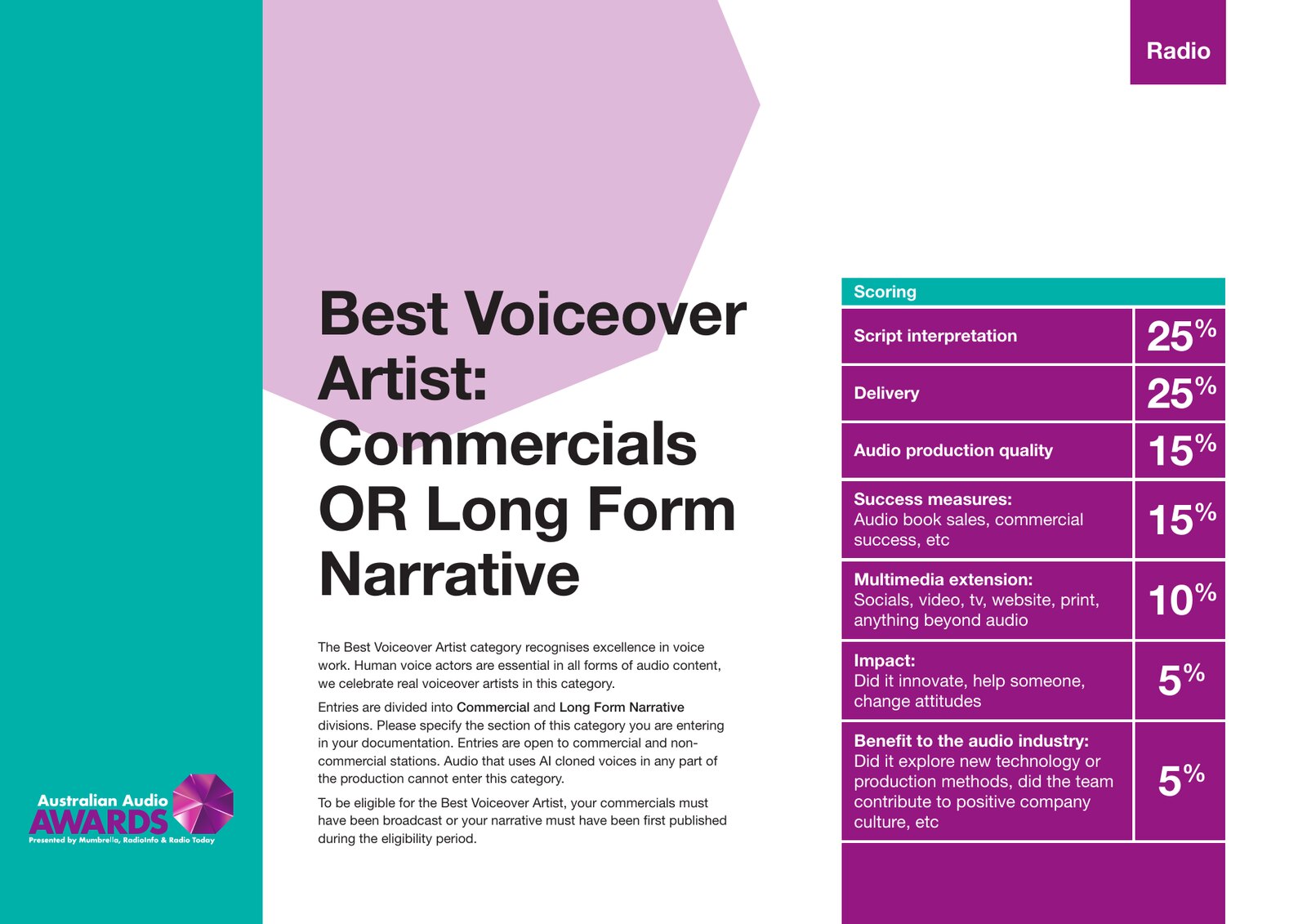
Screenshot: Australian Audio Awards 2027 call for entries, Best Voiceover Artist page, taken 28 November 2026
The smaller slices reward things freelancers often forget to mention: what happened to the work beyond audio, whether it helped someone or changed attitudes, and whether it did anything new for the industry. Unlike most radio categories, this one isn’t split into metro and non-metro markets, so a voice from a regional station competes on the same sheet as a voice from Sydney.
What you’ll need to send
To be eligible, a commercial must have been broadcast, or a narrative first published, between 10 March 2026 and 10 March 2027. The entry form asks for the name of an organisation and the full name of the nominee, plus the name of the client or brand where there is one.
The form also wants a high resolution headshot and up to five extra visual files, such as photos from behind the scenes. At least one representative has to be free on the night of 23 June to collect the award if it wins, which is worth knowing before you enter from Perth or Auckland.
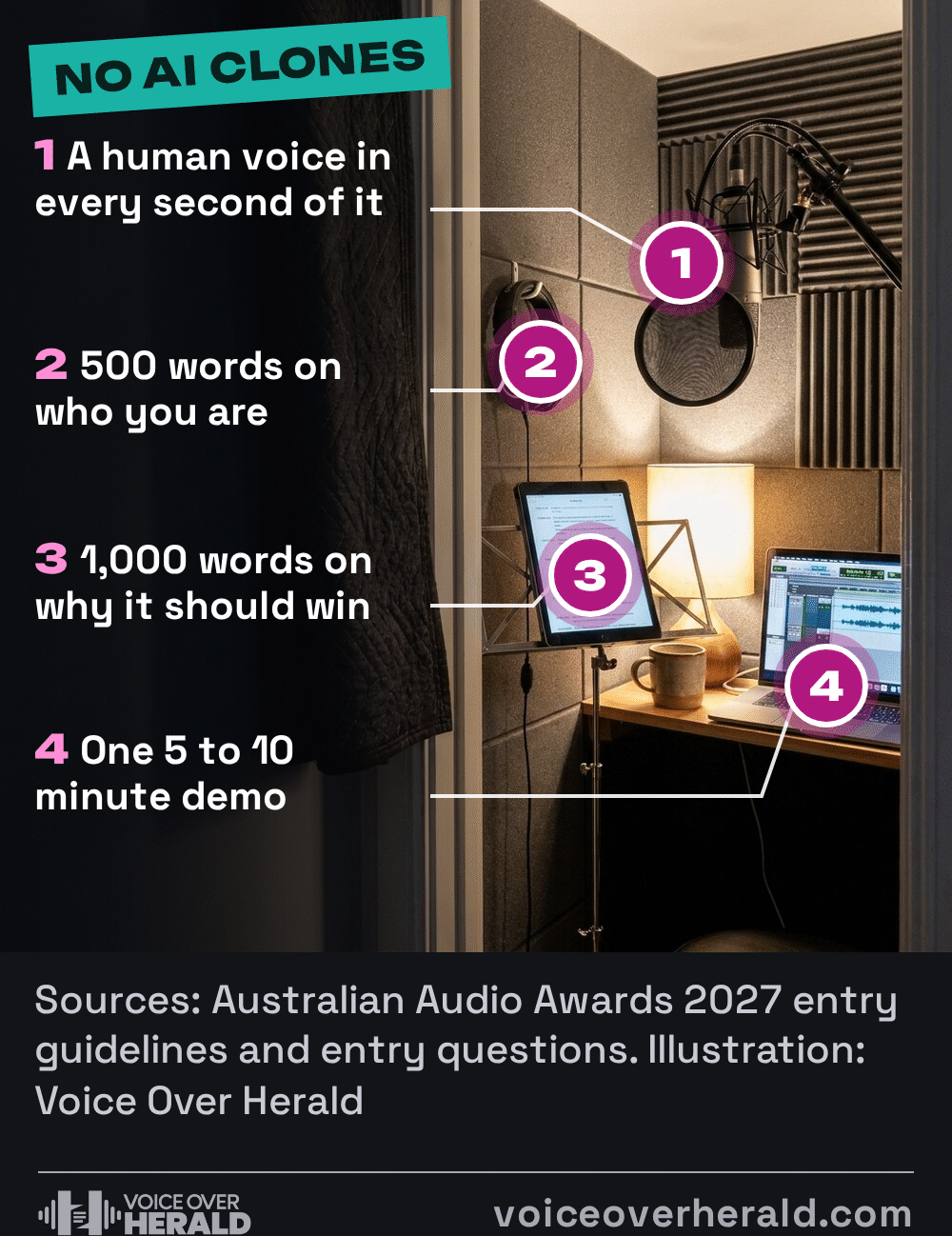
Who can enter, and what it costs
The voiceover category says entries “are open to commercial and non-commercial stations,” and the form is built around an organisation, so the guidelines read as if a station or a producer does the entering. They don’t say a freelance voice actor can’t enter on their own behalf, but they don’t say they can, either. A short email to the event team before you start would settle it.
The fee table is just as quiet on this category. Radio entries cost A$300 plus GST in the big metro markets and A$200 plus GST everywhere else, but the voiceover prize sits outside those market divisions, and the guidelines don’t say which price applies. Entries from New Zealand are welcome under the trans-Tasman trade agreement, and radio entries have to be produced inside Australian radio licence areas.
There’s also a bonus at the top end. The organisers say the two highest scoring radio and podcast entries will be entered into the New York Festivals awards at no cost to the winners.
Why it matters past Sydney
Australia now has two awards programmes that put voice actors on the stage. In October the SONARR Awards handed their performance prize to a voiceover entry, as Voice Over Herald reported when Colin Cassidy took the acting award. Now the radio industry’s own awards night is giving the craft a category with its name on it, and a rule that keeps it human.
If you voiced a spot that aired in Australia this year, or narrated something first published since March, the full category wording, scoring and forms are on the Australian Audio Awards entry page. You’ve got until 11 March. Use the time to pick your best five to ten minutes, not your longest.
Sources: Mumbrella, “Australian Audio Awards return, with entries now open” (26 November 2026), “Winners list: Top radio and podcast talent honoured at Australian Audio Awards” (28 May 2026) and “‘Permission and payment’: Industry bodies team up for ‘Not AI’s to take’ campaign” (19 November 2026); Australian Audio Awards 2027 call for entries, entry questions and key dates; CRN, “Australian Radio Network partners with Arinco on AI-created traffic bulletin workflow” (18 November 2026). Photos: Mumbrella. Screenshots: Australian Audio Awards.
Lee este artículo en español: Los premios de audio de Australia suman un galardón de locución para 2027. Una voz clonada con IA en cualquier parte deja fuera la pieza
Know something about this story, or spotted an error? Tell the newsroom.