



Too Good to Be Booked: How to Spot a Fake Voice Job Before It Costs You
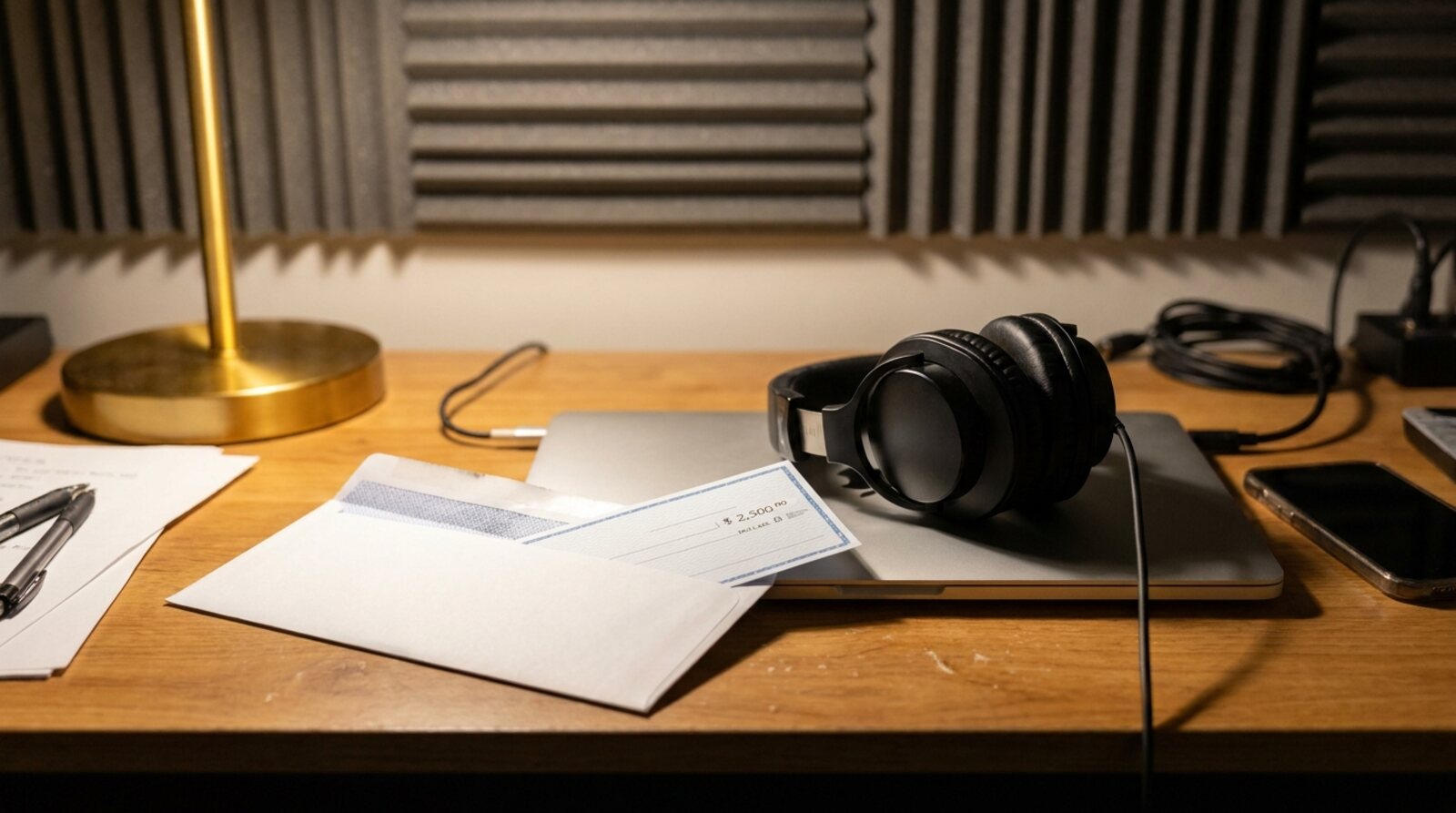
The message lands on a quiet Tuesday. Someone found your website, loved your demo and has a commercial for you. The fee is generous, the deadline is relaxed, and a check is already on its way. Most fake voice jobs start exactly like that, and they work because remote voice work really does arrive by email from strangers. Here’s how the common versions run, the words that give them away, and the one rule that beats nearly all of them.
It starts with a compliment and a check
Doug Turkel has voiced commercials for more than three decades, and he wrote the scam guide published by the National Association of Voice Actors (NAVA). His first point is that the voice job is just the costume: “most of the scams that target voice talent are some version of the classic Overpayment Scam,” he writes. “This scam has nothing to do with voiceovers, and everything to do with getting you to send money to the scammers.”
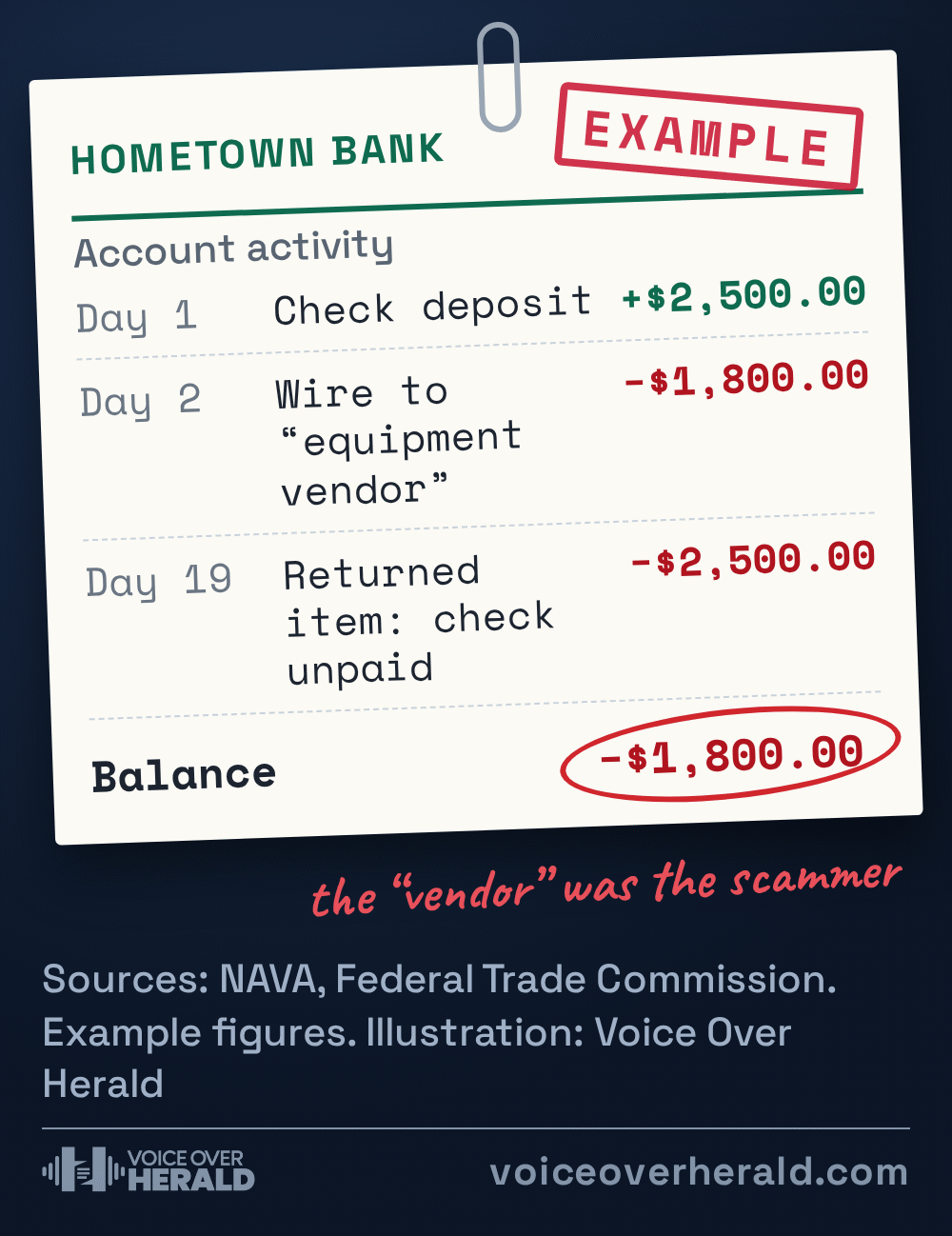
The shape rarely changes. After a short exchange about the work, a check arrives for more than the job pays. The “client” says the extra is for a studio engineer, an equipment vendor or a simple mistake, and asks you to forward the difference, usually by wire transfer, money order or gift card. They’ll be very keen to hear the moment it lands, because, as Turkel puts it, the scammer needs their profit before “your bank flags the check as fake, which can take as little as a few days or as much as a few weeks.”
That gap is the whole trick. In the United States the law makes banks release deposited money quickly, so the funds show up long before anyone knows the check is no good. “It can take weeks for a bank to figure out that the check is a fake,” the Federal Trade Commission warns on its fake check page. “By that time, the scammer has any money you sent, and you’re stuck paying the money back to the bank.”
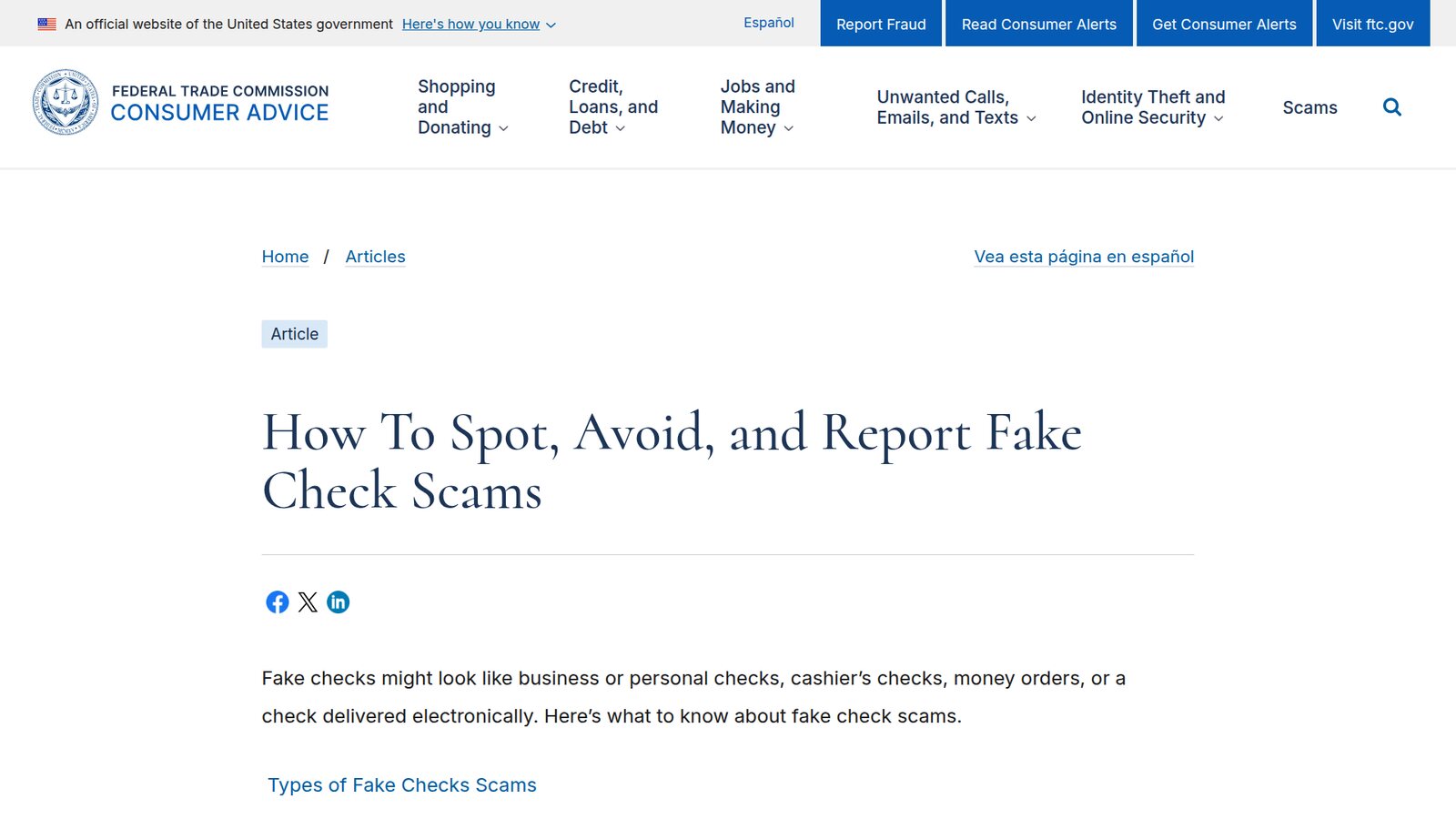
The FTC's fake check guide, as it appeared on 14 November 2026. Screenshot: consumer.ftc.gov
The FTC’s advice is short: “Don’t rely on money from a check unless you know and trust the person you’re dealing with.” And it’s specific about the payment methods that should set off alarms: “Never use money from a check to send gift cards, money orders, cryptocurrency, or to wire money to anyone who asks you to.”
The words that don’t belong in a voice brief
The opening move is harder to spot than the money move, because it keeps changing. Turkel says scammers now borrow the names of real companies, and even real employees, to look credible. “But because the scammers don’t actually work for the company, they’re forced to use a different email provider, often using GMail or Outlook addresses,” he writes. A big studio writing from a free webmail account is worth a second look.
Another newer habit is the “interview”. NAVA’s guide says the scammer may ask to connect “through messaging apps like Signal, Telegram, Skype, WhatsApp or Zoom.” Genuine clients do use video calls, so the app alone proves nothing. What should make you pause is a client who wants to move off email before there’s a script, a usage or a company name on the table.
Then there’s the language. Freelance voice work is booked job by job, so a brief that promises a salaried life is describing a job that doesn’t exist. Turkel lists the giveaways he has seen in scam messages, and he also points to a mismatch that makes no sense on any rate card: a short commercial, priced per finished hour.
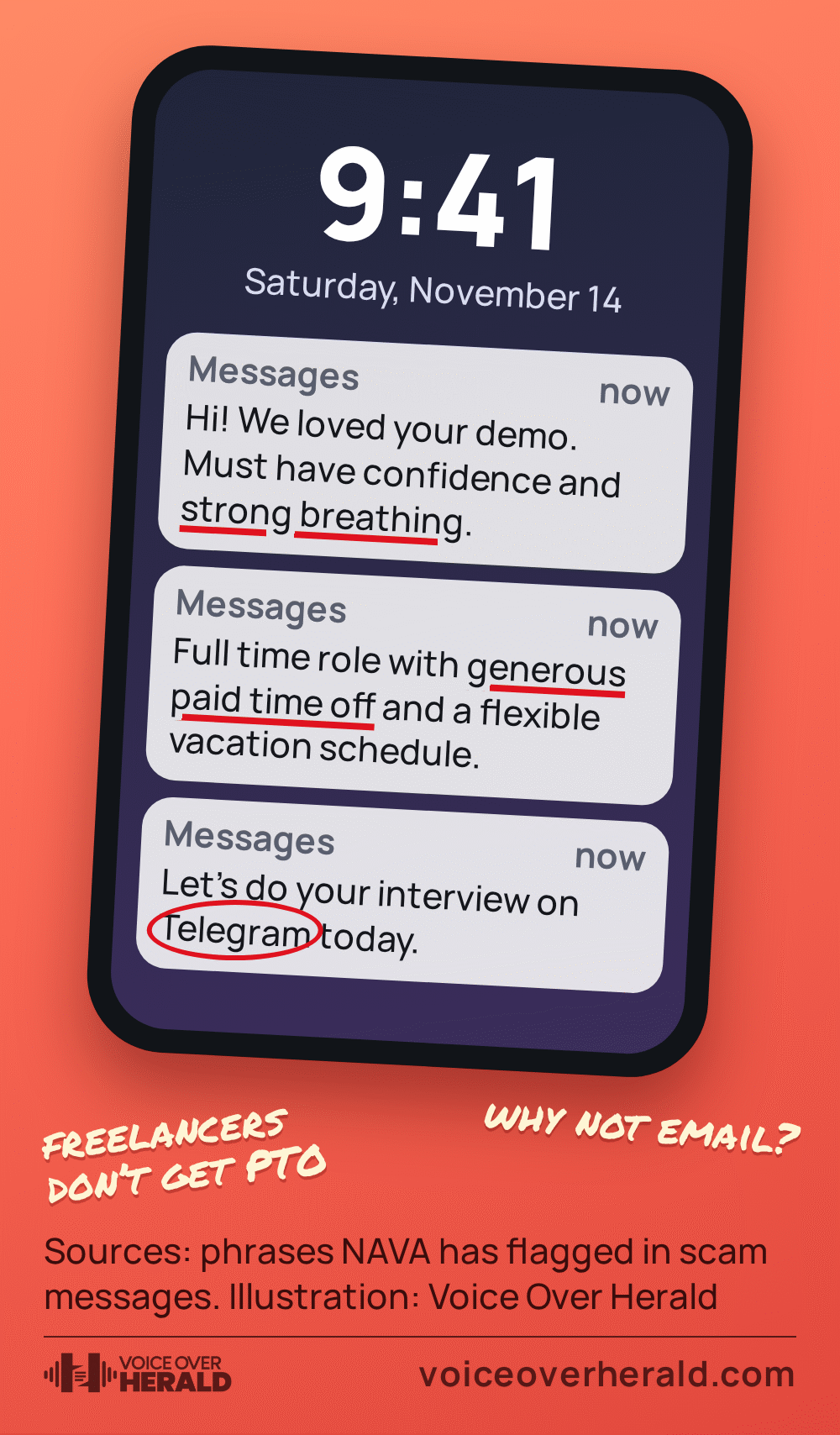
He’s careful about one popular warning sign, though. Lots of advice tells you to watch for broken English or the word “kindly”. “But it’s not uncommon to receive emails from potential clients who speak English as a second language, or even clients who genuinely use the word ‘kindly,'” he writes. Voice work is global, and some of your best clients will write the way they speak. Judge the request, not the grammar.
Paying to get paid
The second big family of scams skips the check and simply asks you for money: a registration fee, a “verification” charge before you can be paid, a paid class or a paid demo as the price of getting onto a roster. The FTC’s job scams page doesn’t hedge: “If someone asks you to pay to get a job, that’s a scam.”

 VoiceEditSuiteIt edits like you would, and it gets better every file.Every fix you make in the editor teaches Auto Clean Up more, so each file comes back sounding like you edited it yourself.See how it worksLearns from numbers, never your audio. Never used to train AI.
The same goes for representation. A scam guide credited to Kira Buckland and NAVA, and published on the website of voice actor and casting director Morgan Berry, puts it plainly: “If an agency is asking you for money, it’s a scam.” It explains that agencies earn a commission when their talent books work, and adds that “they shouldn’t charge you upfront.”
The casting world sees the same pattern. When the Casting Society warned in April 2025 about people posing as casting directors and asking actors for money, its president, Destiny Lilly, didn’t leave room for doubt. “If someone is asking for money, that’s fraud,” she said, in remarks reported by Deadline and BroadwayWorld.
These scams aren’t small. The FTC reported that losses to job scams more than tripled from 2020 to 2023 and, in the first half of 2024 alone, topped $220 million. Its rule for the fastest growing kind, where victims are told to pay before they can collect wages they’ve supposedly earned, applies just as well to a voice booking: “Never pay anyone to get paid.”
- Who are they? A company name, a website and an email address on that company’s own domain.
- What’s the job? A script, a length, a usage and a deadline, before anyone talks about payment.
- Does the money add up? One fee for one job. Never a check for more than you invoiced.
- Which way does money flow? Only towards you. Never a fee, a deposit or a forward.
- Can you check with someone? Search the company, ask peers, and look at NAVA’s list of reported scams.
When the audition is the product
Not every scam is after your bank account. Some are after your voice. Buckland’s guide warns about “overly vague auditions that ask for a large sampling of random phrases or sentences,” and says the goal may be “AI farming”, where “the scammer grabs a sizeable recording of an actor reading assorted copy in hopes of training text-to-speech algorithms using the actor’s voice without their knowledge or consent.”
It also flags recruitment posts that promise “great experience” and an “easy job” with the line “No prior training or experience necessary”, especially unscripted “conversation” sessions. You’re allowed to ask what you’re auditioning for. The guide says actors “have a right to ask questions as to what type of project you’re actually auditioning for and how the recordings would be used.”
The other risk is an audition that quietly becomes the finished spot. For castings you can’t verify, the guide suggests reading only part of the script, so there’s nothing complete to keep. It also lists a client who refuses to say how your voice will be used, or who won’t sign an AI rider like the one NAVA publishes, as a reason to slow down.
If a recording does end up somewhere it shouldn’t, the hard part is proving it was yours. That’s the problem The Voice Realm built Voice Lock to answer: once a voice actor switches it on, the demos on their profile carry a watermark nobody can hear, so a copied demo can be traced back to them with a dated certificate anyone can check online. The Voice Realm says it’s the world’s first voiceover marketplace to protect voice actors’ demos with an invisible watermark.
Before you reply
None of this means every unusual email is a con. Plenty of real clients are new to hiring voice actors, write in a hurry or don’t know the jargon, and Buckland’s guide says a single red flag “doesn’t automatically mean the project is a scam.” Ask questions. A real client answers them, sends a script and talks about the read. A scammer keeps steering the conversation back to the money.
If you’ve already deposited a check from a stranger, don’t spend it and don’t send any of it anywhere. Talk to your bank before you do anything else. And if you spot something new, NAVA keeps a running list of reported voiceover scams on its scam page, with a form for adding more, so the next person gets the warning sooner.
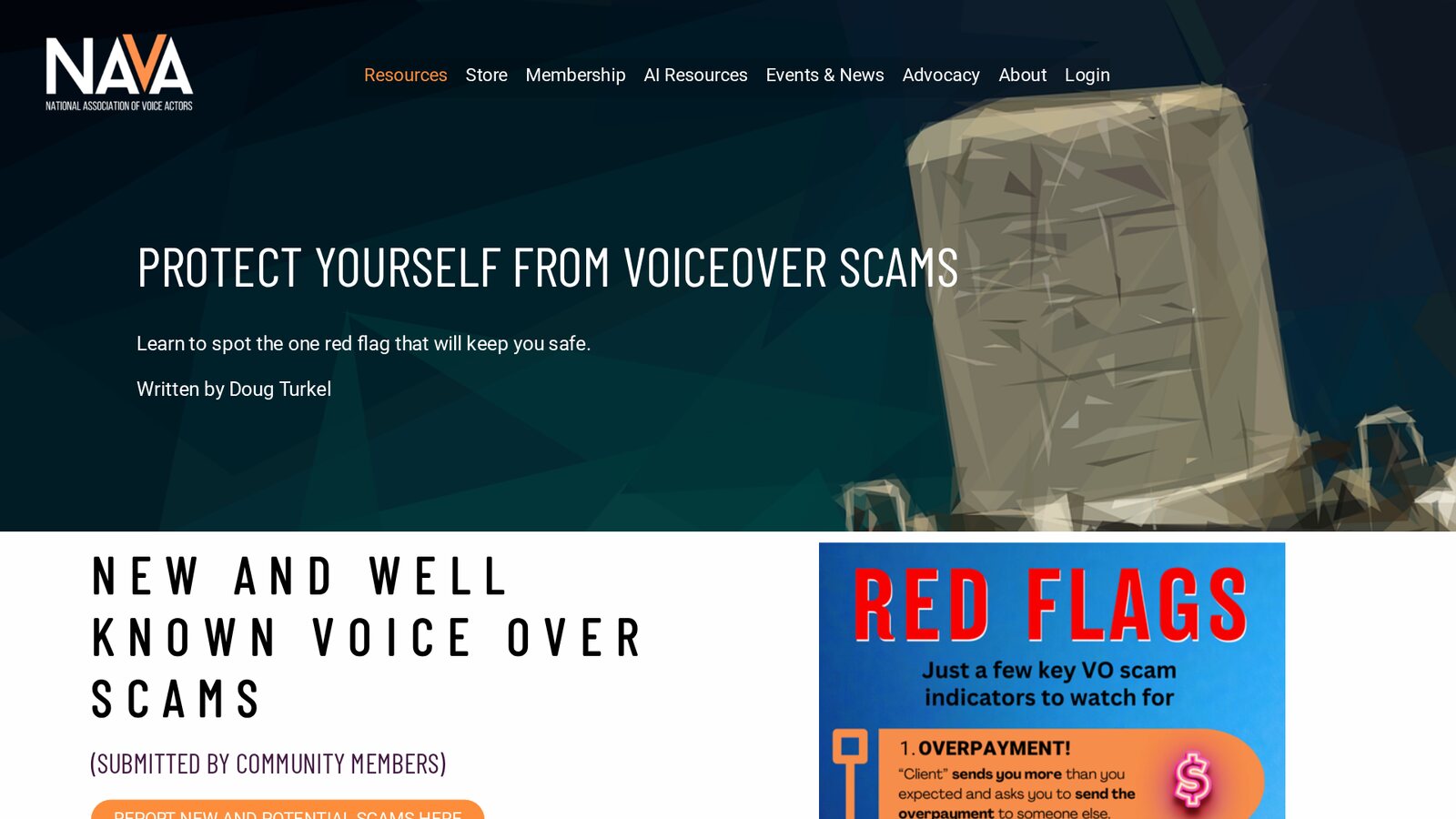
NAVA's scam guide and list of reported scams, as it appeared on 14 November 2026. Screenshot: navavoices.org
Turkel’s last word is the rule worth taping above the mic. After more than thirty years of bookings, he writes, “there has never been a situation in which I needed to send money to a client, or to anyone else, on behalf of a client. That’s just not how things work.”
Sources: Doug Turkel, “Protect Yourself from Voiceover Scams,” National Association of Voice Actors (NAVA), read 14 November 2026; Federal Trade Commission, “How To Spot, Avoid, and Report Fake Check Scams,” June 2025; Federal Trade Commission, “Job Scams,” March 2023; Federal Trade Commission, “Paying to get paid: gamified job scams drive record losses,” Data Spotlight, December 2024; “Voice Acting Job Scams & Red-Flags,” themorganberry.com (resource credited to Kira Buckland and NAVA), read 14 November 2026; Joshua Wright, “Casting Society Issues Warning About Fake Paid Audition Scams,” BroadwayWorld, 25 April 2025, citing Deadline. Screenshots: navavoices.org and consumer.ftc.gov, 14 November 2026.
Lee este artículo en español: Demasiado bueno para ser verdad: cómo detectar un trabajo de voz falso antes de que te cueste caro
Know something about this story, or spotted an error? Tell the newsroom.