
Listeners Took a Voice Clone for the Real Person 80% of the Time. Here’s What Detectors Listen For Instead
A science journalist cloned his own voice with a free tool and went looking for the tells. Researchers say most people can’t hear them: in a Berkeley study, listeners took a clone for the real speaker about 80% of the time. Here’s what detectors measure instead, and what that means for anyone whose voice is their living.
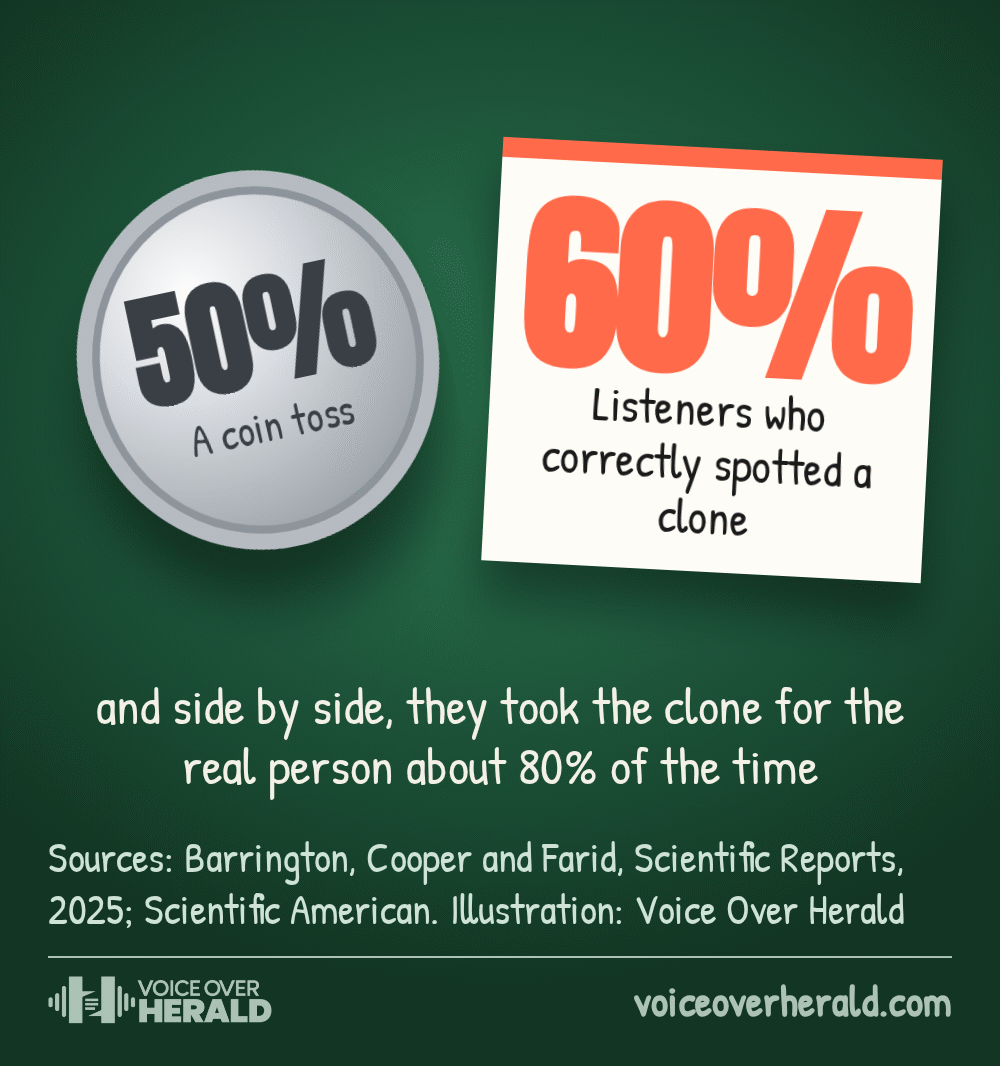
If you earn money with your voice, the most uncomfortable number in voice tech this week isn’t a price or a valuation. It’s 60. That’s roughly how often ordinary listeners correctly spotted an AI-generated voice in a study from the University of California, Berkeley, when a coin toss would get them 50.
The study is the backbone of a piece Scientific American published on Monday, in which science journalist and acoustic analyst Shafik Quoraishee cloned his own voice and then took both versions apart to find out what still gives a clone away. His answer is useful, a little alarming, and worth knowing before a clip you never recorded turns up with your name on it.
Three seconds and a couple of clicks
Quoraishee says that three years ago, cloning his voice took hours of recorded speech and a pile of specialist tools to make even one short line that sounded like him. Last week he did it with a free, open-source program, a few seconds of audio and a couple of clicks.
Sarah Barrington, a doctoral candidate at UC Berkeley who studies AI voice cloning, told him that’s normal now. At most, she said, a cloning service might ask users to confirm they have the right to copy a voice. “There are platforms online that will advertise as few as three seconds’ worth of someone’s voice to create a clone,” Barrington said. Voice cloning went, in her words, “kind of overnight, from quite technical to immediately consumer-accessible.” In her lectures she clones her own voice from a YouTube clip in about 90 seconds.
Scammers have noticed. Scientific American points to a Reuters report from September of someone posing as a lawyer who used a cloned voice to persuade a large Italian private bank to wire about €95 million abroad.
Your ears, and your client’s ears, aren’t the safety net
Barrington’s study, published in Scientific Reports with Emily A. Cooper and Hany Farid, played real and cloned voices of 220 speakers to more than 600 listeners. Asked to flag the fakes one at a time, listeners got it right about 60% of the time. Played a real voice and its clone side by side, they judged them to be the same person about 80% of the time.
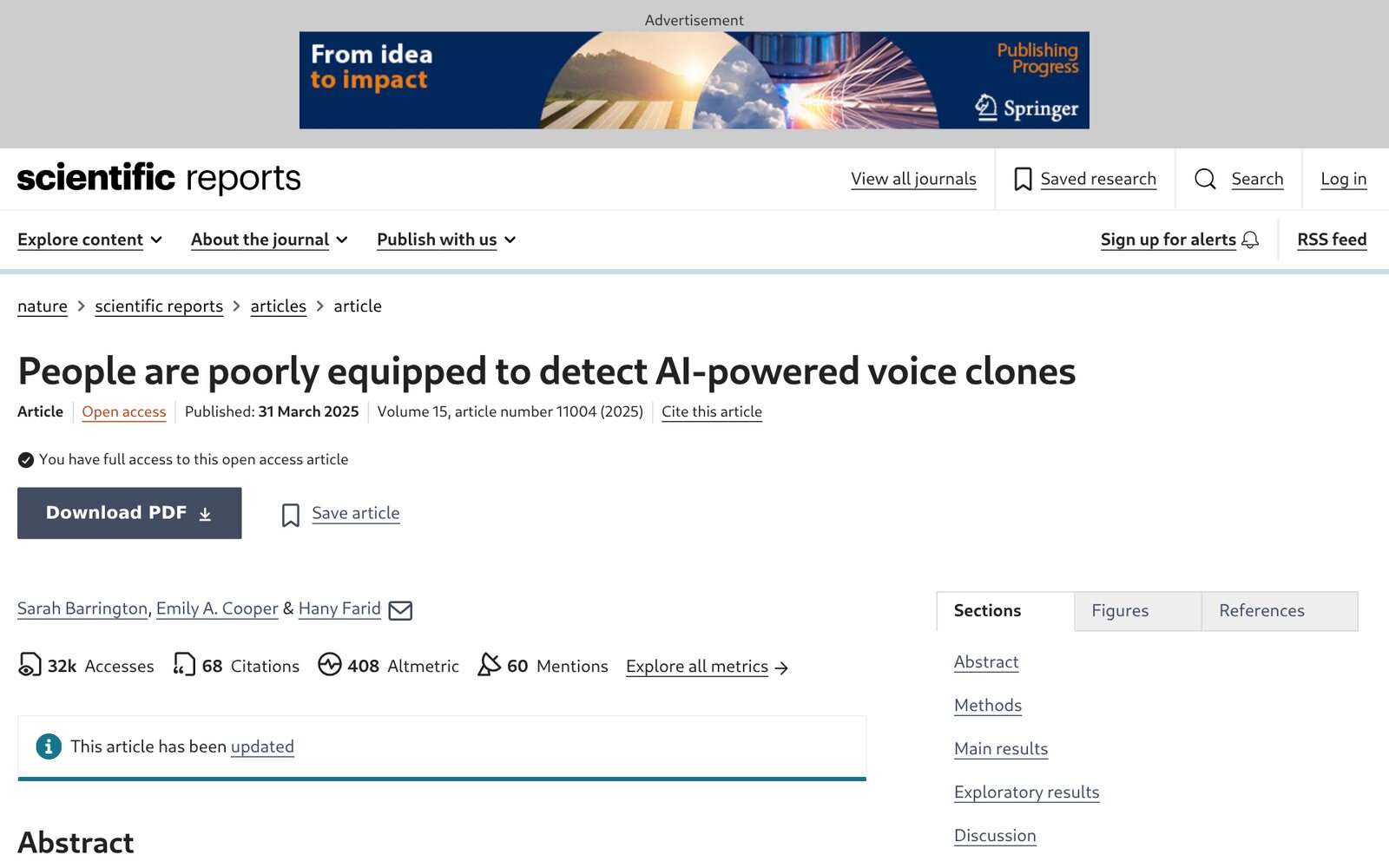
Screenshot: the study's page on Scientific Reports, 4 November 2026
“Only 60% of the time can humans tell something is fake. Bearing in mind that randomly guessing would be 50%, we are not much better than guessing,” Barrington said when Berkeley’s School of Information announced the results. “That’s how we know we’re pretty much through the uncanny valley.”
The old giveaways are gone too. Clones used to sound too polished, with none of the breaths, pauses and “ums” of real speech. Quoraishee writes that those are now added on purpose to hide the clone.
What the machines listen for
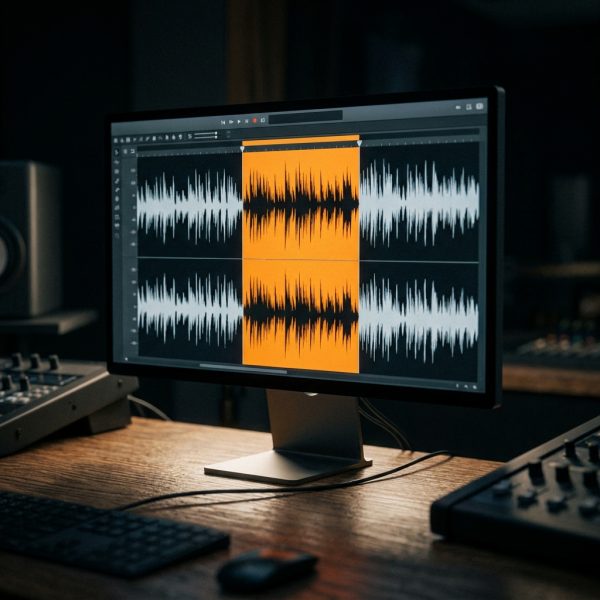
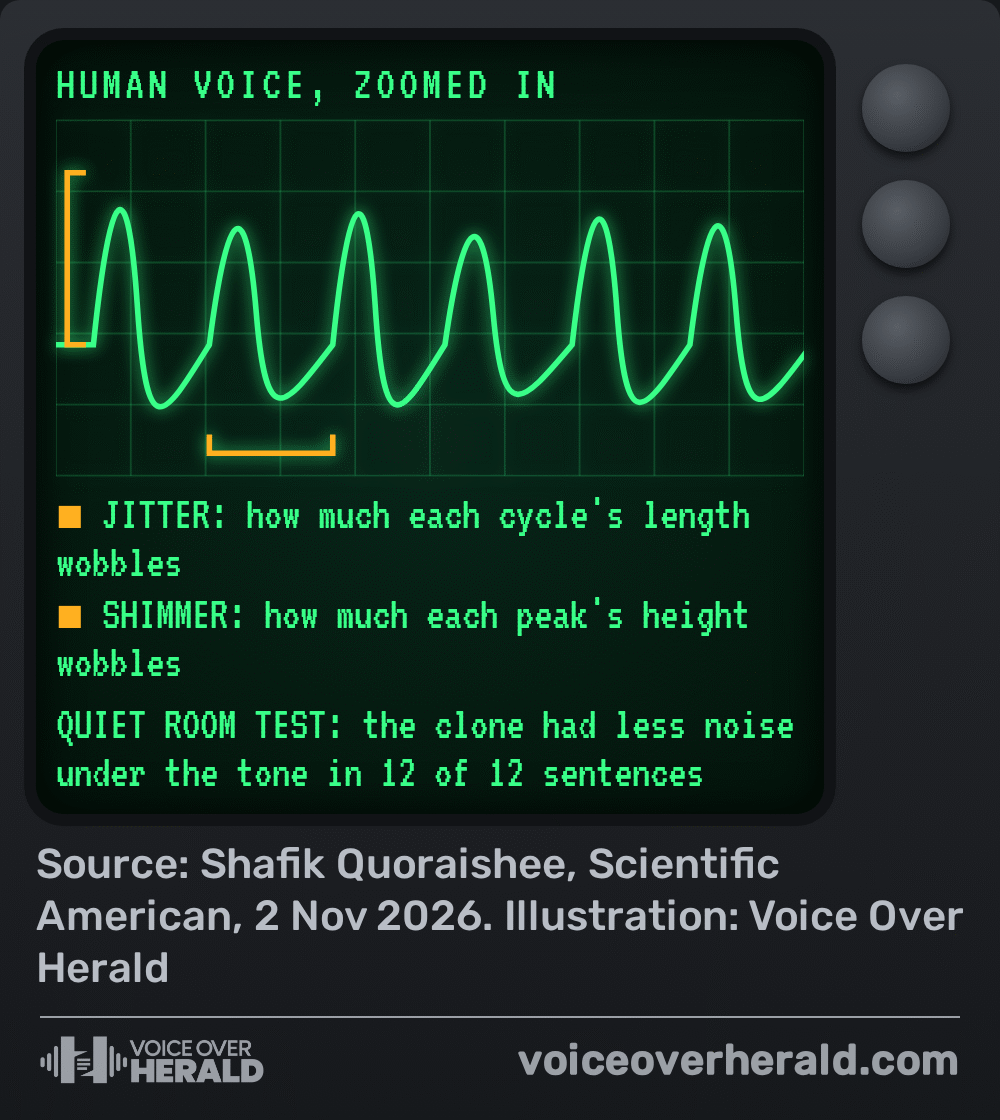
So researchers have stopped relying on ears and started measuring the sound wave itself. Zoom far enough into a recording of a human voice and you can see each vibration of the vocal folds as a repeating bump. Tiny variations in the length of those cycles are called jitter. Variations in the height of their peaks are called shimmer. A detection model weighs features like these, and many others, to decide whether a voice is real.
None of them works alone. Barrington told Scientific American that a detector tuned to spot one cloning company’s tools “often does not transfer well to other providers,” and that spectral analysis can reveal quirks of particular tools but no single measure catches them all. “You would expect to immediately see giveaways,” she said. “That is absolutely not the case.” A phone call makes it harder still, because it strips out much of the forensic detail.
 VoiceEditSuiteAuto Clean Up now learns you.Your breath, your pace and every fix you make, so each file comes back sounding like you edited it yourself.See how it worksLearns from numbers, never your audio. Never used to train AI.
Quoraishee’s own test is the part voice actors may want to read twice. He compared two dozen sentences he spoke with his clone’s versions of the same sentences. With a heater humming in the background, the clone’s jitter was statistically indistinguishable from his, though its shimmer was steadier. In a quiet room, the clone came out measurably cleaner, with less noise under the tone in all 12 sentences, even after a simulated phone call.
In other words, in his small test the clone gave itself away by being tidier than a real person in a quiet room. That’s a curious result for a profession that spends good money on treated booths. It doesn’t mean a clean recording looks fake. It does mean nobody should expect a single meter reading to settle whether a clip is you.
Watermarks: the locked door
The most promising answer, Scientific American says, may be built into the cloning tools themselves. Some companies that make AI audio, Google among them, hide an inaudible watermark in what they generate: tiny changes spread through the sound that a detector can read later, and that travel with the file wherever it’s shared.
Screenshot: Google DeepMind's SynthID page, 4 November 2026
They’re not foolproof. Someone can alter a recording enough to erase the mark, and on some open-source programs the watermark is optional. Barrington still likes them. Like a locked door, she said, a good watermark can “keep out 99 [percent] of the bad cases.” For the rest, detection will have to keep improving as fast as the cloning tools do.
- Don’t trust ears alone. Not yours, not your client’s. In the Berkeley study, side by side listening matched a clone to its real speaker about 80% of the time.
- Keep your originals. Dated raw takes and session files are the simplest way to show which recordings you actually made.
- Ask for the best copy. If a clip you didn’t record turns up, get the highest quality file you can before anyone tests it. Phone audio hides the detail detectors need.
- Ask about watermarks. If a client or platform generates voices from yours, ask whether the output carries a watermark that a detector can read.
Why it matters for working voice actors
The cases Voice Over Herald has covered this autumn keep landing on the same question: who can prove which voice is real. A podcaster’s long quiet show came back with new episodes in what reporters say was his cloned voice, and today a German dubbing actor is suing Netflix over AI training on his recordings. Barrington’s work suggests that in disputes like these, “it sounds like me” won’t carry much weight on its own, for a judge or anyone else.
The better news is that the tools are getting sharper, and the habits that help are cheap ones. A voice actor with an archive of dated originals, a habit of asking clients how generated audio is marked, and a rough idea of what jitter and shimmer are is already better placed than most when a stranger’s clip turns up.
Sources: Shafik Quoraishee, “How to tell if a voice recording is AI-generated,” Scientific American, 2 November 2026; Sarah Barrington, Emily A. Cooper and Hany Farid, “People are poorly equipped to detect AI-powered voice clones,” Scientific Reports, 31 March 2025; UC Berkeley School of Information news release, April 2025; Google DeepMind, SynthID.
Lee este artículo en español: Los oyentes confundieron un clon de voz con la persona real el 80% de las veces. Esto es lo que escuchan los detectores
Know something about this story, or spotted an error? Tell the newsroom.