
Traditional Demo Reel Advice Still Matters, But the Industry Has Changed
For decades, a voice demo has been considered one of the most important investments a voice actor can make. It serves as both a marketing tool and a first impression, often determining whether a producer, casting director, or client chooses to learn more or move on to the next submission. While technology has transformed almost every aspect of the voiceover industry, many of the core principles behind creating an effective demo have remained remarkably consistent.
Voice actors are still encouraged to invest in professional production, demonstrate authentic performances rather than exaggerated character choices, showcase their strongest material first, and regularly update their demos as their skills develop. These recommendations continue to appear in coaching sessions, workshops, and industry discussions because they have proven effective across many different areas of voiceover.
At the same time, the environment in which demo reels are being reviewed has changed considerably. Online casting platforms, talent marketplaces, agency websites, and social media have dramatically increased the number of voices available for almost every project. Producers who may once have listened to a relatively small group of submissions can now receive hundreds of auditions from talent located across multiple countries. As a result, many voice actors have begun asking whether the traditional advice surrounding demo reels still reflects how hiring decisions are made today.
The discussion has become increasingly common within the industry. Some professionals believe the fundamentals have not changed at all. From their perspective, a great performance supported by clean audio and thoughtful production will always stand out regardless of how the demo is delivered. Others argue that while quality remains essential, the modern casting environment has changed the way demos are consumed, creating new expectations around structure, pacing, and presentation.
Why the Conversation Has Changed
Neither viewpoint necessarily contradicts the other. Instead, they reflect different experiences within an industry that continues to evolve alongside technology, changing workflows, and shifting client expectations. The more interesting question may not be whether traditional advice has become outdated, but whether professional demo reels are now expected to achieve more in less time than ever before.
How Producers Listen to Demo Reels Today
One of the most significant changes affecting demo reels may have less to do with recording techniques and more to do with the practical realities of modern production. Producers, casting directors, and creative agencies are often balancing multiple responsibilities at once, from managing client communication and production schedules to reviewing auditions, coordinating revisions, and meeting increasingly tight deadlines. That environment naturally influences how demo reels are reviewed.
This does not necessarily mean decision-makers are giving demos less attention. Rather, many professionals have developed faster ways of identifying whether a voice is likely to suit a particular project before spending additional time listening more closely.
Why First Impressions Matter
An initial impression may be formed within the opening moments, followed by a more detailed review of shortlisted candidates who appear to fit the brief.
For voice actors, this creates an important consideration. If producers are often making early decisions about whether to continue listening, the opening section of a demo may carry even greater importance than it did in previous years. Rather than gradually building toward stronger material, many professionals now recommend beginning with the type of work a talent most wants to book, allowing listeners to quickly understand where that voice fits within the market.
That approach does not mean every demo should sound rushed or overloaded with rapid edits. In fact, many producers continue to value confident pacing, natural performances, and thoughtful production over reels that attempt to impress through constant changes or excessive variety. A polished, believable read that immediately demonstrates the talent’s strengths may leave a stronger impression than a highly edited montage that sacrifices authenticity for speed.
The way demos are consumed has therefore become part of the conversation. The recording itself remains important, but so does understanding the context in which it will be heard. A producer reviewing fifty demos during a busy afternoon may naturally approach the listening experience differently from someone evaluating a small number of carefully selected submissions for a major advertising campaign.
Why Changing Listening Habits Are Influencing Demo Strategies
The discussion surrounding professional voice demos is also influenced by broader changes in the way people consume digital content. Across many industries, audiences have become accustomed to making quick decisions about whether a video, article, podcast, or advertisement is worth their attention. While professional casting decisions involve far more consideration than casual social media browsing, changing digital habits have inevitably shaped expectations around presentation and accessibility.
Targeted Demos Are Becoming More Common
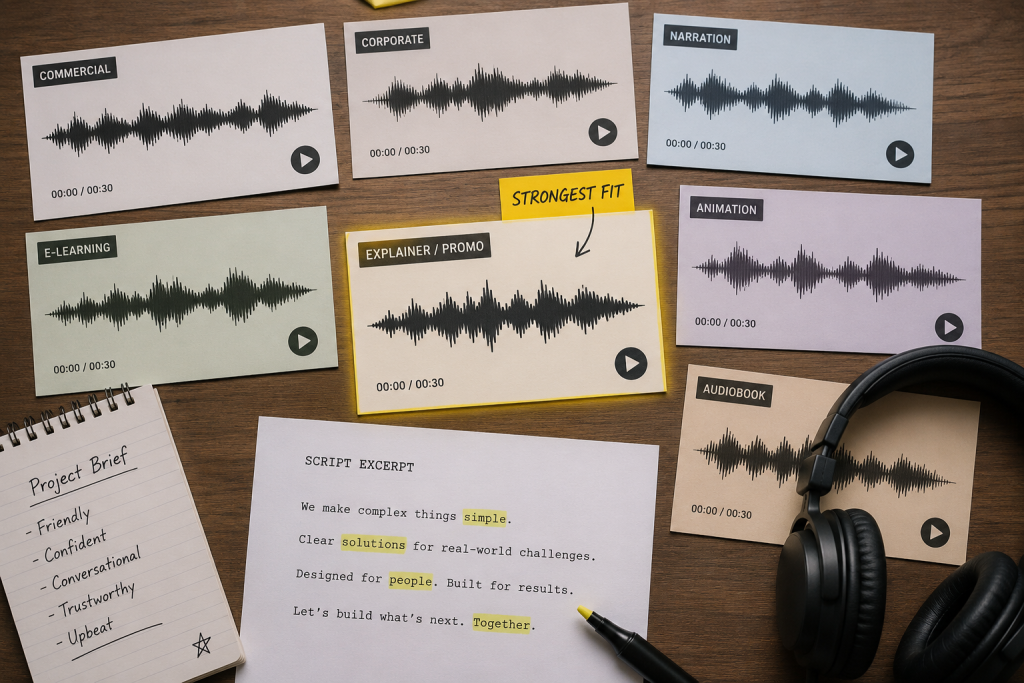
Many voice actors have responded by creating multiple targeted demo reels rather than relying on a single general showcase. Instead of presenting commercial, corporate, narration, e-learning, animation, promo, and audiobook work within one recording, talent increasingly organise their material into specialised demos that allow producers to hear exactly what is most relevant to their current project. This approach can reduce unnecessary listening while making it easier for clients to evaluate a voice within the context of the role they are casting.
Others have focused on refining the overall experience of their demos. Openings have become more immediate, editing has become cleaner, and unnecessary introductions have largely disappeared. Rather than attempting to demonstrate every possible vocal ability in one recording, many professionals now emphasise clarity and relevance, recognising that clients often appreciate hearing exactly what they need instead of searching through unrelated material.
Despite these evolving strategies, experienced producers frequently point out that no amount of clever editing can replace genuine performance ability. A well-produced demo may encourage someone to continue listening, but authentic acting, believable delivery, and strong storytelling remain the qualities that ultimately persuade clients to book talent. In many ways, modern demo reels represent a balance between timeless performance skills and an awareness of how today’s production environment operates.
The conversation is therefore less about abandoning traditional advice and more about adapting established principles to suit modern listening habits. Voice actors who understand both perspectives may be better positioned to create demo reels that respect proven industry standards while also recognising how producers and clients increasingly discover, review, and compare talent in a highly competitive digital marketplace.
What Still Makes a Voice Demo Stand Out
Although technology has changed how demo reels are distributed and reviewed, the qualities that make one memorable have remained surprisingly consistent. Producers are rarely looking for the most complicated edit or the widest range of voices packed into a single minute. More often, they are looking for confidence, authenticity, technical quality, and a performance that immediately feels appropriate for the type of project they are casting.
A demo should answer an important question as quickly as possible: “Can this person deliver the style of performance this project requires?” If the answer is clear, producers are more likely to continue listening and explore the voice actor’s broader portfolio. If the answer is unclear because the demo tries to showcase everything at once, even strong performances can become less effective.
Many experienced voice actors have also recognised that quality often outweighs quantity. Instead of creating one lengthy demonstration of every possible vocal style, they invest in multiple targeted demos designed for specific markets. A producer searching for a commercial voice may never need to hear audiobook narration or animation work, just as a game developer may not be interested in corporate narration. Providing focused demos helps clients make faster decisions while presenting the talent as someone who understands the needs of different markets.
Presentation outside the recording itself has also become more important. Demo titles, file names, website organisation, and how easily recordings can be accessed all contribute to the overall professional impression. While these details may seem secondary compared to performance, they form part of the complete experience a producer has when evaluating potential talent.
7 Things Producers Often Notice Within the First 20 Seconds
- Whether the recording sounds clean and professionally produced.
- How quickly the performance establishes the intended style.
- Whether the voice feels natural rather than overly performed.
- The relevance of the opening clip to the type of project being cast.
- Confidence, pacing, and vocal control.
- Audio quality, editing, and consistency.
- Whether they want to continue listening.
These observations are not universal rules, nor do all producers evaluate demos in exactly the same way. However, they illustrate why opening moments have become increasingly important in a competitive marketplace where decision-makers may review many submissions during a single casting session.
Should Voice Actors Update Their Voice Demo Strategy?
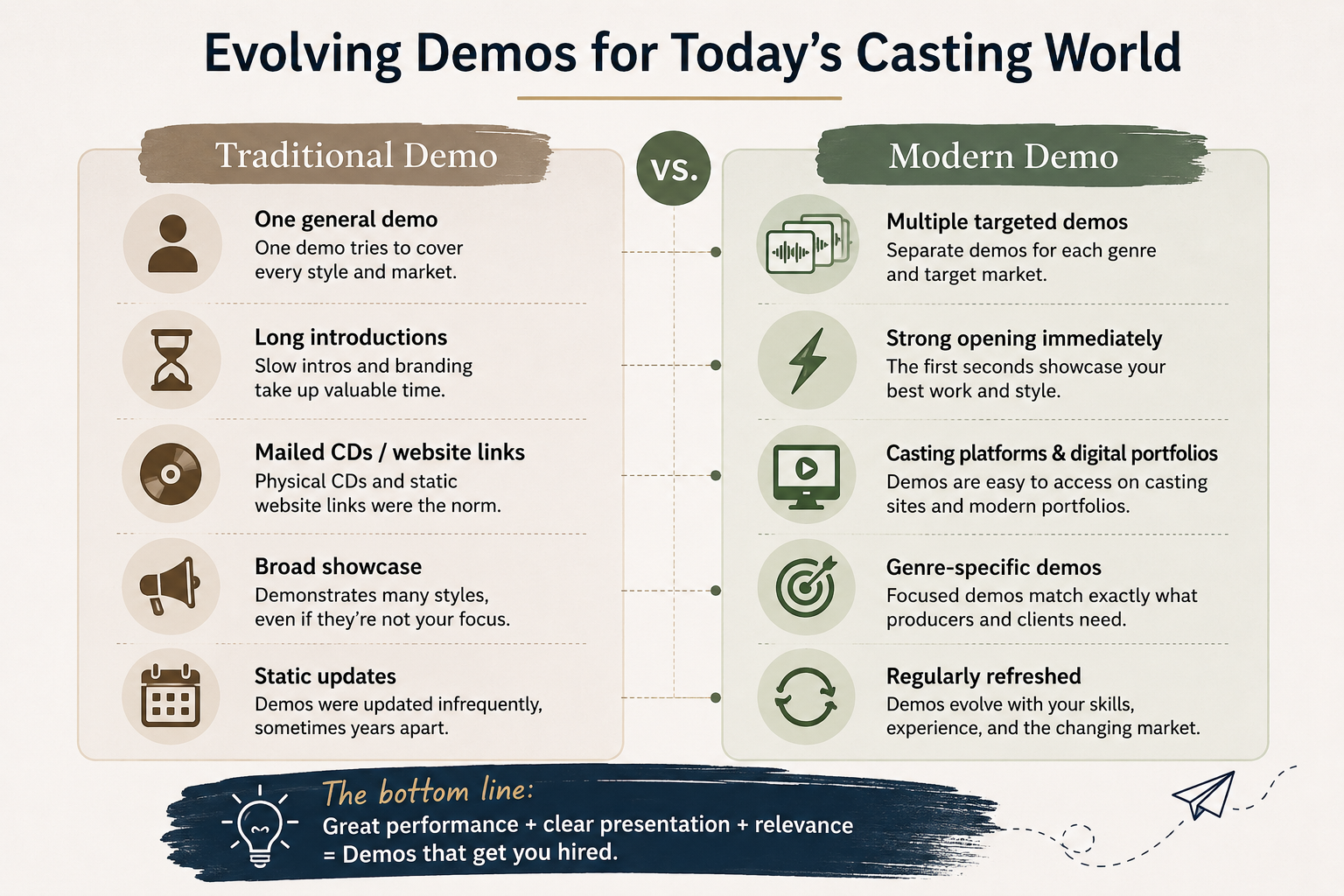
Perhaps the better question is not whether demo reels have changed, but whether voice actors should periodically reassess how effectively their demos represent the work they want to book today. A professional voice demo created several years ago may still contain excellent performances… while no longer reflecting current skills, newer specialisations, or the types of projects a talent is actively pursuing.
Regular evaluation does not necessarily mean producing a completely new demo every year. Instead, it encourages voice actors to review whether their existing material still supports their career goals. Have their strongest performances changed? Are they booking different genres than they were previously? Have client expectations shifted within their primary market? Questions like these can help determine whether updates are worthwhile.
A Demo Is Part of a Bigger Professional Brand
It is equally important to remember that no demo exists in isolation. Producers often view a demo alongside a professional profile, website, résumé, client testimonials, studio information, and previous work. Together, these elements create an overall impression of professionalism. Even an outstanding professional voice demo may be less effective if it is difficult to find, poorly organised, or presented without supporting information that helps clients make confident hiring decisions.
At the same time, voice actors should avoid feeling pressured to follow every emerging trend. New editing styles, changing preferences, and differing opinions will always exist within a creative industry. Not every recommendation will suit every market, and what works well for commercial advertising may not be appropriate for long-form narration, animation, or documentary work. Understanding the expectations of a particular audience remains more valuable than simply following the latest advice.
Looking Ahead
The definition of a professional voice demo has not been completely rewritten, but it has certainly evolved alongside the industry itself. The qualities that have always mattered, including authentic performances, strong production quality, and clear storytelling, continue to form the foundation of an effective demo. What has changed is the environment in which those demos compete for attention.
As producers review increasing numbers of submissions across a growing range of online platforms, presentation, organisation, and relevance have become more important than ever. Voice actors who combine timeless performance skills with an understanding of modern casting habits may be better positioned to make strong first impressions while remaining adaptable as the industry continues to change.
Rather than asking whether the traditional rules are obsolete, the more useful conversation may be whether those principles can be refined to better reflect today’s casting environment. For many professionals, the answer is likely to involve evolution rather than complete reinvention.
Join the Discussion
Do you think the definition of a professional voice demo has changed in recent years, or do the same qualities still matter regardless of how producers discover talent? Have online casting, digital workflows, and changing listening habits altered your approach to creating demo reels, or do you believe the fundamentals remain exactly the same? Share your thoughts in the comments and join the discussion.


