
Have Online Casting Platforms Changed the Voiceover Industry for Better or Worse?
The Debate Over Accessibility, Competition, and Opportunity Continues to Divide Industry Opinion
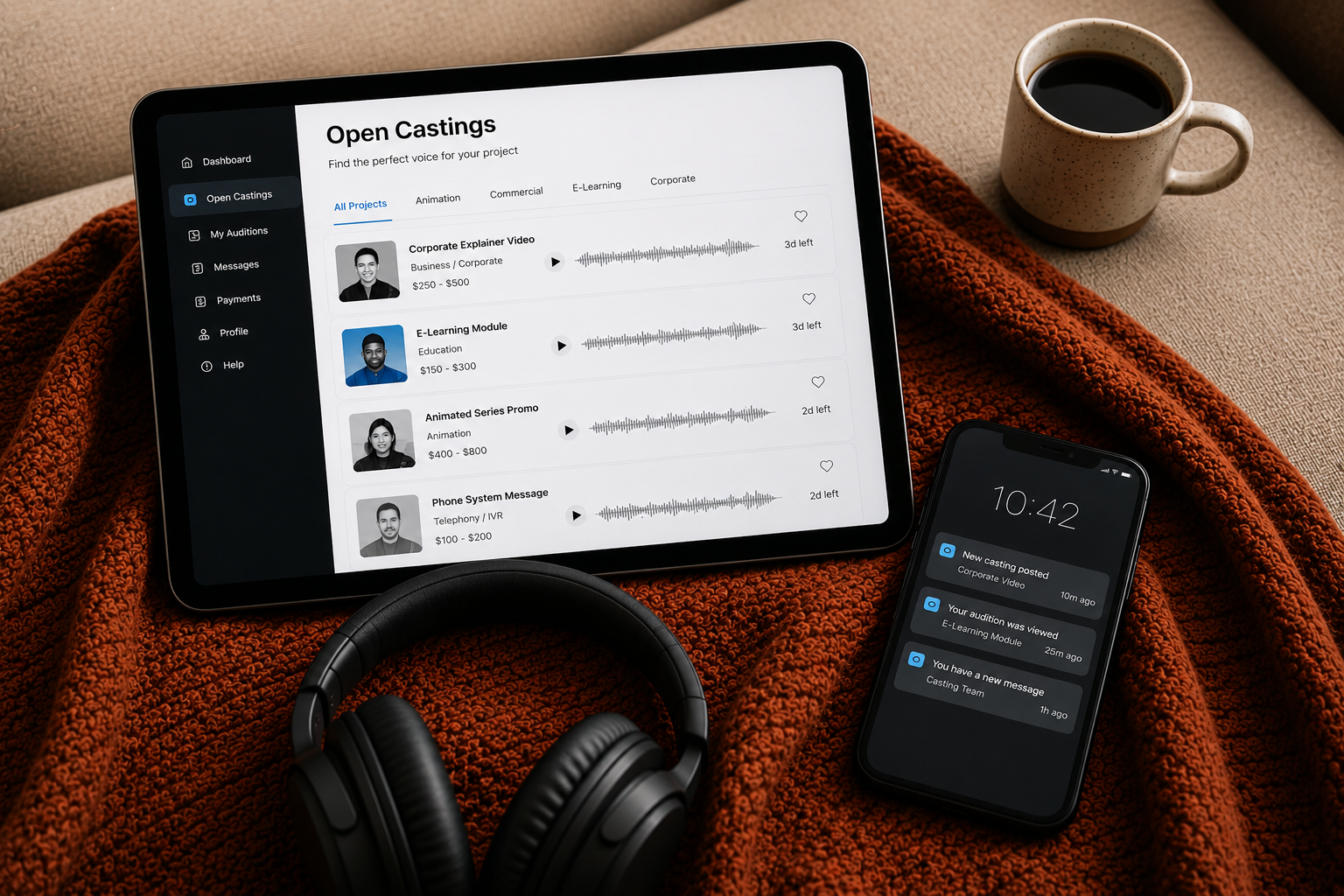
Few developments have transformed the voiceover industry as dramatically as the rise of online casting platforms. What was once a profession heavily dependent on agents, casting directors, production companies, and personal industry connections has become significantly more accessible to talent around the world. Today, a voice actor in a small town can audition for the same project as a performer working in Los Angeles, London, Sydney, or Toronto. The barriers that once limited access to opportunities have been lowered, creating a marketplace that is more connected, competitive, and global than ever before.
For many voice actors, this transformation has been overwhelmingly positive. Online casting platforms have opened doors that previously remained closed to newcomers and independent talent. Rather than relying entirely on representation or industry contacts, performers can create profiles, upload demos, audition for projects, and communicate directly with clients. This increased accessibility has allowed countless professionals to build careers that may never have been possible under the industry’s traditional structure.
At the same time, not everyone views these developments through a positive lens. Critics argue that the same platforms that created new opportunities have also introduced new challenges. Increased competition, discoverability issues, pricing pressure, and concerns about long-term sustainability frequently appear in industry discussions. While online casting has undoubtedly expanded access, some professionals question whether it has also made it harder for talent to establish themselves and maintain consistent earnings.
More than two decades after online casting began reshaping the industry, the debate remains far from settled. Supporters view these platforms as a democratizing force that has made voiceover work more accessible than ever before. Critics see a system that has increased competition while shifting more responsibility onto performers. Understanding both perspectives requires looking at how the industry operated before online casting became a dominant force and examining what has changed since.
How Voiceover Casting Worked Before Online Platforms
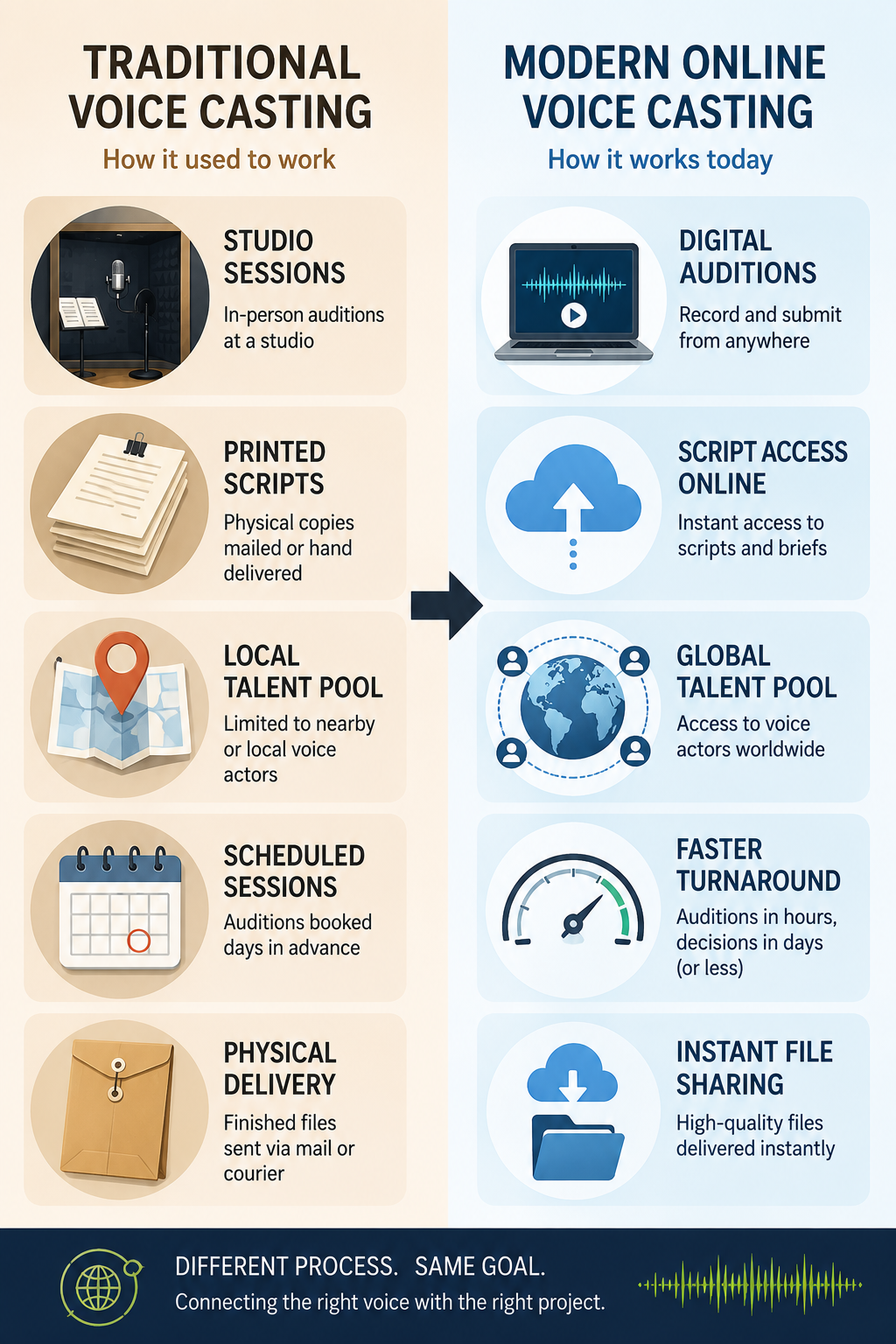
Before the widespread adoption of online casting, finding voiceover work often depended on relationships and proximity. Many opportunities were concentrated in major production hubs where talent could attend auditions in person, meet producers face-to-face, and build networks through industry connections. Representation by an agent was often considered one of the most effective ways to gain access to higher-profile opportunities, particularly in commercial, animation, and broadcast sectors.
This system offered certain advantages. Producers and casting directors frequently worked with talent they already knew or who had been recommended by trusted industry professionals. Performers who established strong reputations could benefit from repeat business and referrals, creating stable career pathways built on long-term relationships. Clients often relied on industry gatekeepers to narrow talent pools and identify suitable candidates, reducing the amount of time required to review auditions.
However, the traditional model also had limitations. Geographic location could significantly influence career opportunities, and breaking into the industry often required access to networks that were difficult for newcomers to penetrate. Talented performers living outside major production centers sometimes faced substantial barriers simply because they were not physically present where opportunities existed. For many aspiring voice actors, the path into professional work could feel uncertain and highly dependent on connections rather than accessibility.
The emergence of online casting platforms changed many of these dynamics, making it possible for clients to search for talent directly, listen to demos instantly, and receive auditions from performers located almost anywhere in the world.
The Argument That Online Casting Improved the Industry
Supporters of online casting platforms often point to accessibility as the most significant benefit. The ability to connect clients and talent regardless of geographic location has expanded opportunities for countless performers. A voice actor no longer needs to live near a major studio or production hub to compete for projects. Instead, talent can build professional home studios and audition remotely for work originating anywhere in the world.
This increased accessibility has also encouraged greater diversity within the industry. Clients can now search for voices that reflect specific languages, accents, cultural backgrounds, and performance styles without being limited to local talent pools. For performers, this creates opportunities to reach clients who may never have discovered them through traditional casting methods.
Many professionals also appreciate the level of control online platforms provide. Rather than waiting for opportunities to arrive through agents or referrals, talent can actively pursue projects that match their interests and skills. This direct access to opportunities has helped many voice actors build businesses on their own terms, particularly those working in niches such as corporate narration, e-learning, audiobooks, and explainer videos.
The rise of online casting has also accelerated the growth of remote production workflows. Clients and talent have become increasingly comfortable collaborating across cities, countries, and continents. What may have once required travel, studio bookings, and extensive scheduling can now often be completed through digital communication and remote recording technology. For many businesses, this flexibility has become an essential part of modern content production.
From this perspective, online casting platforms have made the voiceover industry more open, more efficient, and more accessible. They have expanded opportunities for talent while providing clients with unprecedented access to a diverse range of voices. Supporters argue that these benefits outweigh the challenges and have helped create a more inclusive marketplace.
7 Ways Online Casting Has Changed the Voiceover Industry
- Expanded opportunities for voice actors worldwide
- Greater competition across nearly every project
- Faster casting and hiring decisions
- More direct access to clients and producers
- Higher expectations for self-marketing and personal branding
- Increased demand for high-quality home recording
- Easier collaboration across countries and time zones
Why Some Voice Actors Believe the Industry Became More Difficult
Despite the opportunities created by online casting, many experienced professionals argue that accessibility has come with significant trade-offs. One of the most common concerns involves competition. When barriers to entry decrease, more people enter the market. While this creates opportunities for newcomers, it also means that individual projects often attract far larger numbers of auditions than they might have in previous decades.
For voice actors, increased competition can create discoverability challenges. Even highly skilled performers may find it difficult to stand out when clients have access to hundreds of submissions. A strong demo and professional recording quality remain important, but they are no longer enough on their own. Marketing, branding, relationship-building, and business development have become increasingly important components of career success.
Pricing pressure is another frequently discussed issue. Because online platforms connect clients with talent from across the globe, performers often find themselves competing within a marketplace that includes a wide range of budgets and expectations. Some professionals believe this has contributed to downward pressure on rates in certain sectors of the industry, particularly where clients prioritize affordability over experience or specialization.
These concerns do not necessarily mean that online casting has been harmful overall. Rather, they highlight the complexity of the issue. A system that increases opportunity can also increase competition. A platform that expands access can simultaneously make visibility more difficult. Understanding whether online casting has improved or weakened the industry depends largely on which outcomes a person considers most important.
What Clients and Producers Value Most
While voice actors often debate the impact of online casting platforms from the talent perspective, clients and producers tend to focus on a different set of priorities. Their primary objective is usually straightforward: finding the right voice for a project as efficiently as possible. Online casting platforms have dramatically simplified that process by providing immediate access to large pools of talent, searchable demos, and rapid audition turnaround times.
For many clients, this convenience represents one of the most significant advantages of modern casting platforms. Rather than contacting multiple agencies or relying on a limited network of recommendations, producers can review dozens of suitable candidates within a relatively short period. This expanded access can be particularly valuable for projects requiring specific accents, languages, vocal styles, or niche expertise.
However, convenience also introduces new challenges. Some producers have noted that reviewing large numbers of auditions can become overwhelming, particularly when many submissions sound similar or fail to address the project’s specific requirements. As a result, some clients increasingly prioritize factors such as responsiveness, professionalism, communication skills, and the ability to follow instructions. In a crowded marketplace, these qualities can become important differentiators.
This shift has led some industry observers to suggest that online casting platforms may have changed what clients value in voice actors. While performance quality remains essential, clients may also place greater emphasis on efficiency, reliability, and ease of collaboration than they did in the past. A talented performer who consistently communicates well and delivers projects on schedule may have a significant advantage over someone who relies solely on vocal ability.
Have Online Platforms Changed What Clients Value?
This question sits at the heart of the debate. Some voice actors argue that online casting has fundamentally altered client behavior by creating an environment where speed and convenience often receive greater attention than long-term relationships. Because clients have immediate access to large numbers of performers, they may feel less dependent on established connections and more inclined to evaluate talent based on immediate project needs.
Others believe the core qualities clients value have remained largely unchanged. In this view, producers still seek professional, dependable talent who can deliver strong performances and contribute positively to the production process. Online casting may have changed how clients find voice actors, but it has not necessarily changed what they ultimately want from them.
There is evidence supporting both perspectives. Many clients appreciate the flexibility and efficiency online platforms provide, yet repeat business continues to play an important role throughout the industry. Numerous successful voice actors report that long-term client relationships remain one of the most reliable sources of income, suggesting that trust and consistency still matter significantly despite the growth of digital marketplaces.
Perhaps the most accurate conclusion is that online casting has expanded the list of qualities clients evaluate rather than replacing existing priorities. Vocal performance remains important, but factors such as communication, turnaround times, professionalism, and ease of collaboration may carry greater weight than they did when opportunities were filtered through more traditional channels.
Have Voice Actors Adapted to the New Reality?
The growth of online casting has required many professionals to rethink how they approach their careers. In a marketplace where competition is often just a few clicks away, voice actors increasingly need to differentiate themselves through more than vocal ability alone. Marketing, branding, customer service, and business development have become essential components of long-term success.
This shift has led some professionals to view voice acting less as a purely creative profession and more as a business. While performance remains central, many successful talent spend significant time maintaining websites, updating demos, communicating with clients, building networks, and managing their personal brands. These activities may not be the aspects of voice acting that attract people to the profession, but they often play a critical role in securing consistent work.
At the same time, many performers have embraced the opportunities created by online casting. The ability to work with clients around the world, build independent businesses, and access opportunities that were previously unavailable has allowed countless voice actors to create careers on their own terms. For these professionals, the benefits of accessibility outweigh the challenges associated with increased competition.
The industry’s evolution has not affected everyone equally, which helps explain why opinions remain so divided. A performer who built a successful career through online platforms may view them very differently than someone who experienced greater success under traditional casting models. Both perspectives are valid, and both reflect genuine experiences within a rapidly changing profession.
Looking Ahead
Online casting platforms are unlikely to disappear. If anything, their influence is expected to continue growing as remote production workflows become increasingly common and clients seek efficient ways to connect with talent. Future developments may include improved search capabilities, enhanced matching algorithms, greater use of data-driven recommendations, and new tools designed to streamline the hiring process.
At the same time, many of the industry’s longstanding challenges will remain. Competition, discoverability, pricing pressure, and relationship-building are unlikely to disappear simply because technology evolves. The most successful professionals will likely be those who adapt to changing platforms while continuing to develop the skills that clients have valued for decades.
The debate over whether online casting has improved or weakened the industry may never produce a definitive answer because the impact has not been universally positive or negative. These platforms have created opportunities for many performers while introducing new challenges for others. They have increased accessibility while intensifying competition. They have expanded client choice while making visibility more difficult for individual talent.
Ultimately, the question may not be whether online casting platforms changed the voiceover industry for better or worse. The more interesting question is whether the industry has fully adapted to the opportunities and challenges these platforms created. The answer depends on who you ask, which is precisely why the discussion remains relevant today.
Join the Discussion
Have online casting platforms improved the voiceover industry, or have they created more challenges than opportunities? Have they helped you build your career, or do you believe they have made it harder for talent to stand out and maintain sustainable rates? Share your thoughts in the comments and join the conversation.