

Are Producers and Voice Actors Defining “Professionalism” Differently?
The Word Everyone Uses, but Few Define the Same Way
Professionalism is one of the most frequently discussed concepts in the voiceover industry. Producers want professional talent. Clients expect professional service. Voice actors strive to present themselves as professionals. Despite how often the word appears in industry conversations, however, there is surprisingly little agreement about what professionalism actually means in practice.
Ask a group of voice actors to define professionalism, and many will point to performance quality, technical standards, studio setup, training, preparation, and industry knowledge. These are all reasonable answers. After all, delivering high-quality work consistently requires skill, discipline, and experience. A professional voice actor is expected to understand scripts, interpret direction effectively, maintain reliable recording equipment, and produce audio that meets industry standards.
Ask a producer the same question, however, and the answer may look somewhat different. While performance quality remains important, many producers also emphasize communication, reliability, responsiveness, flexibility, and the ability to solve problems quickly. A voice actor who responds promptly, meets deadlines, and handles revisions professionally may leave a stronger overall impression than someone who possesses exceptional vocal skills but creates unnecessary complications throughout the production process.
Neither perspective is wrong. In fact, both highlight important aspects of professional behavior. The challenge is that voice actors and producers sometimes prioritize different qualities when evaluating what professionalism looks like. These differences in perspective can occasionally lead to misunderstandings, particularly when talented performers struggle to understand why they are not receiving repeat business or why clients continue working with talent whose vocal abilities may not necessarily stand out from the competition.
As the voiceover industry becomes increasingly competitive, understanding how different professionals define success may be more important than ever. While technology, marketing, and industry trends often dominate discussions about career growth, professionalism remains one of the few qualities that influences nearly every interaction between talent and clients. The question is whether everyone is using the same definition.
What Voice Actors Often Mean When They Talk About Professionalism
For many voice actors, professionalism begins with the work itself. Years of coaching, practice, and experience are often required to develop the skills necessary to perform at a professional level. Talent invest in training because they understand that clients expect more than simply reading words from a page. Effective voice acting requires interpretation, emotional awareness, storytelling ability, and the technical control needed to deliver consistent performances across a wide range of projects.
Professionalism is also closely tied to preparation. Voice actors are expected to understand scripts, research unfamiliar terminology, clarify client expectations, and approach each project with a level of care that reflects the importance of the work. Many professionals view preparation as a sign of respect for both the client and the project itself. Showing up unprepared, submitting careless auditions, or failing to understand a project’s objectives can quickly undermine credibility regardless of vocal talent.
Technical Standards and Preparation
Technical standards represent another major component of professionalism from the talent perspective. Over the past decade, the growth of home studios has increased expectations regarding audio quality and production capabilities. Voice actors frequently invest substantial amounts of time and money into equipment, acoustic treatment, software, and workflow improvements designed to deliver broadcast-quality recordings. For many professionals, maintaining these standards is viewed as a fundamental responsibility rather than an optional advantage.
There is also a strong emphasis on continuous improvement. Many successful voice actors regularly participate in coaching sessions, workshops, industry events, and professional development opportunities. They study market trends, refine their skills, and seek feedback from trusted mentors. From this perspective, professionalism is not simply a destination but an ongoing commitment to growth and excellence.
These qualities undoubtedly matter. Clients hire voice actors because they need skilled performers capable of bringing scripts to life. Without talent, technical competence, and preparation, the rest of the production process becomes significantly more difficult. Yet while most producers appreciate these qualities, they are often only part of a much larger picture.
What Producers Often Mean When They Talk About Professionalism
While voice actors frequently focus on performance and technical excellence, producers often view professionalism through the lens of project management. Their primary responsibility is usually not to evaluate talent in isolation but to ensure that projects move forward efficiently and successfully. As a result, qualities such as communication, reliability, and responsiveness often carry substantial weight.
From a producer’s perspective, professionalism may begin with something as simple as replying to emails promptly. Delayed responses can create uncertainty, particularly when deadlines are tight and multiple stakeholders are involved. A talented voice actor who takes several days to answer basic questions may inadvertently create additional stress for clients managing complex production schedules.
Professionalism: Two Perspectives
| Producers Often Prioritize | Voice Actors Often Prioritize |
|---|---|
| Reliability | Performance quality |
| Clear communication | Acting ability |
| Meeting deadlines | Ongoing training |
| Flexibility | Technical quality |
| Problem solving | Studio standards |
| Easy collaboration | Creative interpretation |
| Consistency | Continuous improvement |
Reliability is another factor that frequently appears in discussions about professional talent. Producers need confidence that deadlines will be met, files will arrive as expected, and revisions will be handled without unnecessary complications. Trust becomes increasingly valuable over time because it reduces risk. When producers know they can depend on a particular voice actor, future hiring decisions often become much easier.
Communication and Collaboration
Communication also plays a significant role. Projects rarely unfold exactly as planned. Scripts change, deadlines shift, client expectations evolve, and unexpected challenges emerge throughout the production process. Voice actors who communicate clearly, ask thoughtful questions, and adapt to changing circumstances are often viewed as valuable collaborators rather than simply service providers.
This collaborative mindset can influence long-term relationships in ways that are not always visible from the outside. A producer may remember a voice actor not only because of a strong performance but because they helped solve a problem, accommodated a last-minute request, or handled a difficult situation professionally. These experiences often shape future hiring decisions just as much as vocal ability.
The result is an interesting dynamic. Voice actors may view professionalism primarily through the lens of performance quality and technical standards, while producers may place equal importance on reliability, communication, and ease of collaboration. Both perspectives are valid, yet the difference between them helps explain why professionalism can sometimes feel like a moving target within the industry.
Why Misunderstandings Happen
Misunderstandings about professionalism often occur because voice actors and producers enter the working relationship from different positions. A voice actor may spend years refining performance skills, upgrading a studio, and learning how to interpret scripts more effectively. A producer, on the other hand, may be managing deadlines, client approvals, budget limitations, revision requests, and communication between multiple people involved in the project. Both sides care about quality, but they may experience the production process very differently.
For a voice actor, the most visible measure of professionalism may be the final recording. If the performance is strong and the audio is clean, the talent may reasonably feel they have delivered professional work. For a producer, however, the experience surrounding that delivery can matter just as much. If the process included delayed communication, unclear file naming, missed instructions, or difficulty handling revisions, the project may feel less professional even if the final read itself is usable.
This difference in perspective can create frustration on both sides. Voice actors may feel that clients undervalue performance quality or fail to appreciate the skill involved in delivering a strong read. Producers may feel that some talent underestimate the importance of communication, organization, and workflow. The gap between these perspectives is not usually caused by bad intentions. More often, it reflects the fact that different roles within the industry measure success in different ways.
Understanding this gap can help explain why some voice actors receive repeat bookings while others struggle to convert strong auditions into long-term relationships. A producer’s decision to hire someone again may be based not only on the quality of the previous performance, but also on how smooth the entire process felt from start to finish.
Can Great Talent Overcome Poor Communication?
One of the most debated questions in any creative industry is whether exceptional talent can compensate for difficult working habits. In voiceover, the answer often depends on the type of project, the client’s priorities, and the level of creative uniqueness a performer brings to the table. For highly specialized character work, distinctive narration, or projects requiring a very specific vocal quality, some producers may tolerate more friction if the performance is difficult to replace.
In many commercial, corporate, e-learning, and narration projects, however, the balance may be different. If several voice actors can deliver a strong read, the producer may choose the person who is easiest to work with. This does not mean performance quality is unimportant. It means that performance quality is often evaluated alongside reliability, responsiveness, and the likelihood that the project will move forward without unnecessary complications.
This reality can be difficult for some talent to accept because voice acting is, at its core, a performance profession. It is natural for performers to focus heavily on craft. Yet in a client-service environment, the work does not end when the recording is finished. The way a talent communicates, handles feedback, manages revisions, and supports the overall production process can influence whether a client chooses to return.
Finding the Right Balance
There will always be situations where exceptional talent outweighs logistical inconvenience. Some projects require a voice or performance style that only a small number of people can provide. However, for much of the day-to-day work that sustains the industry, professionalism is measured through a combination of creative ability and dependable collaboration.
Is Reliability Becoming More Valuable?
As production timelines become shorter and more projects are managed remotely, reliability may be becoming even more valuable than it was in the past. Clients often work under tight deadlines, and producers may be coordinating voice talent, editors, designers, writers, and stakeholders at the same time. In that environment, uncertainty becomes costly.
A reliable voice actor helps reduce that uncertainty. When producers know that a talent will respond quickly, follow instructions, deliver clean files, and handle revisions professionally, they can plan with greater confidence. That confidence can become a major factor in repeat hiring decisions, especially when projects involve tight schedules or demanding clients.
Remote production has also made communication more important. In a studio setting, producers and directors can often resolve questions instantly during a live session. When work is completed remotely, instructions must be clearer, files must be organized properly, and both sides must communicate effectively without the benefit of being in the same room. This has made workflow professionalism a larger part of the overall client experience.
For voice actors, this shift creates both a challenge and an opportunity. The challenge is that talent are now expected to manage more of the production process independently. The opportunity is that those who handle communication and delivery exceptionally well can stand out in ways that go beyond vocal performance.
Where Producers and Voice Actors Actually Agree
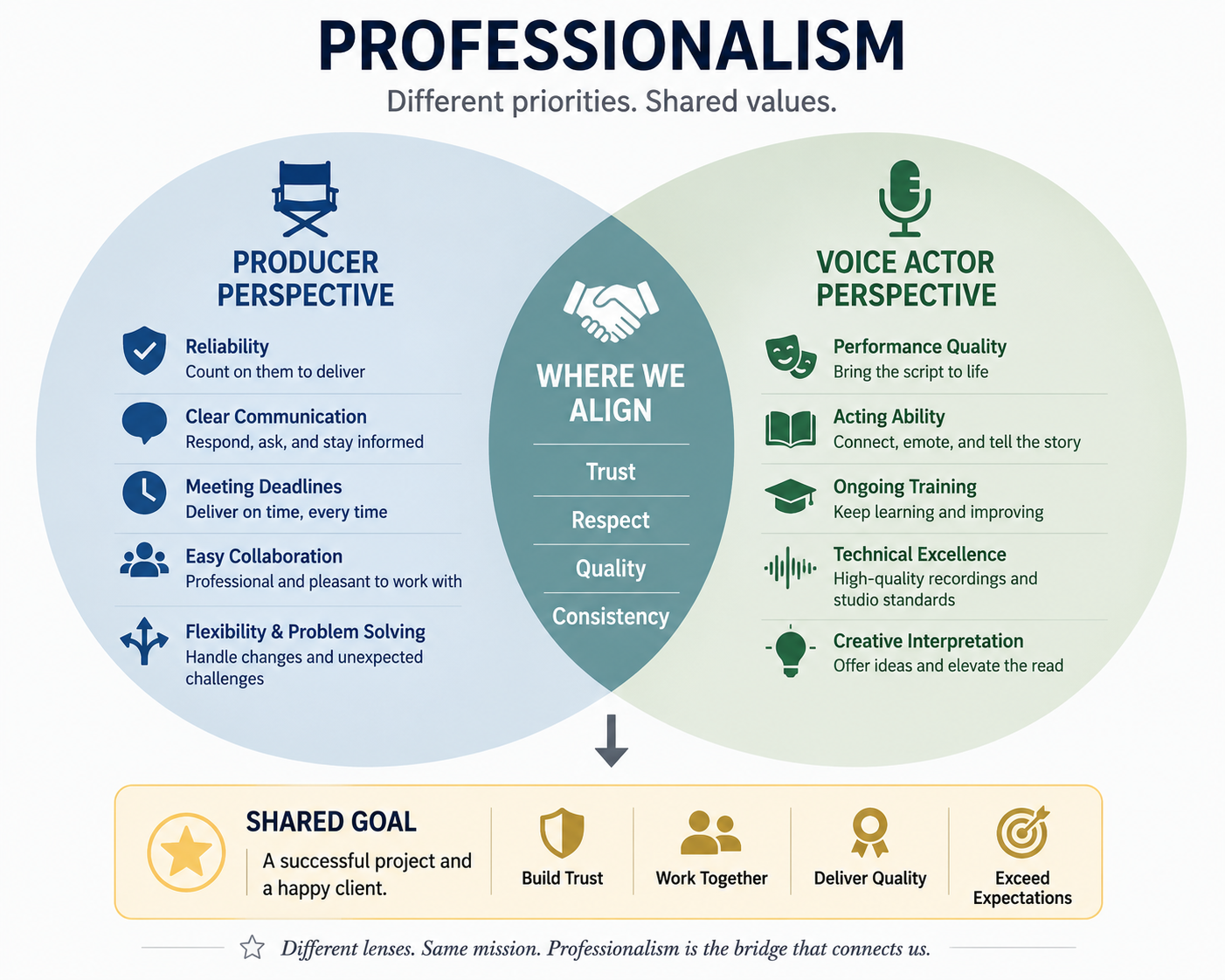
Although producers and voice actors may emphasize different aspects of professionalism, there is more overlap than the debate sometimes suggests. Both sides want projects to succeed. Each group values quality. They also benefit when expectations are clear, communication is respectful, and the final result meets the project’s goals.
Voice actors are right to emphasize training, performance ability, studio quality, and preparation. Without those elements, professional voiceover work cannot succeed. Producers are also right to emphasize responsiveness, reliability, adaptability, and ease of collaboration. Without those qualities, even a strong performance can become difficult to manage within a larger production workflow.
The most successful professional relationships are often built when both perspectives are recognized. Talent who understand the producer’s pressures can communicate more effectively and anticipate potential concerns. Producers who understand the creative process can give clearer direction and create conditions that help talent deliver stronger performances.
In that sense, professionalism may not be a single fixed quality. It may be a combination of craft, communication, judgment, preparation, and collaboration. The voice actors who understand this broader definition may be better positioned to build sustainable careers in a competitive industry.
Looking Ahead
As the voiceover industry continues to evolve, the definition of professionalism is likely to become even more important. Online casting, remote recording, faster turnaround expectations, and increased global competition have changed how clients and talent interact. In this environment, being talented is essential, but it may not be enough on its own.
For voice actors, this does not mean performance should receive less attention. Craft remains the foundation of the profession. However, the client experience surrounding that craft has become a larger part of how professionalism is judged. Talent who can combine strong performances with clear communication, reliable delivery, and thoughtful collaboration may have a meaningful advantage.
For producers, the challenge is to recognize the full range of skills that professional voice actors bring to a project. Creative interpretation, emotional nuance, and performance experience are not interchangeable commodities. While efficiency matters, the quality of the final result often depends on respecting the craft as well as the workflow.
The debate is not really about whether producers or voice actors are correct. Both groups are describing different parts of the same professional relationship. The more useful question is whether the industry has become better at recognizing how those expectations overlap, and where they sometimes conflict.
Join the Discussion
When you hear the word professionalism in voiceover, what matters most to you? Is it performance quality, studio standards, communication, reliability, responsiveness, or the ability to take direction? Do producers and voice actors define the word differently, or are they simply emphasizing different parts of the same expectation? Share your thoughts in the comments and join the discussion.