
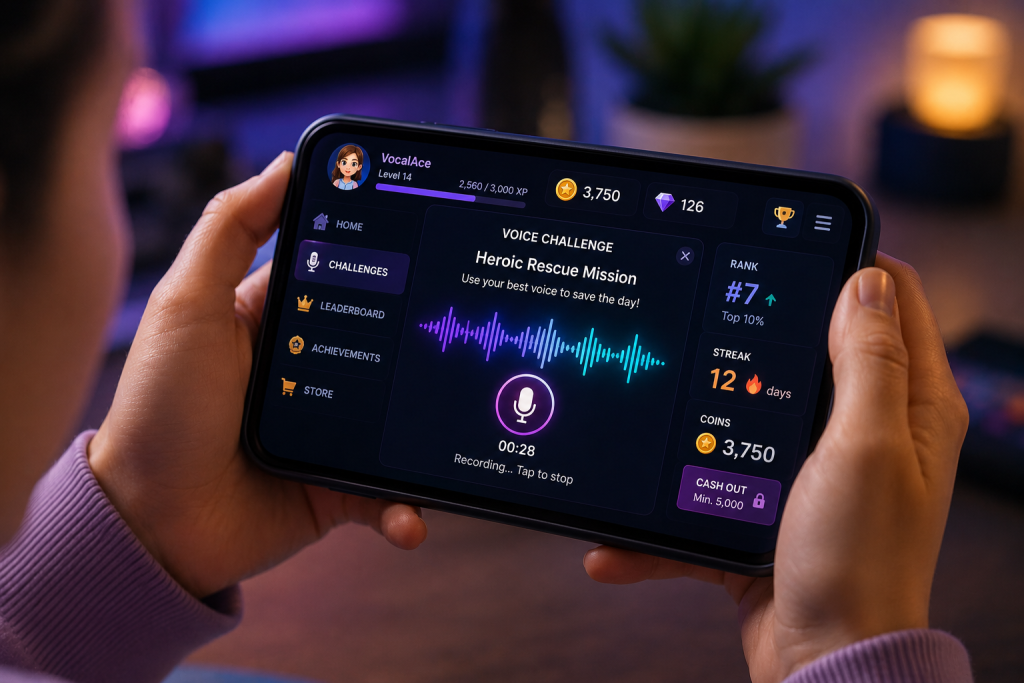
As AI companies search for ever-larger speech datasets, one new platform has sparked an important conversation: what happens when collecting voice data starts looking more like playing a game than accepting a recording contract?
The voice acting industry has spent the past few years adapting to a rapidly changing AI landscape. Conversations that once centred on microphones, demo reels and auditions now regularly include topics such as synthetic voices, digital replicas, biometric data and increasingly complex licensing agreements.
Now, another development is attracting attention.
A recently launched platform called TinyStage has prompted discussion across the voice acting community after users began sharing excerpts from its Terms of Service on social media. At first glance, TinyStage presents itself as a voice improv and roleplay game where users perform short spoken challenges, earn coins, improve their ratings and, if they meet certain requirements, can exchange those coins for small cash rewards. According to the platform’s published Terms of Service, the experience is designed as “a voice improv and roleplay game” in which recordings are evaluated by automated systems and other players, with rewards based on performance.
That concept, by itself, is not particularly unusual. Gamification has become one of the most successful ways to encourage participation across countless industries, from fitness apps and language learning to financial education and productivity tools.
What makes TinyStage noteworthy is not that it has adopted game mechanics. It is what the published Terms reveal about the relationship between voice recordings, AI development, and informed consent.
Rather than relying on social media commentary alone, Voice Over Herald reviewed TinyStage’s publicly available Terms of Service to better understand how the platform operates and why it has become the subject of industry discussion.
A Different Kind of Voice Acting Experience
Professional voice actors generally understand how a typical project works. A client posts a casting, approaches an agency or contacts a performer directly. The talent records an audition or attends a directed session and, if selected, licenses the finished recording for agreed purposes. Payment is negotiated according to the scope of the project and the intended usage.
TinyStage operates very differently.
Instead of auditioning for commercial projects, users complete short performance prompts within a game environment. Other players and automated systems evaluate those performances while participants earn virtual rewards including coins, streaks and rating points. Where cash-outs are available, the published Terms state that 1,000 coins are equivalent to USD $1, subject to minimum payout thresholds and eligibility requirements.
For many participants, the experience may feel less like contract work and more like progressing through levels in a mobile game. That distinction is worth examining because games influence behaviour differently from traditional employment. Players are naturally encouraged to complete another challenge, improve their ranking or maintain a streak. During that process, legal agreements, privacy policies and licensing terms may not receive the same level of attention they would in a conventional business transaction.
None of this suggests contributors are being misled. Instead, it raises an important question that extends well beyond one platform.
Does presenting voice contribution as entertainment change how carefully people consider the long-term value of what they are contributing?
The Discussion Isn’t About Hidden Terms
It is important to clarify what this discussion is, and what it is not.
The debate surrounding TinyStage is not based on allegations that the company secretly uses recordings for AI development. Rather, it focuses on how AI-related permissions are presented to contributors and whether people fully understand the long-term implications of the consent they choose to provide.
According to TinyStage’s published Terms of Service, contributors are asked to provide separate affirmative consent before their recordings and related voice data may be used for certain AI-related purposes, including synthetic voice creation, Digital Replicas, and licensing to AI development partners. Those permissions are requested through separate consent flows during onboarding or another clearly presented consent process, rather than being granted automatically when someone creates an account.
That distinction is significant because transparency and informed consent are central to any discussion about AI voice licensing. The more interesting question is not whether these permissions are disclosed, but whether contributors fully appreciate what those permissions could mean years into the future.
More Than Just Voice Recordings
One of the most significant sections of the Terms explains what may be licensed to AI partners when contributors choose to provide those additional permissions.
According to the published Terms, depending on the consent provided, the company may license or sell not only voice recordings but also derived voice data, voiceprints, acoustic features, metadata, self-reported demographic information and other related information to AI research laboratories and development partners. Those partners may use the materials for purposes including speech recognition, text-to-speech systems, voice cloning, synthetic voices and Digital Replicas.
For many professional voice actors, that list immediately stands out.
Unlike a traditional commercial recording, where usage is generally tied to a specific campaign or production, AI training datasets may contribute to technologies that continue evolving long after the original recording session has ended.
The Terms also state that contributors do not assign their underlying rights to their own voice, likeness or identity beyond the permissions they specifically choose to grant. Even so, the document illustrates just how different AI licensing agreements can be from conventional voice acting contracts and why reading those agreements carefully has become increasingly important.
What Happens If Someone Changes Their Mind?
One of the most widely discussed sections of the Terms concerns what happens if a contributor later decides to withdraw consent.
According to the published policy, if a user deletes their account or withdraws the relevant consent, the company says it will stop collecting future recordings for those AI-related purposes and stop including them in new datasets where reasonably possible.
However, the Terms also explain that recordings and related contributor data already licensed or transferred to AI partners before that request may remain with those partners. They further state that downstream model weights, embeddings, synthetic outputs and other effects already incorporated into trained AI systems may not be removable or practically extractable.
This issue is not unique to TinyStage. Instead, it reflects one of the broader technical and legal questions surrounding AI development. Once information has contributed to training a model, reversing that process can become significantly more complicated than simply deleting a file.
Why Gamification Changes the Conversation
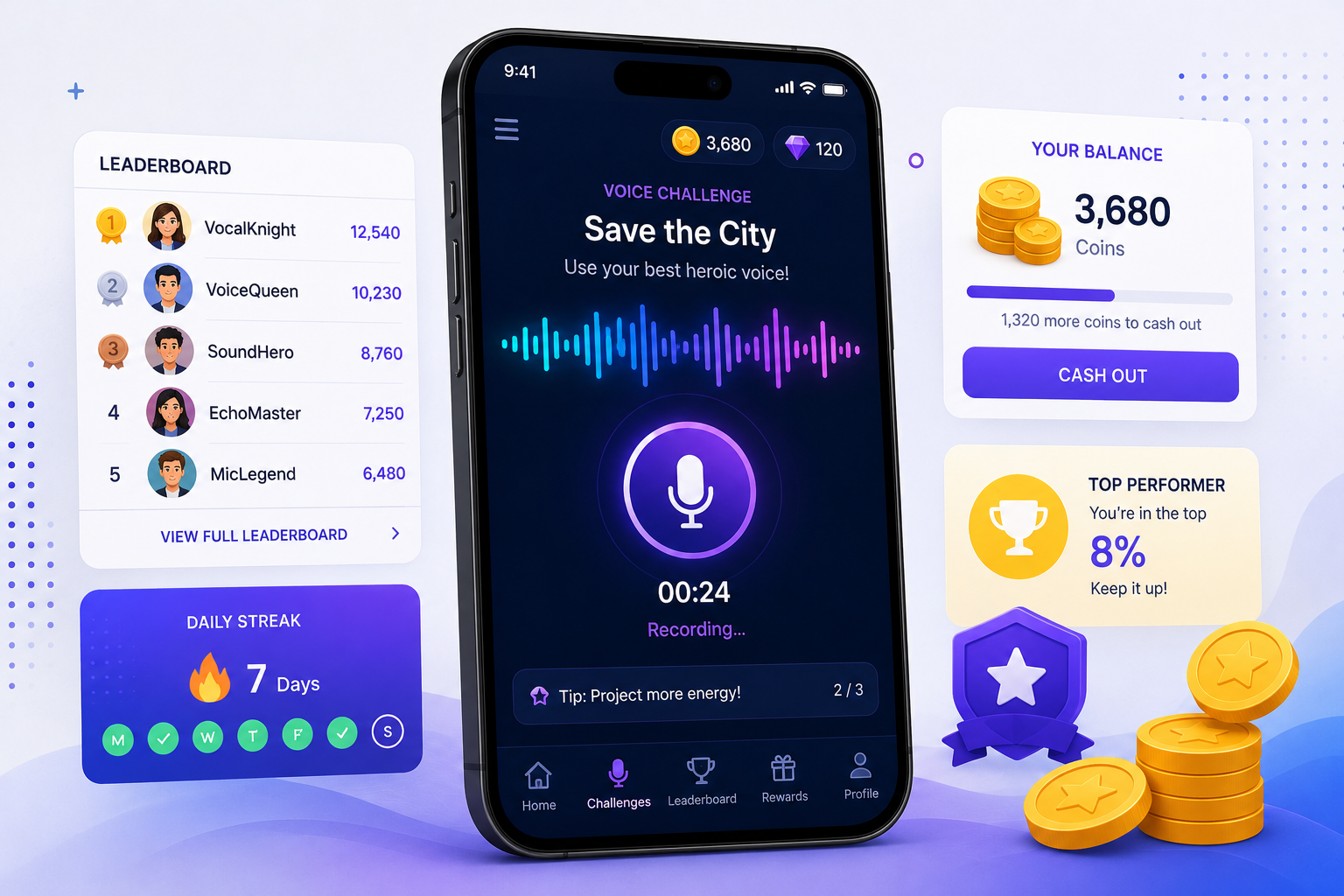
The technology itself is only part of the story. What makes this development particularly interesting is the way voice data collection is presented to contributors. Rather than feeling like traditional contract work, it is packaged as an interactive experience designed to encourage ongoing participation.
For years, companies needing large speech datasets typically recruited contributors through research studies, commissioned recording projects or professional voice talent. Gamification introduces a very different model. Instead of inviting people to complete structured recording sessions, participation is encouraged through familiar game mechanics such as points, achievements, rankings, daily streaks and relatively small financial rewards.
Psychologically, those environments feel very different from traditional work. Games are intentionally designed to encourage continued engagement, with each completed challenge naturally leading to another. That does not make the model unethical, nor does it suggest contributors are being treated unfairly. However, it does create an environment where the excitement of participating may overshadow the importance of carefully reading licensing agreements and understanding the long-term implications of consent.
For voice actors, whose voices represent both creative work and personal identity, understanding those agreements has arguably never been more important.
This Isn’t Just About One Company
Although TinyStage has become the focus of recent discussion, the broader issue extends well beyond a single platform. As AI development continues to accelerate, more companies may explore innovative ways of collecting speech data from willing contributors. Whether gamification ultimately becomes a common approach remains to be seen, but the concept reflects a wider shift in how AI datasets may be built in the future.
That possibility makes this conversation relevant to anyone considering contributing their voice to AI-related projects, regardless of which platform they choose. Understanding licensing agreements, consent processes and long-term usage rights is likely to become increasingly important as new participation models continue to emerge.
The voice acting industry has already experienced significant change over the past decade. Home studios have become the norm, online casting has transformed how talent connect with clients, and AI has introduced entirely new licensing models that barely existed a few years ago. The emergence of gamified voice collection platforms may simply represent another step in that evolution.
Whether this approach ultimately benefits contributors will depend on how transparently platforms communicate their terms, how fairly they compensate participants, and how comfortable individuals feel with the long-term use of their recordings. Those are decisions every contributor must make for themselves, but they are decisions best made with a clear understanding of the agreement rather than assumptions based on the user experience alone.
Questions Every Voice Actor Should Ask
Regardless of which platform someone chooses to use, there are several important questions worth asking before submitting voice recordings for AI-related projects.
- What exactly am I consenting to?
- Can my recordings be licensed to third parties?
- Will my voice be used only to operate the platform, or can it also contribute to AI development?
- If I withdraw my consent in the future, what happens to recordings that have already been licensed or transferred?
- Does the compensation reflect the scope and duration of the permissions I am granting?
- Have I taken the time to read the Terms of Service rather than relying solely on marketing materials or social media discussions?
These questions are not intended to discourage participation. AI voice licensing is becoming an increasingly legitimate area of work, and many contributors may decide the opportunities align with their personal and professional goals.
The important point is that contributors should make those decisions with a full understanding of the agreement they are entering. In an industry where a person’s voice is both a creative skill and a unique personal characteristic, informed consent is becoming just as valuable as performance ability.
A Broader Conversation About the Future of Voice
Platforms such as TinyStage highlight an important shift in how voice data may be collected in the years ahead. Rather than treating recordings purely as contracted creative work, some companies are experimenting with experiences that blend entertainment, community participation and AI data contribution into a single platform.
For some contributors, that may represent an exciting opportunity to earn additional income while participating in the development of emerging technologies. Others may prefer traditional voice acting contracts that define usage more narrowly and clearly. Neither perspective is inherently right or wrong, and both are likely to continue existing as the industry evolves.
What matters most is that contributors understand exactly what they are agreeing to before they press the record button. Reading the Terms of Service, understanding how recordings may be used, and considering the long-term implications of consent have become essential parts of working in an AI-driven marketplace.
TinyStage has sparked an important conversation, but the larger discussion is not really about one company. It is about how the relationship between performers, technology companies and AI developers is changing, and how voice actors can continue making informed decisions as new business models emerge.
As the industry continues to evolve, conversations like these are likely to become increasingly common. The more informed voice actors are about licensing, consent and AI usage, the better equipped they will be to decide which opportunities are right for them.
Join the Discussion
TinyStage is unlikely to be the last platform to explore new ways of collecting voice data for AI-related purposes.
As more companies experiment with interactive experiences, new licensing models and community-driven participation, voice actors will continue facing important decisions about where they contribute their voices and under what conditions.
Would you contribute your voice to a gamified platform if you knew it could also be used to help train AI systems?
Does presenting voice work as a game change how people think about licensing agreements and long-term usage rights?
We’d love to hear your thoughts. Share your perspective in the comments below and join the conversation.


