
For voice actors, artificial intelligence is no longer a distant technology waiting somewhere on the horizon. It is already being used across areas including dubbing, online video, advertising and other forms of spoken content that have traditionally created opportunities for professional performers. What has changed is the nature of the conversation, as the industry moves beyond debating whether synthetic voices should exist and begins confronting the practical consequences of using them.
Increasingly, performers are being faced with a much more personal question: Would you license an AI replica of your own voice? For some actors, the answer may be yes, provided the agreement offers meaningful compensation and clearly defined controls. Others regard voice cloning as a threat not only to individual jobs, but to the long-term value of recorded human performance. The divide is becoming more complicated as authorized licensing develops alongside continuing concerns about voices being copied or used without permission.
That tension is particularly visible in 2026 as performers, unions, technology companies and legislators attempt to establish what responsible use should actually look like. Rather than producing a simple conflict between people who support AI and those who oppose it, voice cloning is creating a series of difficult questions about consent, compensation, ownership, bargaining power and what happens when a recording can be transformed into a reusable digital replica.
Voice Cloning Is No Longer Only About Unauthorized Use
Much of the early anxiety surrounding AI voice technology focused on a relatively straightforward scenario: somebody takes recordings of a performer without permission and uses them to create a synthetic copy. That remains a serious concern, particularly as increasingly accessible tools make it possible to imitate recognizable voices without requiring the person being copied to participate in the process.
Those concerns gained fresh attention on August 28 when performers including Nicola Coughlan, Hugh Bonneville, Matt Lucas, Luke Evans, Siobhán McSweeney and Pearl Mackie backed the UK campaign Save Our Voices Now. Around 80 people have reportedly signed an open letter connected with the campaign, which is calling for stronger statutory protections over an individual’s voice as AI cloning technology becomes more widely available.
Authorized AI replicas, however, present a different ethical and commercial question. If a performer knowingly provides recordings for the creation of a voice model, understands the intended uses and receives agreed compensation, that arrangement is fundamentally different from having recordings taken and replicated without permission. The distinction between those two scenarios is important because discussions about AI voice technology can otherwise collapse into a misleading choice between being entirely “for AI” or entirely “against AI.”
For working voice actors, the questions are becoming much more specific. They need to know who is creating the model, what recordings will be used to create it, which projects the resulting voice can appear in, how long those rights will last, whether the voice can be transferred to another company and what happens to the model when an agreement ends. Just as importantly, performers need to understand how they will be compensated when the technology can potentially generate new material without requiring them to return to the recording booth.
The Opportunity Is Real, but So Are the Questions
There is a legitimate commercial argument for performers choosing to participate in licensed AI voice work. A conventional voice actor is limited by time, availability and the number of sessions that can realistically be completed. A properly licensed digital replica could potentially be used to produce additional versions of approved material without requiring the performer to record every individual variation.
Localization provides an obvious example. A production that could not previously justify recording multiple localized versions might find the economics more workable with AI-assisted production. Personalized content and projects involving large numbers of variations could create similar possibilities. In those circumstances, performers who retain meaningful rights over their digital replicas could potentially participate in work that would otherwise be difficult to produce through conventional recording alone.
The important point is that the performer is no longer selling only a recording session. A voice model may have the ability to generate additional performances after the original session has ended, which means the value of the agreement cannot sensibly be measured only by the amount of time spent behind the microphone. The scope, duration and future uses of the model become part of what is being exchanged.
That creates a very different negotiation from an ordinary voice-over booking. A limited model authorized for a clearly identified campaign is not equivalent to a broad license allowing a synthetic voice to be used across multiple clients, industries or territories for years. The technology may be similar in both cases, but the commercial value of the rights being granted is not.
The Other Side of the Equation Is Work Displacement
The potential opportunity cannot be considered separately from the possibility of displacement. Voice-over has never consisted solely of major national commercials, animated features and high-profile video games. A substantial part of the professional market is made up of less visible work including corporate narration, eLearning, training material, localization, web videos, telephone systems and other recurring forms of spoken content.
Those categories matter because many working actors build sustainable careers from a large number of relatively modest bookings rather than a small number of celebrity-level contracts. If synthetic voices become sufficiently inexpensive and acceptable for certain types of routine production, even a gradual reduction in those smaller jobs could have a significant effect on performers who rely on them.
The economic consequences are also unlikely to be distributed evenly. An established performer with a recognizable voice and experienced representation may be able to negotiate significant compensation and detailed restrictions for an AI replica. A newer freelancer may instead receive an offer for a comparatively modest payment while being asked to grant much broader rights.
That difference in bargaining power is one reason the AI voice debate cannot be reduced to whether licensing is inherently good or bad. The same technology can produce very different outcomes depending on the contract, the performer involved and the ability of that performer to negotiate.
The Freelance Market Creates Another Complication
Union agreements are an important part of the emerging AI framework, but a large amount of voice-over work takes place outside union contracts. Freelance performers frequently deal directly with production companies, agencies, casting platforms and clients, which means the protections available in one part of the industry may not automatically apply elsewhere.
For those performers, contract literacy is becoming increasingly important. A conventional usage clause might establish where a finished commercial or narration can appear and for how long. An agreement involving AI may need to answer additional questions about machine learning, synthetic generation, digital replicas, storage of training recordings and the possibility of future uses that do not require another performance from the actor.
The distinction between granting rights to a finished recording and granting rights that allow someone to create a reusable model of the performer’s voice can therefore be substantial. Performers who encounter unfamiliar language concerning synthetic media, digital replicas or machine learning should understand exactly what those provisions permit before treating the agreement as an ordinary recording contract.
What Does a Protected AI Agreement Actually Look Like?
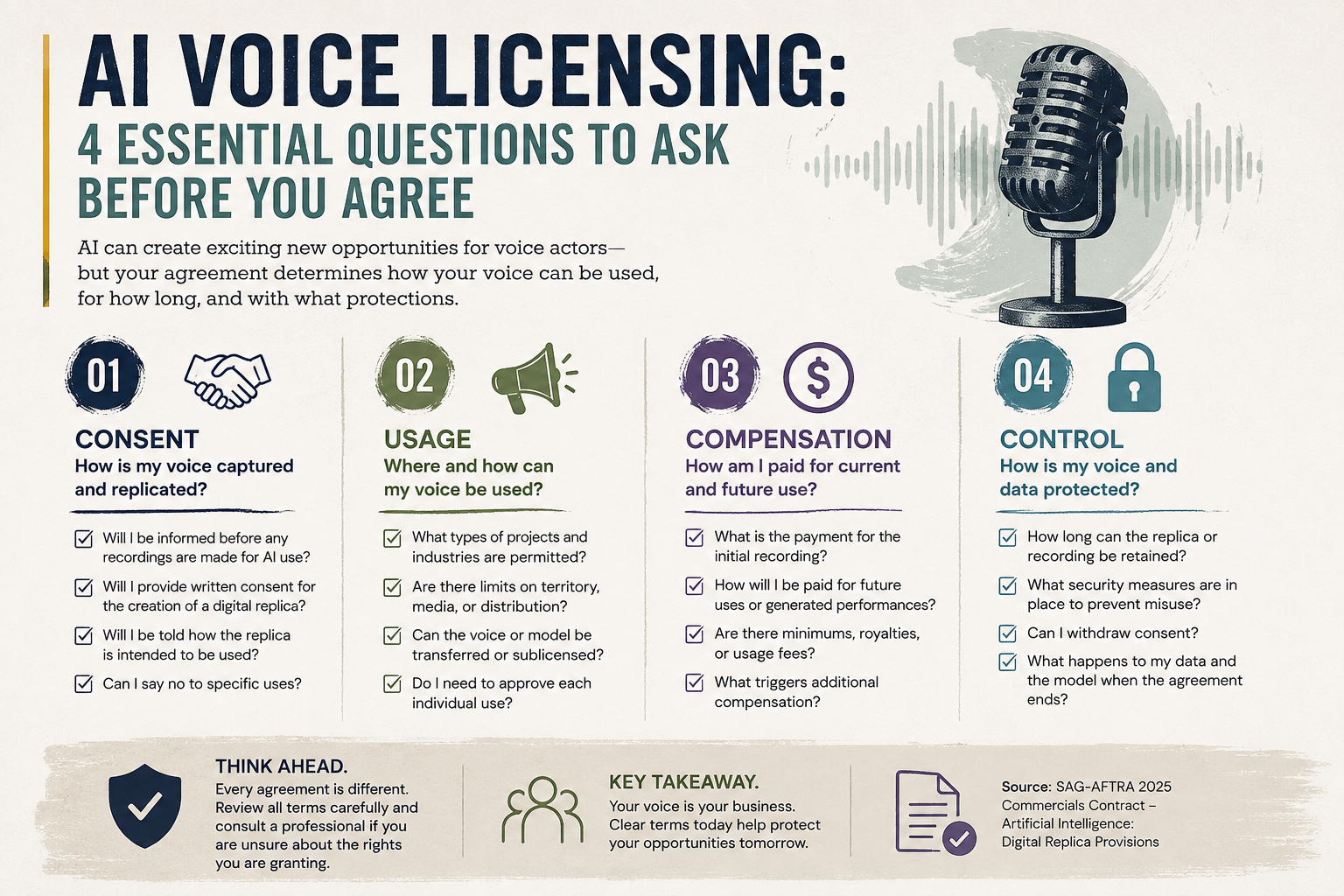
Existing SAG-AFTRA contract provisions provide a useful example of how digital-replica protections can work in practice. Under the 2025 Commercials Contract, a digital replica is defined as a computer program created using a performer’s voice, image or performance that is capable of independently generating performances the performer did not originally render.
The agreement contains requirements around notice and consent when performers are asked to record specifically for creation of a digital replica. It also establishes consent requirements when existing material is used to create one, and requires a reasonably specific description of the intended use when a replica will generate a new performance. Uses that go beyond the description originally provided require additional consent.
Compensation is addressed as well. For commercials covered by the agreement, SAG-AFTRA says performers receive compensation when a generated performance created from their digital replica is used, with the contract establishing specific session and usage provisions. Producers are also required to make commercially reasonable efforts to secure digital replicas against unauthorized access, use or copying.
Retention is another important issue. The contract limits how long a producer may retain a replica without additional written consent and provides for deletion when the required permission to retain it has not been obtained. These provisions demonstrate why asking whether a performer is willing to “do AI” is far less useful than examining exactly what rights, restrictions, safeguards and payments accompany the proposed use.
Consent Is Only Valuable When It Is Informed
Consent has become one of the most frequently used words in discussions about generative AI, but obtaining a signature does not necessarily mean a performer fully understands the implications of an agreement. Meaningful consent depends on receiving enough information to make an informed decision about how a voice will be captured, replicated, stored and ultimately used.
For a voice actor considering an AI licensing arrangement, that means looking beyond the initial recording fee. The length of the license, permitted applications, territories, ability to sublicense the voice, approval of individual uses, termination provisions and treatment of the model after the agreement ends can all materially change the value and risk of the deal.
Content restrictions can be equally important. A performer might be comfortable allowing a replica to narrate approved corporate material while refusing its use in political advertising, explicit content or messages that could damage their professional reputation. A well-defined agreement gives the performer enough information to make those distinctions rather than granting permission for uses that have not yet been identified.
Compensation also needs to reflect what is actually being licensed. A recording session traditionally pays a performer for time and performance, often with additional value attached to usage. A reusable voice model can separate future output from future studio time, creating a difficult but increasingly important question for the industry: What should a performer be paid when a client may be able to generate future recordings without booking another session?
Audience Acceptance Could Change the Economics
One factor that voice actors cannot directly control is whether audiences are willing to listen to synthetic voices. For years, concerns about unnatural delivery and poor listener experience provided a practical reason for companies to remain cautious about AI-generated speech, even when the technology offered potential savings.
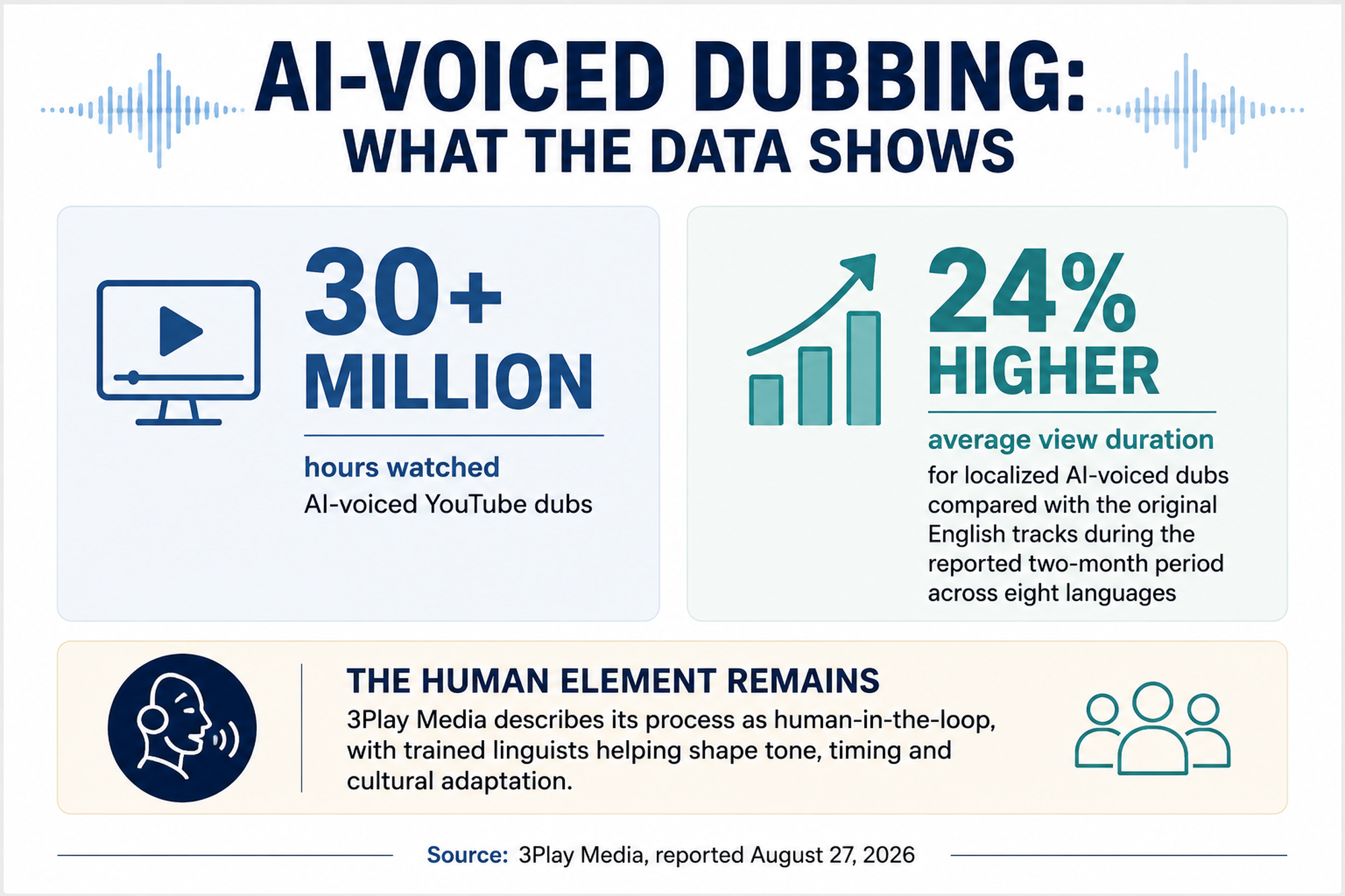
New data from 3Play Media suggests audience resistance can’t be assumed. The company reported on August 27 that its AI-voiced YouTube dubs had accumulated more than 30 million hours of watch time. During a two-month period across eight languages, 3Play said its localized AI-voiced dubs achieved a 24 percent higher average view duration than the original English tracks.
Those figures require careful interpretation. They do not establish that audiences generally prefer synthetic voices to human performers because the comparison involves localized content and original English-language tracks. Providing material in a viewer’s own language may itself explain some of the difference in engagement, so the figures should not be presented as a simple human-versus-AI preference test.
There is another important qualification. 3Play describes its dubbing system as a human-in-the-loop workflow in which trained linguists shape voice, tone, timing and cultural adaptation. The result therefore does not represent completely automated dubbing without human involvement. Instead, it illustrates a production model in which synthetic speech and human expertise are being combined.
For voice actors, the commercial implication remains significant. If audiences are willing to engage with well-produced AI-assisted dubbing in some contexts, companies have less reason to reject the technology purely out of concern that viewers will immediately dislike synthetic speech. That does not determine what will happen across every category of voice-over, but it does change one part of the economic calculation.
Not Every Voice-Over Job Faces the Same Pressure
It is tempting to discuss “voice acting” as though it were a single category of work, but the creative and commercial demands vary considerably. A straightforward informational recording and an emotionally complex character performance may both require a microphone and a performer, yet the reasons a client hires a human actor for each can be very different.
Projects involving large quantities of relatively standardized speech are obvious candidates for automation because scale can provide a strong financial incentive. Localization is another area in which AI-assisted production may allow companies to create versions in languages that previously could not justify the cost of conventional dubbing, particularly when human reviewers remain involved in adapting and refining the output.
Performance-heavy work presents a different challenge. Comedy, dramatic character work, improvisation and heavily directed sessions depend on interpretation and collaboration as much as vocal sound. A performer may change an entire reading in response to a director’s note, discover an unexpected interpretation during a session or make creative choices that were never explicitly contained in the script.
None of this means performance-focused work is permanently insulated from technological change. AI speech systems continue to improve, and it would be unwise for the industry to pretend otherwise. The more realistic question is whether a particular project benefits enough from human interpretation, adaptability and collaboration for the client to consider those qualities worth paying for.
A Voice Is Not the Same Thing as a Performance
That distinction may become increasingly important as voice synthesis improves. A voice has recognizable characteristics that technology can attempt to reproduce, while a performance involves decisions about intention, pacing, emphasis, subtext, emotion and the relationship between the spoken words and the wider creative context.
Professional actors do more than generate acceptable speech. They interpret what a writer is trying to communicate, respond to direction and make choices about how a line should land with an audience. In collaborative sessions, those choices can evolve repeatedly as the actor, director and client work toward something that may not have been obvious from the script alone.
At the same time, defending human performance does not require pretending that synthetic speech is incapable of becoming convincing. The more useful discussion concerns where human interpretation adds sufficient creative or commercial value to justify the traditional production process and where clients decide that an AI-assisted alternative meets their needs.
The answer is unlikely to be identical for a national commercial, a corporate explainer, an audiobook, a game character and a localized social-media video. Different sectors of voice-over may therefore experience AI adoption at very different speeds, making broad predictions about the disappearance or survival of “voice acting” less useful than examining individual markets.
Voice Rights Are Becoming an International Issue
The debate is expanding beyond individual contracts as performers seek stronger legal recognition of the relationship between a person’s voice and their identity. The newly launched Save Our Voices Now campaign in Britain is calling for statutory protection against unauthorized voice cloning, with around 80 people reportedly backing an open letter urging the UK government to strengthen protections for people’s voices.
The campaign illustrates a broader concern that technological capability is moving faster than the legal and contractual frameworks surrounding it. Unauthorized cloning, consensual commercial licensing and legitimate creative uses of AI can involve similar underlying technology while raising very different questions about permission, compensation and control. That distinction is becoming increasingly important as synthetic voice tools become more accessible.
This is also why the industry’s growing focus on consent and control matters. Voice actors have traditionally considered usage rights in relation to a particular recording, including where it will run, how long it will be used and which media or territories are covered. AI introduces another consideration because a recording can potentially become source material for a digital replica capable of generating additional speech.
As a result, performers increasingly need to consider not only the rights attached to the audio they deliver, but also what rights they may be granting over the recognizable characteristics of their voice. How those rights should ultimately be protected is still developing across different jurisdictions, but the issue is likely to remain central as governments, unions, technology companies and performers respond to the expansion of generative AI.
So, Should a Voice Actor License Their Voice to AI?
There cannot be a universal answer because performers have different careers, financial circumstances, risk tolerances and views about synthetic media. For one actor, a carefully controlled licensing arrangement may create an additional source of income from technology that will continue developing whether or not they personally participate. Another performer may decide that creating a reusable synthetic version of their voice conflicts with their long-term interests regardless of the immediate payment.
Both positions can be rational. The more concerning situation is one in which a performer makes the decision without understanding exactly what the agreement allows. An attractive upfront payment can look very different when considered alongside a long license period, broad sublicensing rights or permission to generate material for purposes that were not clearly identified when the recordings were made.
Before agreeing to an AI voice project, performers should establish what is actually being created, which parties will have access to it, what it may be used for and how long those rights remain valid. They should also understand whether individual uses require approval, whether the model can be transferred or sublicensed, how subsequent uses are compensated and what happens to the recordings and model data when the relationship ends.
Restrictions on sensitive categories of content and safeguards against unauthorized access may also deserve careful attention. Where contractual language is unclear or the rights being transferred are particularly broad, obtaining appropriate professional or legal advice may be worthwhile. The amount being paid today is only one component of an AI licensing agreement; the future rights being granted can be just as important.
The Career Decision May Be More Important Than the Technology
Voice actors have adapted to major technological changes before. Home studios transformed where professional recordings could be produced, online casting altered how performers found clients, remote direction changed the relationship between actors and studios, and digital distribution created categories of work that barely existed in earlier generations of the industry.
AI voice technology differs in one particularly important respect because it can potentially reproduce aspects of a performer’s voice without requiring that performer to return to the microphone for every new piece of audio. That makes the technology unusually personal for people whose voices are not merely part of their work, but the identifiable instrument through which much of that work is performed.
The debate is therefore unlikely to be resolved by declaring artificial voices inherently good or bad. A more useful distinction exists between unauthorized replication and arrangements in which performers knowingly participate under clearly defined conditions, although even a well-protected licensing agreement will not appeal to every actor.
Technology companies will continue developing new tools, clients will experiment with different production models, legislators and unions will continue debating protections, and audiences will encounter synthetic speech in more places. Voice actors will have to decide how, or whether, they want to participate while paying much closer attention to the value and rights attached to their recorded voices.
Join the Discussion
As licensed digital replicas become a genuine option alongside conventional voice-over work, performers are likely to reach very different conclusions about where their personal boundaries should sit. Some may see carefully controlled licensing as another commercial opportunity, while others may regard creating an AI replica as a line they do not want to cross.
The central question is therefore becoming less about whether AI voice technology should exist and more about the terms under which a performer might choose to participate. Would you license an AI version of your voice if the compensation, usage restrictions and contractual protections were right, or would you prefer your voice to remain exclusively tied to performances you record yourself? Share your thoughts with Voice Over Herald readers in the comments below.
Featured image: Photo by Gabriel Weyand on Unsplash.


